
A Brief History of the Marque
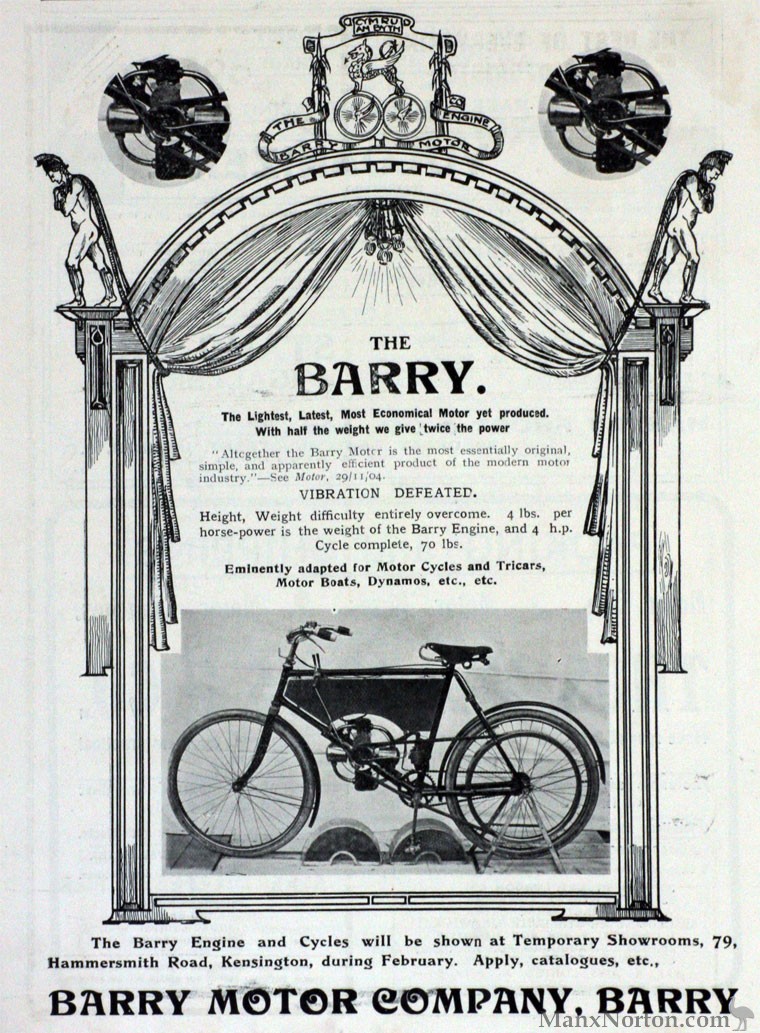
First seen at the Stanley show of 1904, the machine was unusual in that it had a 200cc flat-twin-cylinder rotary engine that turned on a fixed crankshaft. Designed by Redrup (who hailed from nearby Barry), it was fed by a gas storage reservoir that balanced the silencer. The engine rotated between twin downtube sections of the frame and was enclosed in an aluminium case that had cooling air holes.
In 1905 the frame was revised so that the engine could be moved to just in front of the pedals and it was fitted with belt drive. It was not a great success and faded from the scene for some years until 1910 when the engine name appeared again as a patent raised by W. A Richards and C. R. Redrup.
The Barry Motor Co., Barry
(Stand 365).–
What is decidedly a novelty in motor bicycles is to be found on this stand, which is in somewhat of an obscure corner of the Berner's Hall in the Gallery. The way in which the motor cylinders revolve around the fixed crankshaft will be grasped more quickly on reference to our illustration. Two opposed cylinders are fitted on one crank chamber, and there is no flywheel, the mass of the engine revolving at high speed forming its own flywheel. There is an explosion at each revolution of the engine, the charge being forced into a chamber each time the pistons approach one another. The silencer is fitted exactly opposite to the gas storage reservoir, being of the same weight, and so balances the weight of this reservoir when the whole mechanism is revolving.
The total weight of the engine is 15 lbs., and the complete machine about 70 lbs. The method of ignition is by high tension, with induction coil and battery. The centre portion on the opposite side to the illustration is used as a contact breaker plate, contact being made inside behind the plate by a metal segment let into the insulated disc. This contact plate can be revolved around the fixed shaft, and so the ignition can be advanced or retarded in the usual manner. The engine, silencer, gas reservoir–in fact, the whole revolving part, with the exception of the pulley–is enclosed in an aluminium case, in which holes are bored to allow the air draught to leave the casing after it has been drawn into the centre by the revolving engine.
Report on the 1904 Stanley Show, The Motor Cycle, November 28th.
Sources: Graces Guide, The Motor Cycle.
If you have a query about Barry motorcycles, or have some information to add about these classic British machines, please contact us