
A Brief History of the Italian Marque
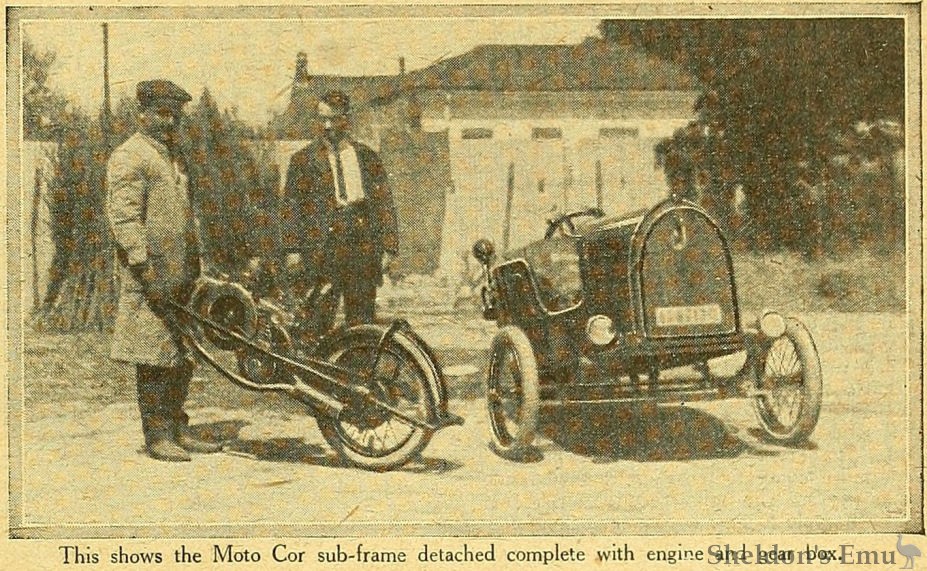
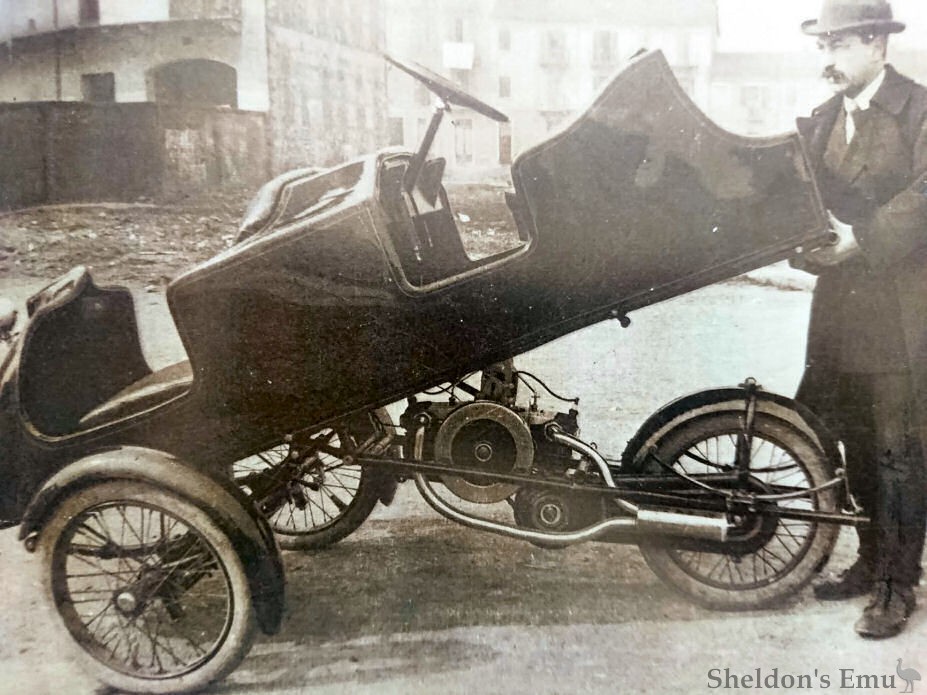
This shows the Moto Cor sub-frame detached complete with engine and gear box.
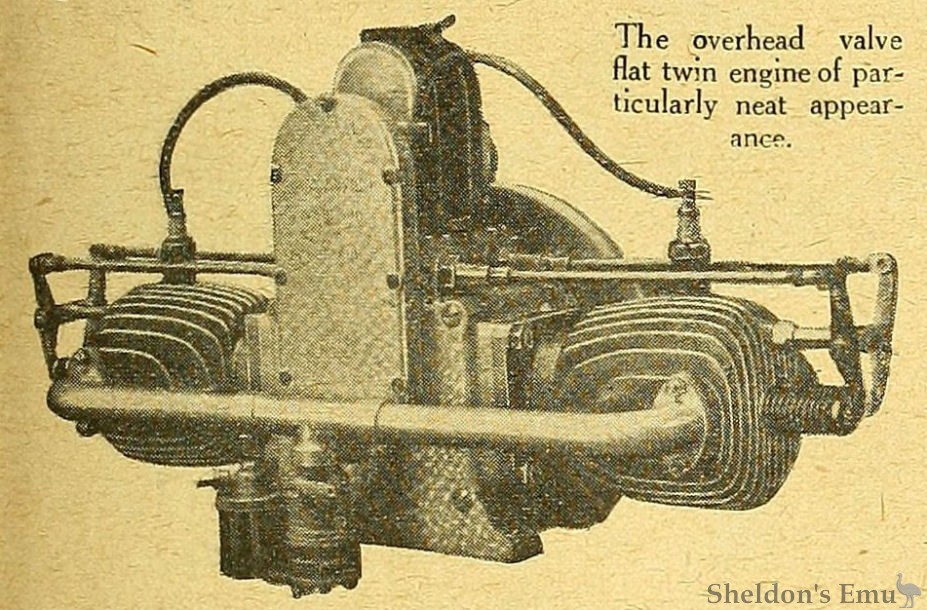
The overhead valve flat twin engine of particularly neat appearance.
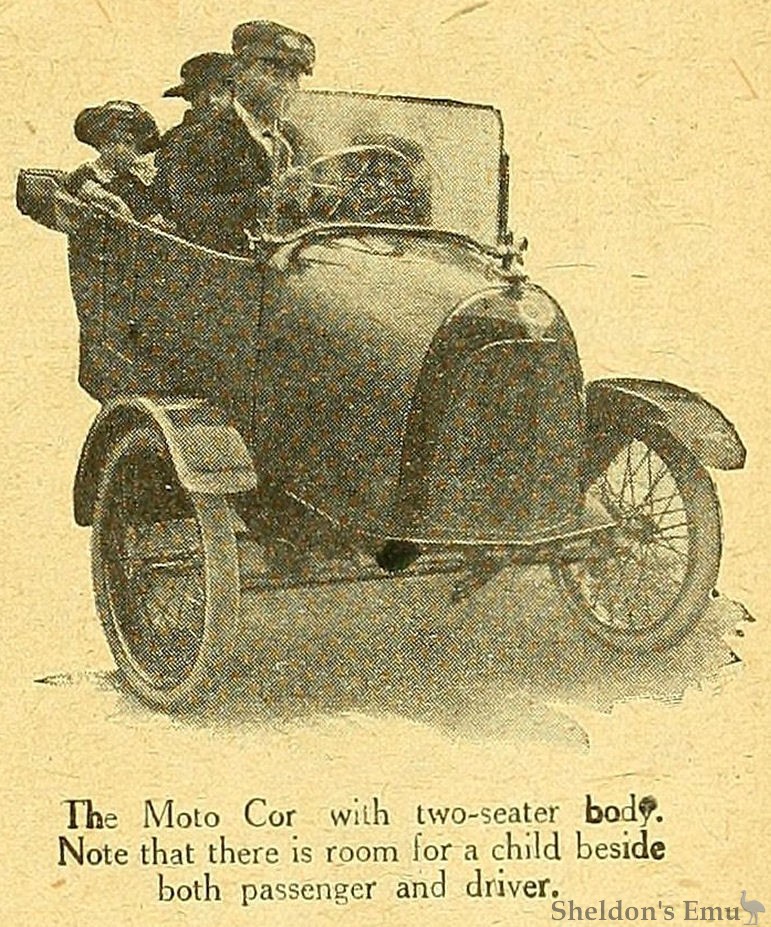
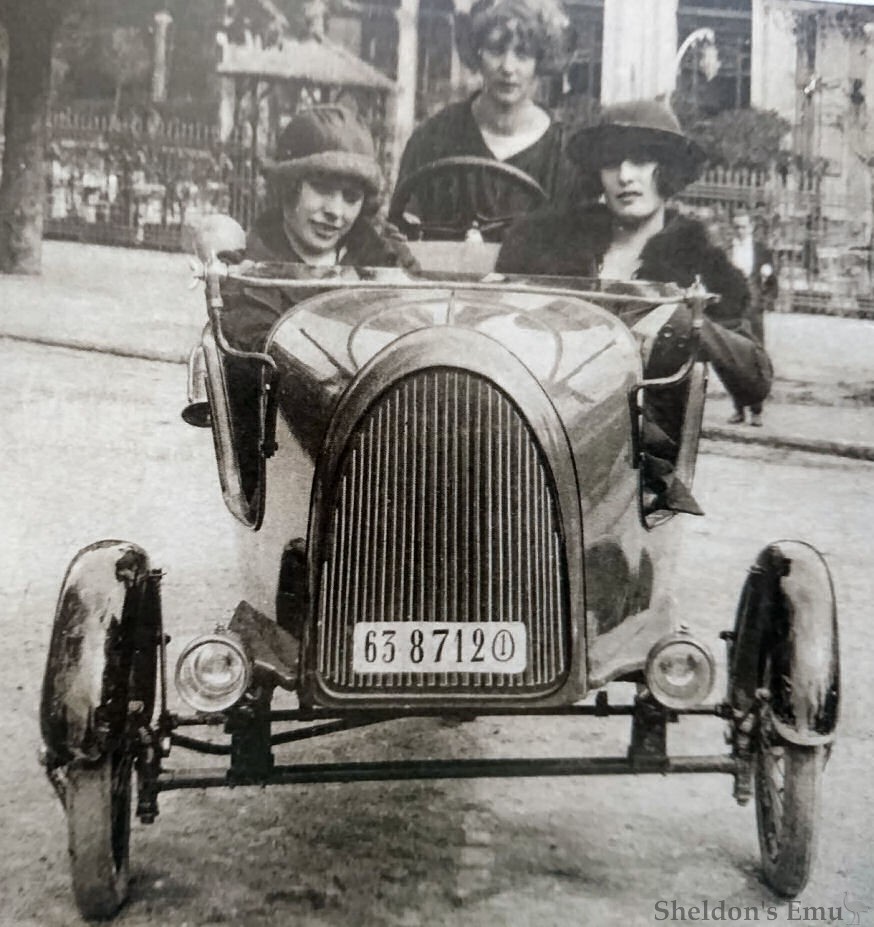
The Moto Cor with two-seater body. Note that there is room for a child beside both passenger and driver.
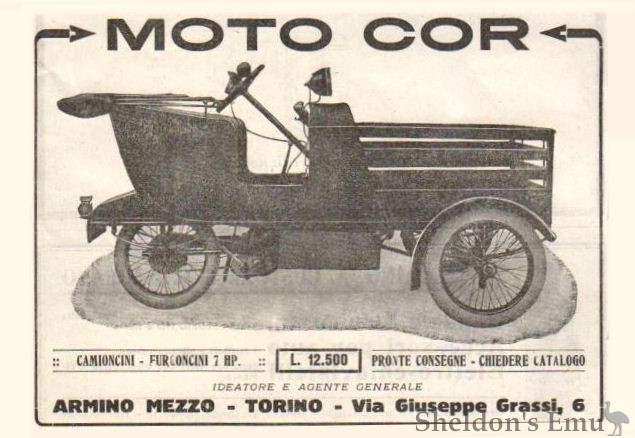
Designed by Armino Mezzo, Torino, Via Giuseppe Grassi, 6.
Manufactured at Adolfo Salza's COR workshops (Motovetturetta Carrozzata Originale Resistentissima).
Built in 1920-1921, these 3-wheel vehicles came in several versions including a commercial (furgoncini) with two wheels at the front supporting a carrier box, a passenger vehicle with a retractable hood with the driver's seat much further foward, and a 3-seater with the driver seated behind the passengers. All had a steering wheel column and rear wheel drive.
Sources: marques105.rssing.com; museoauto.com
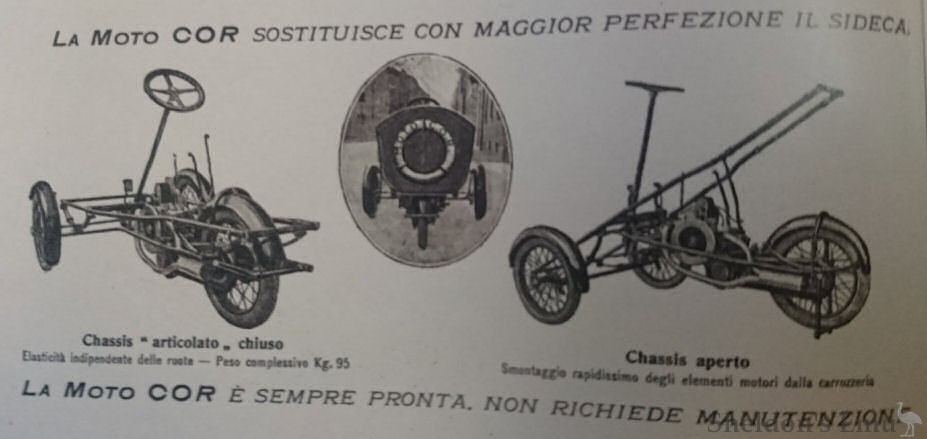
Engine, Gear Box, and Driving Wheel carried in Hinged Sub-frame.
THE designer of the Moto Gor has mounted engine, gear box, and driving wheel in a sub-frame hinged to the main chassis, connection between the two being effected by semi-elliptic springs.
By this construction, of course, the body and passengers are adequately sprung, but a fairly high proportion of the engine and transmission weight is unsprung.
Flat Twin o.h.v. Engine.
The power unit is a horizontally-opposed four-stroke twin of 575 c.c, having all valves overhead. Vertical radiating fins, set longitudinally upon the cylinders, are used.
Lubrication is by hand pump with semi-automatic drip-feed delivering oil to a reservoir in the crank case and on to the ball bearing connecting rods and crankshafts, and conducting it by means of grooves to all other moving parts of the engine.
Placed behind the engine and anchored to the sub-frame is the three-speed gear box, which gives three ratios of 4 1/2, 8, and 13 to 1.
The driving wheel is easily detachable, by means of a withdrawable spindle, without interfering with the transmission mechanism and a motor cycle type, of stand is provided. Both brakes are applied to the rear wheel, one being of the external and the other of the internal variety.
Semi-elliptical springs are used for the front suspension; also the body lends itself to many variations : one type carries the seats tandem fashion, and the stability of the machine is not affected by the presence or absence of the extra passenger, while a commercial body can be fitted without structural alterations.
The designer of this vehicle is Armino Mezzo, 6, Via Giuseppe Grassi, Turin, Italy.
The Motor Cycle February 23rd, 1922.