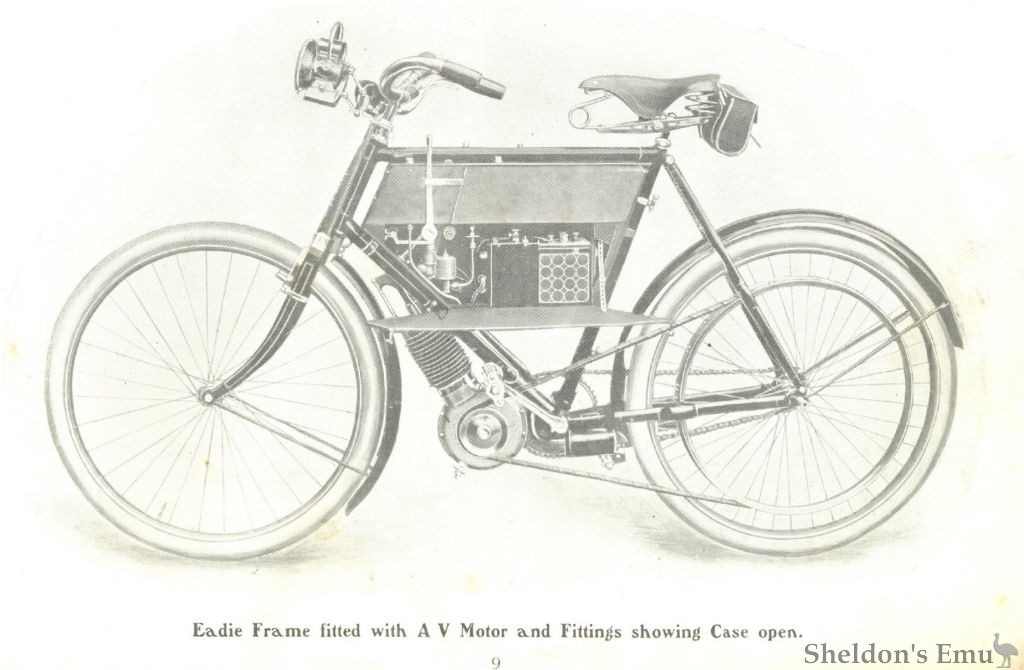
Manufactured by the A. V. Motor Co., Aston Lower Grounds, Witton, Birmingham.
The company name is derived from the surname initials of J.G. Accles and F.H. de Veulle.
Their 1903 catalogue offered a motor set consisting of engine, brass fuel and oil tanks and a wooden case which contained them, carburettor and ignition components, cables and all necessary fitting to assembles a complete motor cycle using, typically, an Eadie frame.
"The A.V. motor-bicycle engine, in 1.75 size, was exhibited on a machine built of B.S.A. fittings; the engine was clipped onto the down tube of the frame; the tank was made of polished oak; petrol, oil, coil, accumulators, and spare tools were accommodated within the tank, which also contained the carburetter. A belt drive was used, the belt being of twisted raw hide." ~ Report on the 1902 Stanley Show.
A Moting Engineer Lectures to the Engineers' Institute on Motor Cycling.
In connection with transmission the advisability of a free engine on down grades was considered although not mentioned at the meeting. It should be observed that with a drive such as the Humber, or the proposed Accles-De Veulle-Starley machine, this is afforded by throttling the engine when the machine will overrun the free wheel clutch by which the power is transmitted.
IN Mr. Craig's opinion chain transmission will probably become the most popular in all cases where the engine is not sufficiently near the road wheel to admit of spur gearing being used. Its efficiency is undoubtedly higher than that of the belt, and, as the author had remarked, it can be made as smooth in its action. It the reduction from the engine to the road wheel be attempted in one step, a very large and unsightly sprocket wheel or belt pulley must be fixed to the driving wheel. With the high efficiency obtainable on a chain drive it may be worth while to make the reduction in two steps, in which case the drive would appear less clumsy, and a suitable gear-case could be easily fitted. Chains were used at the earliest stages of motor bicycle construction, and had the initial development of business taken place in this country instead of abroad, most probably the chain drive would be as common as the belt drive is at the present day. Worm drive is exemplified in the Accles, De Veulle and Starley motor bicycle illustrated on this page.
By the use of worm gear the necessary reduction between the engine and the road wheel can be effected in a very small space, and although the worm is certainly less efficient than spur gearing, yet it well designed and properly made it is doubtless more efficient than the belt drive commonly used.
The worm drive on the last-named machine elicited a very practical speech from one of the designers of the machine, who was, however, careful to inform the hearers that the bi- cycle in question was of an experimental nature. He produced however, data from past experience which would appear to indicate that his claims for a relatively high efficiency for his system were fully justified.
Dealing with the future possibilities of the motor bicycle Mr. Craig remarked:- "There is a very wide field for the designer of motor bicycles, as tandems and spring frames have yet to be dealt with. If water-cooling be adopted, there should be no difficulty in enclosing the motor and accessories in one portion of the frame and concealing it with a panel on each side. By this means a very neat result could be obtained.
Details cannot have too much attention, as the efficiency of the machine as a whole largely depends upon them. A weak rod to the compression tap or contact breaker, for instance, would be an endless source of annoyance, and the lubricating arrangements must have very careful attention. The motor bicycle is the simplest, and consequently the least expensive, form of motor vehicle which can be made. The fact that it has proved practicable in actual use insures its popularity in the future; indeed, the trade has already assumed much greater proportions than is generally known. The subject is, therefore, worthy of the most careful consideration on the part of cycle engineers, and they will find that it is not lacking in interest."
Motor Cycling Vol 1 No. 1 February 12th 1902
Starley, mentioned in the article above, built motorcycles under his own name: William Starley.
Sources: Graces Guide; 1903 sales brochure; Motor Cycling.
If you have further information or a query related to this page, please contact us.