
Geo. A. Barnes of 34, Algernon Road, Lewisham, London S.E., and 112 Prince-street, Deptford, Kent.
1904 He entered the market using 2½ hp, 3hp or 3½ hp Stevens engines. A solo and a forecar with twin exhaust pipes were offered.
1905 The forecar model was available with either a 5hp water-cooled engine or a 4hp air-cooled one from MMC or Minerva. The same engine was also offered for a solo, lighter versions of which were fitted with a 2¼ hp engine.
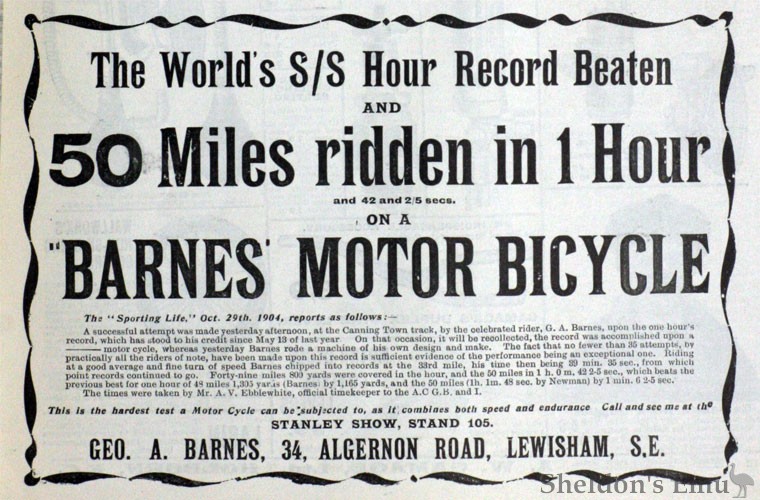
That year they advertised that they had obtained a world record for a 50 miles standing start, and that they would appear at the Stanley Show (Stand 105).
1904-5 George Arthur Barnes was in a partnership with George Wilton, manufacturing and selling motorcycles as George A. Barnes and Co.; the partnership was dissolved on 17 August 1905.
1905 August. Partnership dissolved. '... the Partnership heretofore subsisting between us the undersigned, George Arthur Barnes and George Wilton, carrying on business as Motor Manufacturers and Dealers in Motors, at 112, Prince-street, Deptford, Kent, under the style or firm of "GEORGE A. BARNES AND CO.," has been dissolved by mutual consent...'
1909 ' Mr. George A. Barnes, motor engineer, Lewisham, and formerly a prominent motorcycle rider in England and on the Continent, has for some months been engaged in the construction of a monoplane on some marsh ground in the neighbourhood of Abbey Wood, near London. On Monday a trial was made. The machine left the ground, and a circuit of about one and three-quarter miles was made, lasting about two and half minutes. On coming down to earth a sudden current of wind tilted the rear of the machine up, and the front came in contact with the bank of a ditch. Mr. Barnes was able to retain his seat, but the monoplane was travelling at about forty miles an hour, the shock sprained his left wrist. He was at once released from his position, and it was then found that the woodwork was completely wrecked. Mr. Barnes claims to the first to have flown in an all-English machine.
1910 Gained his aviator's certificate No. 16 flying a Humber monoplane at Brooklands
1910 September. Accident at the 1910 Folkestone Aviation Meeting
1919 February 1st. Died of pneumonia; death registered in Rochford, Essex
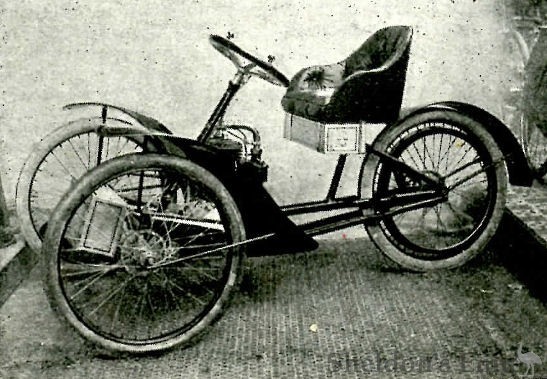
Geo. A. Barnes, Algernon Road, Lewisham, S E. (Stand 105)–This is an interesting exhibit of smart little machines. First we have the new runabout, which is built with a drop frame of special design, and fitted with a 4 h.p. motor. The footboards are comfortably inclined, and the particular machine in question is fitted with a belt drive, but a chain drive with three-speed rear can be bad if desired. Steering is effected by a wheel, upon which are mounted the levers controlling the throttle and the spark.
The seat is of the bucket type, and also carries the petrol and oil tanks. The battery and coil are carried in a box at the front of the machine.
All the mudguards are of good width and of flat pattern, the front ones bring splayed Band brakes are fitted to all three wheels, and are applied by foot levers. A device for providing a free engine consists of a split ring connection between the hub body and the belt pulley or chain ring. The split ring is expanded by a roller working in an inclined recess. To free the engine a band is tightened round the split ring, the roller then retiring into the larger part of the recess. When the band is released the roller jams into the contracted part of the recess and expands the ring. It appears to be a simple arrangement for the purpose. Next there is a 5 h.p. water-cooled tricar on similar lines to the Runabout, but, of course, fitted with a front seat.
The water is circulated by means of a pump, and the radiators are fitted right in front of the seat, where they obtain the full blast of air. An adaptation of the Oppermann three-speed near is employed, the clutch being operated by foot levers. Another forecar is fitted with an air-cooled motor, and has a simple belt drive. Two patterns of motor bicycles are exhibited, one of specially light weight–about 110 lbs.– having a 2¼ h.p. motor, the other is some 20 or 30 lbs. heavier, and has a 4 h.p. motor. This was the type Mr. Barnes employed in his recent one hour record. The oil and petrol are carried in entirely independent tanks, and the well-known Barnes double exhaust system is employed. Special attention is given to making the parts readily accessible, a though neither of the machines on view are fitted with pedals, they can be had to order. Altogether the exhibit is a very creditable one, and well worth attention.
Report on the 1904 Stanley Show, The Motor Cycle, November 28th.
Sources: Graces Guide; The Motor Cycle.
If you have further information or a query related to this page, please contact us.