

A Brief History of the Marque
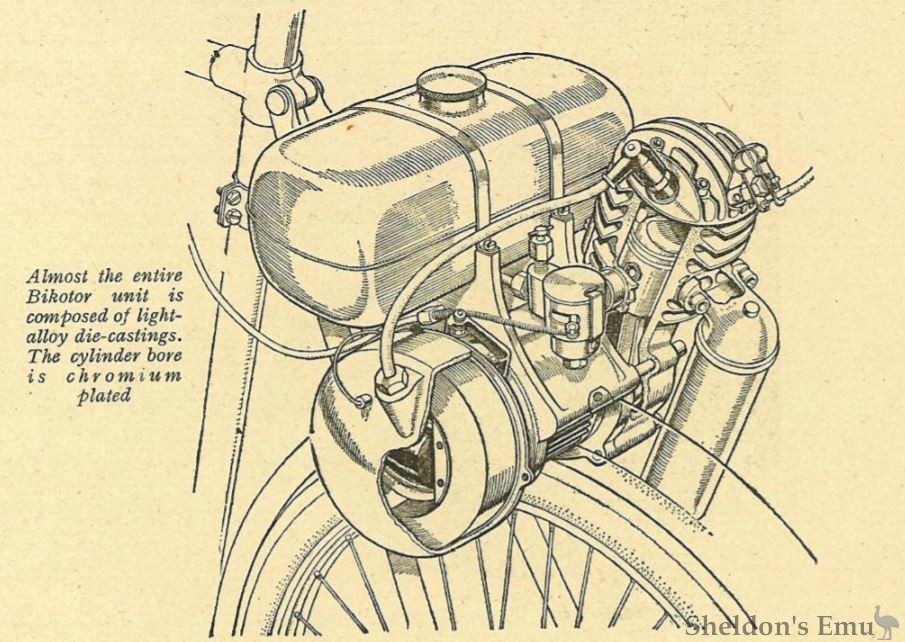
The Bikotor cyclemotor was produced in 1951. It was a cycle attachment that had its 47cc two-stroke engine positioned over the rear wheel, which was friction driven. To keep it lightweight it was constructed of alloy, with a flywheel magneto and petroil lubrication. The fuel tank was strapped on top of the crankcase. Despite being neat and well made, it was not popular and did not long remain on the market.
Low-priced 47 c.c. Two-stroke Unit
BIKOTOR is the name of the latest motor attachment for pedal cycles; it will be in production by next spring. The designer set himself an astonishingly low weight limit. Total weight of the unit, including mountings and fuel tank, is 10lb.
The engine is a 47 c.c. two-stroke. Almost needless to say, light-alloy, pressure die-castings are employed wherever practicable. Cylinder and crankcase are in one casting. One side of the crankcase is "open." The cylinder bore is not sleeved; instead, it is plated with hard chromium by a patented process and has a number of tiny indentations, about the size of a large pinhead, set to a regular spiral pattern; these help to retain the oil film...
Article abbreviated. Source unknown.
Sources: Graces Guide et al.