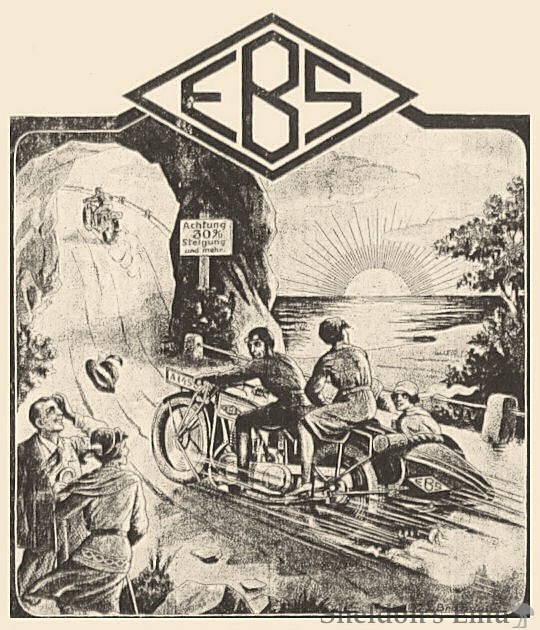
Manufactured by Ernst Bauermeister & Söhne, Berlin, 1924-1930 (or '31)
Berlin-Baumschulenweg, Behringstrasse 50-56.
From 1920 Berliner Motorenfabrik (Berlin Motor Factory) operated under the name Ernst Bauermeister and, as E.B. Berliner Motoren- und Maschinenfabrik, produced stationary and bicycle engines of its own design. The factory is likely to have employed some 250 to 300 workers at this time. In 1924 his sons Ernst and Rudolf joined the company and name was changed to Ernst Bauermeister und Söhne (Ernst Bauermeister and Sons), E.B.S.
In July of that year, Bauermeister entered two motorcycles with 200cc side-valve engines in a race in Swinemünde, ridden by Fritz Putins and Otto Flick from Berlin. Putins was in the lead for six laps but had to retire after a puncture - a remarkable performance for such a youthful marque.
First presented at the Berlin Motor Show of 1924, a larger range followed at the 1925 event.
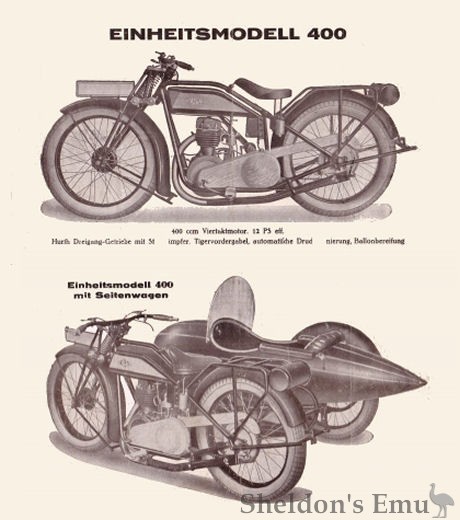
Single cylinder motorcycles of 198cc to 496cc and a 796cc side-valve V-twin were produced with engines of their own design.
From 1926 onwards, Bauermeister offered a five-year warranty against frame breakage.
Until the end of 1928 Bauermeister engines were all four-strokes built in-house, ranging from 200cc to 800cc.
In late 1928 the Model 200 became available with either a four-stroke engine or a 198cc MK IE Villiers. The EBS 198cc four-stroke (70x60 b/s) appears to be the same unit fitted to Defa, Charlett, Gruhn, Cambra and others. It is possible that the EBS 200 engine was actually built by Richard Gruhn. The 200cc models were exempt from taxes and licencing under regulations of the day.
During that period they produced a prototype using an engine similar to the EBS 200 for Engelbert Zaschka's folding car, a machine which which could be disassembled with little effort, allowing it to be moved through corridors and stored in a small space. (See this page)
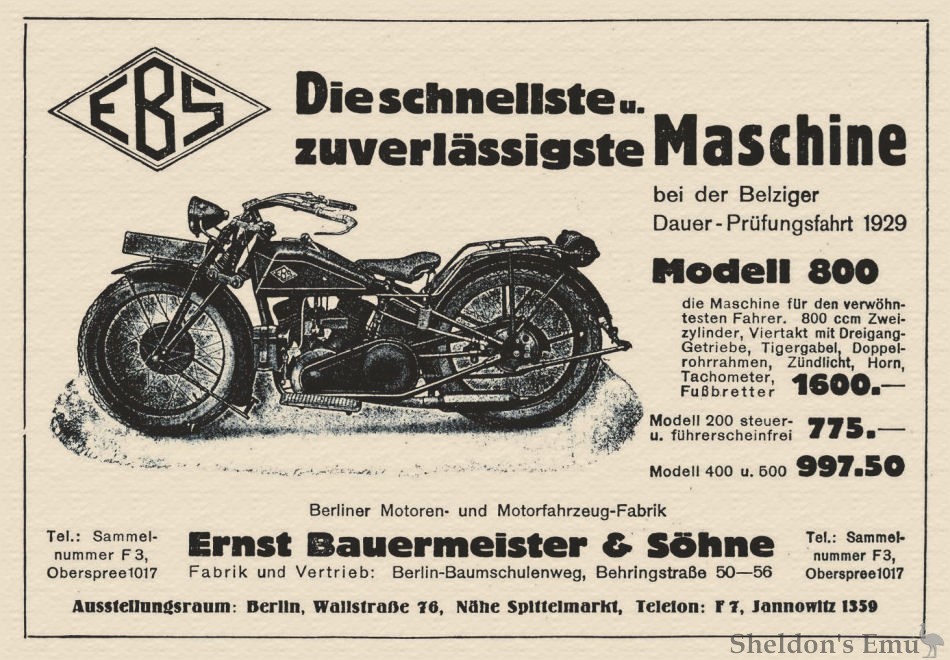
The largest machine built was the EBS 800 which appeared in early 1929 fitted with an 800cc twin-cylinder engine. These, along with other models, were available with a sidecar which was also manufactured in-house.
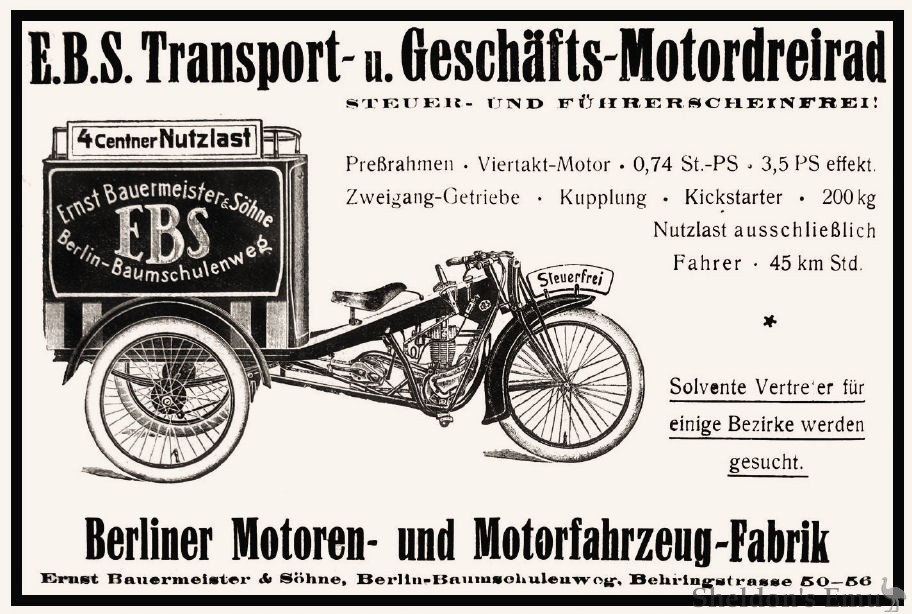
EBS also built commercial 3-wheelers (Transportdreirad). Models were LR200, LR250, LR350, LR400 and LR750, the model designation indicating the engine capacity. They had pressed-metal frames and cardan-shaft drive.
Production of EBS vehicles ended around 1930 and the company was dissolved in June 1931. Ernst Bauermeister Senior then renamed another company he owned to EBS E. Bauermeister & Co. GmbH and this business continued with some of the previous activities. His wife, Elise Bauermeister, née Hilger, assumed management in July 1936.
Bauermeister's sons established the Favorit company in Berlin in 1934, building sidecars and various motorcycles until 1938.
N.B. An Austrian official record indicates that an EBS was first registered in 1920; however, most sources give production dates of 1924-1930.
Sources: Tragatsch p124; mvca.at; Axel Oskar Mathieu Archive; Motopedia
If you have a query or information about these German motorcycles please contact us.