Debenham Sisters
Betty and Nancy Debenham, with their dog, Poncho, were keen motorcyclists. Nancy won a Gold Medal at Brooklands in 1926.
The Debenham Sisters

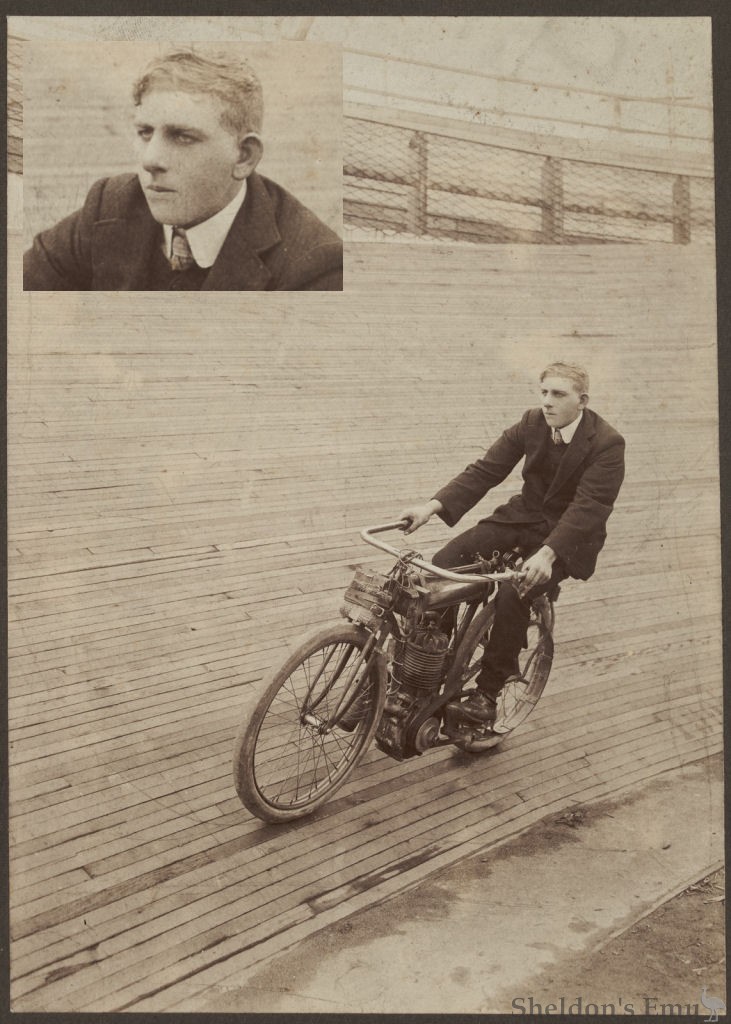
This image clearly illustrates the very high quality of Darge photography. Made with a plate glass negative, the subject appears to be in motion on a board track velodrome. Despite this, the pupils of the rider's eyes are visible. (Image: State Library Victoria)
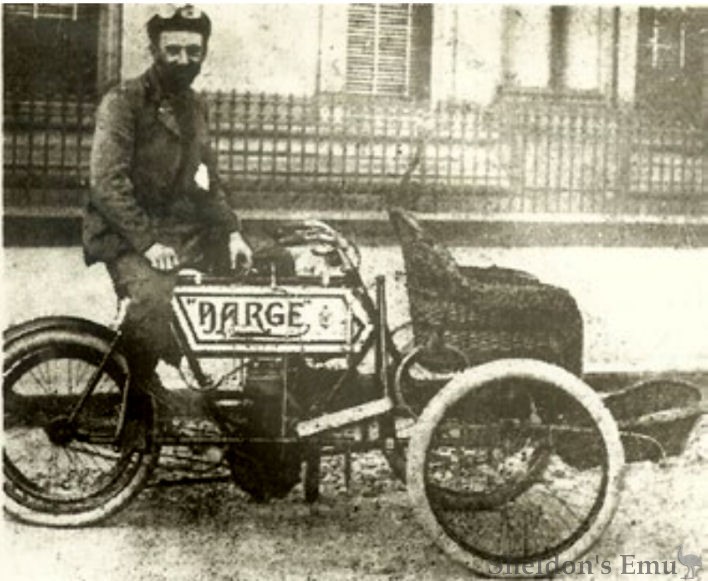
In 1905 Algernon Darge (1878-1941), known as one of Australia's foremost photographers, had a motorcycle with forecar built named the Darge using an Antoine engine.
The Australian War Memorial purchased some 19,000 of the photographers' original glass-plate negatives in 1938.
Thundering along the road at the flat out speed of 35 m.p.h.! Turn back the hand of time to 1905 and we find A. Darge piloting his 3½ h.p. Antoine Fore-Car, with forgivable pride at this "hectic" speed, to the wonderment of all and sundry. The engine was a French production, and with the exceptions of this and the carburetter, the whole outfit was made in Australia. Coil ignition was one of the features, while single-gearing and belt drive were employed.
Hill climbing was one of the nightmares of motor cycling in those days. Commenting on the Antoine's performance, Darge has stated that as soon as he sighted anything in the nature of a hill he would turn the works just about flat with the view of getting a running start at the rise. But in practically every case the engine would rapidly develop tiredness and then he would have to hoe in and stamp away at the pedals for his life, Another interesting feature of the Antoine was the ancient wipe-type style of make and break.
Darge tells a rather amusing story of a breakdown with this component. He and Mrs. Darge were making a trip from Melbourne to Geelong - quite a long trip per motor cycle in those days - and when near Werribee he met a push bike rider heading for Geelong also, and carrying an oversize in packs. Emulating the boy scout in regard to "one good deed a day" Darge offered to take the pack on his outfit to save the push cyclist unnecessary labour.
The offer was accepted—but lo! - the push cyclist arrived at Geelong two and a half hours before Darge. Half-way between Werribee and Geelong a pin that retained the cam of the make and break dropped out and was lost. Darge tried many ways and means of effecting repairs, but without success. Then he had a brainwave. The pin in the buckle of the belt he was wearing was just the right thing.
Darge continued on, to be met at Geelong by his push bike friend, who certainly must have retained some not too complimentary ideas of the motor cycles of 1905.
Australian Cycling & Motor Cycling magazine, April 1931. Trove NLA
Sources: Simon Fleming; caseycardinialinkstoourpast.blogspot.com; Trove NLA; et al.
If you have a query or information about this Australian machine please contact us.