
The company built the Swan semi-enclosed machines using JAP and Precision engines. Although usually known as Swan, they were sometimes referred to as Cygnus.
The company was founded by F. H. Thornton and later changed its name to Swan Motor Manufacturing.
Their machine was unusual, with an open frame of light alloy, braced by steel, and an inner alloy frame for the two-speed gearbox. It had a tubular rear-suspension fork, controlled by laminated springs, and Druid forks. It was powered by a 3½ hp JAP engine. The crankcase was concealed, with the top half exposed, and the oil tank went behind the headstock. The petrol tank and chain-driven magneto went under the rider's seat, and it had chain transmission.
JAP V-twin and Precision engine were also used but Thornton's father (who had financed the venture), discovered that some employees had been stealing faulty parts and swiftly closed the firm. This therefore brought production to a close in 1913.
Source: Graces Guide
The Olympia Show.
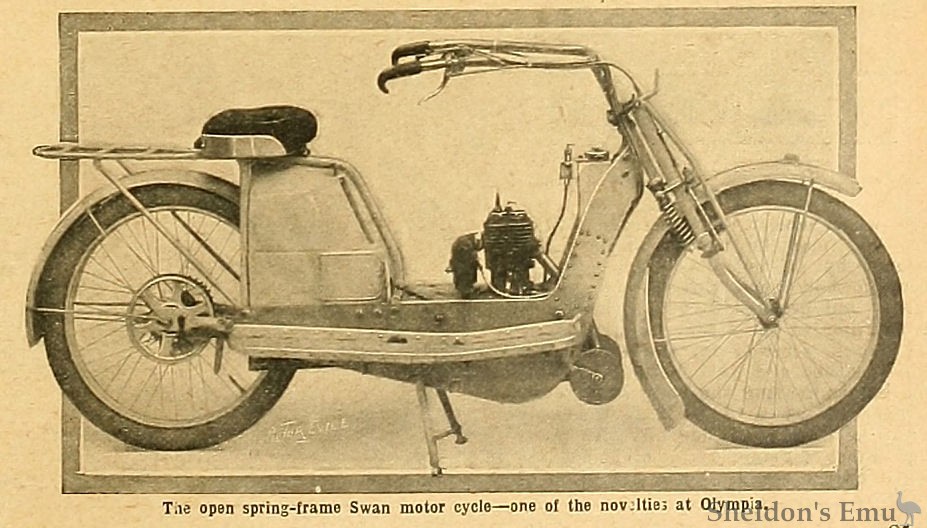
The open spring-frame Swan motor cycle — one of the novelties at Olympia.
The Swan Motor Mfg. Co., Frodsham, near Warrington. This machine is a distinct departure from the standard. The main portion of the frame is of a heavy gauge sheet steel. The rear forks are tubular, and are suspended on laminated springs. The oil tank is carried in the front adjacent to the head, while the petrol tank is carried to the rear beneath the driver's seat. This seat is of the pan type, and is provided with a heavily padded cushion. The only parts of the mechanism which are visible to the eye are the cylinder and the carburetter, the crank case, etc., being entirely enclosed. Footboards of ample size are provided, as also a stand, which raises the front or rear wheel. The magneto is carried in a separate compartment underneath the driver's seat.
The Motor Cycle November 23rd, 1911. Page 1251
If you have further information or a query related to this page, please contact us.