

The Ribble was produced by Jackson and Kinnings of Eastbank Street, Southport, Lancashire (Est 1900). The company owners were Sydney Park Jackson and Arnold Kinnings.
A machine built in 1903 was powered by a 400cc MMC engine and had direct-belt drive. This was ridden by W. Bottomley at the Southport Speed Trials held in the October of that year. It is not clear whether this was a motorcycle or a tricycle, but more likely the latter.
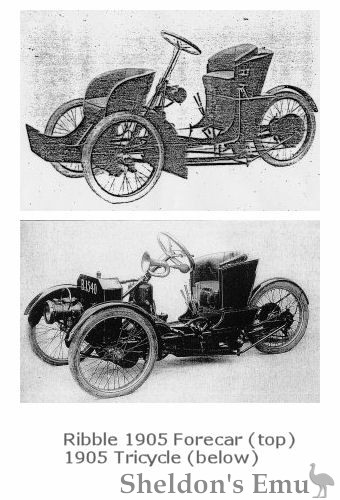
In 1905 they offered the Ribble 4½ h.p Tandem forecar and an 8 h.p. solo saddle tricar, both using water cooled engines which delievered power to the single rear wheel by chain. Production ceased in 1908.
N.B. The firm's address is also given as 168a, Norwood Road, Southport. It is possible that the vehicles were also sold under the name Jackson and Kinnings.
Ribble Motors, Southport (Stand 160).–
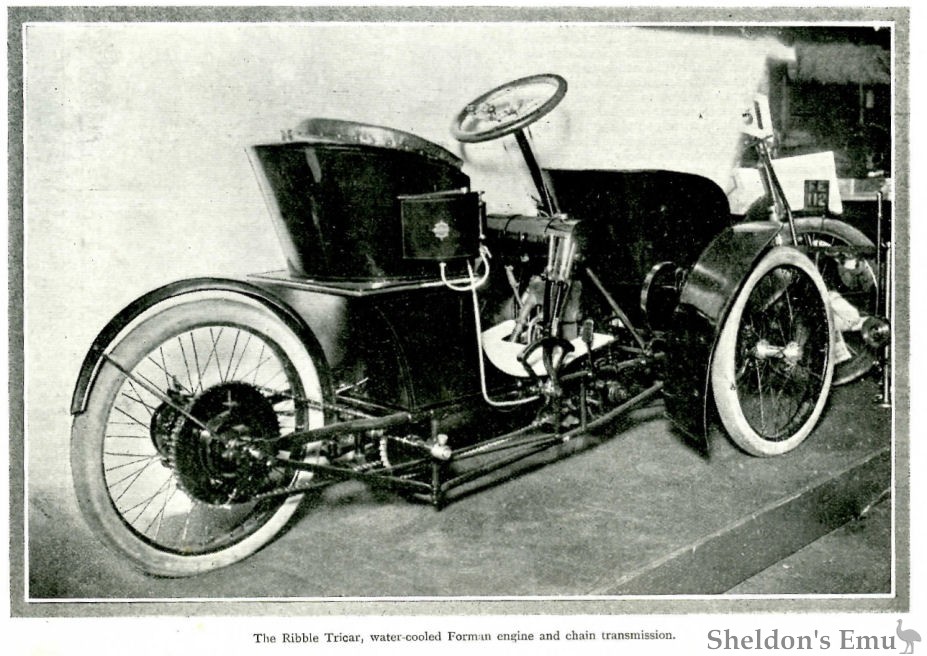
This firm are showing a somewhat unique form of tricar which is fitted with a 4½ h.p. water-cooled motor with mechanically operated valves. The water tank is carried above the head of the cylinder attached to the stays supporting the steering column, while the radiators are placed beneath the front seat. The drive from the engine is taken to a countershaft through the agency of a pedal-operated friction clutch, and on the countershaft are mounted two sprocket wheels of different diameters, giving the high and low gears. These actuate the back road wheel through chains and chain wheels placed on either side of the back wheel. These gears are brought into operation by means of dog clutches actuated by a side change speed lever. For starting purposes the gear is put into the neutral position, and a handle attached to one end of the countershaft and the engine is started up in the ordinary way. In operation the engine clutch is taken out, the low speed gear is put in, and the engine clutch gently let into engagement. For changing on to the high speed the operation is precisely similar to that of driving a car. The engine clutch is taken out on the rear hub, while a side lever on the right of the driver operates a similar band brake on the opposite side of the hub. The seats are both body built, and beneath the rear one is placed a convenient cupboard carrying the accumulators, and providing a useful tray for the storage of tools and spare parts. The petrol tank is located behind the rear seat, and the oil tank is placed on the right hand side of this. The driver's seat is spring upholstered, and the footboard is also sprung. The front seat is nicely carried on the usual type of C spring.
An 8 h.p. single of somewhat similar construction, which has been in use for some considerable time, is also shown on this stand. This was illustrated and dealt with in The Motor Cycle of October 24th last.
Report on the 1904 Stanley Show, The Motor Cycle, November 28th, page 1165
Sources: Graces Guide; 3-wheelers.com, The Motor Cycle.