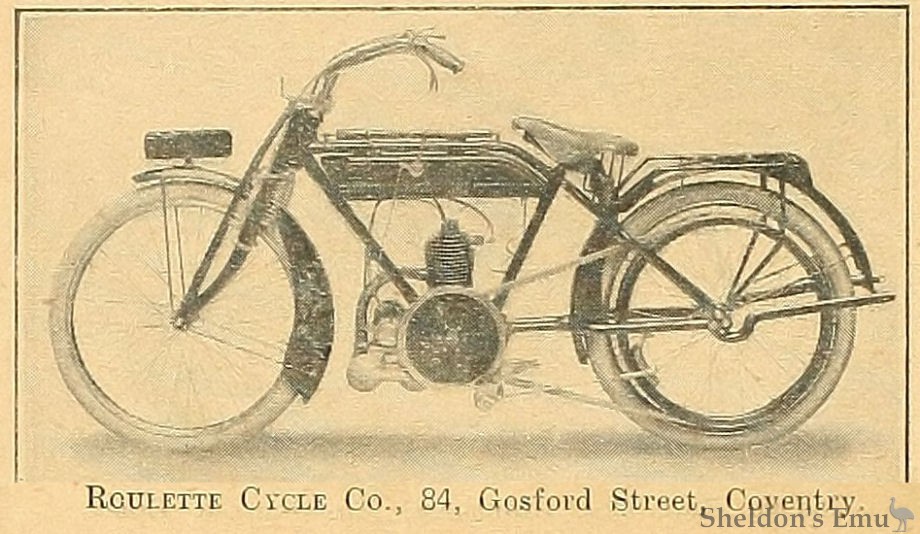
Produced from 1911 to 1914 by the Roulette Cycle Co of Gosford Street, Coventry.
1896/7 - Directory: Listed under cycles.
1911 - Late in the year the company showed a machine with a new kind of frame construction that they hoped to licence to other firms. It was invented by F. T. Robb and consisted of duplex tubes bolted together. The result was a light and rigid frame with easily replacable tubes. The prototype was fitted with a 2½ hp JAP engine and direct-belt drive.
1912 - Listed in Spennell's directory of Coventry as Cycle Manufacturers.
1913 - A larger 4¼ hp model was added.
1914 - Only the smaller model ran on for that year. This was soon joined by a lightweight with a 269cc Villiers two-stroke engine, two-speed gearbox, belt final drive and Druid forks.
Production ceased during the First World War and did not recommence following the armistice.
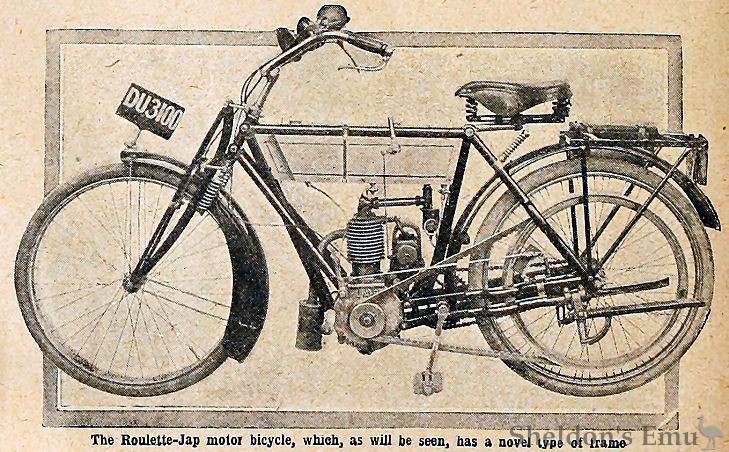
The Roulette-Jap motor bicycle, which, as will he seen, has a novel type of frame
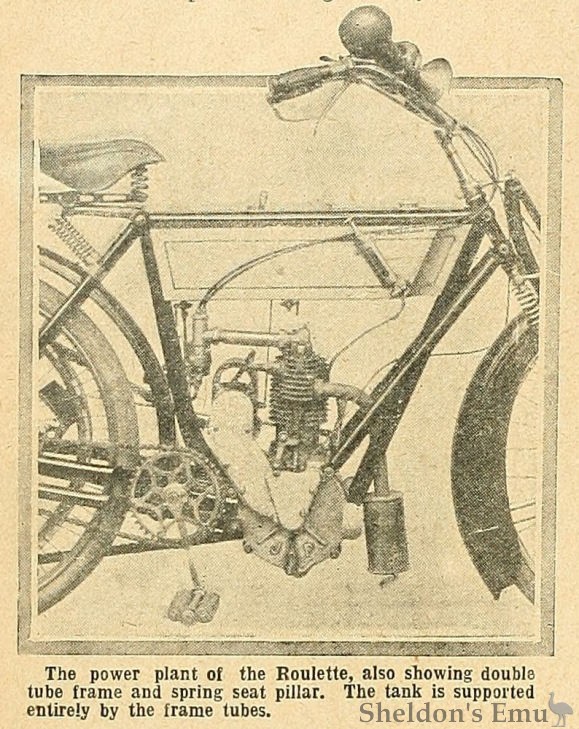
The power plant of The Roulette, also showing double tube frame and spring seat pillar. The tank is supported entirely by the frame tubes.
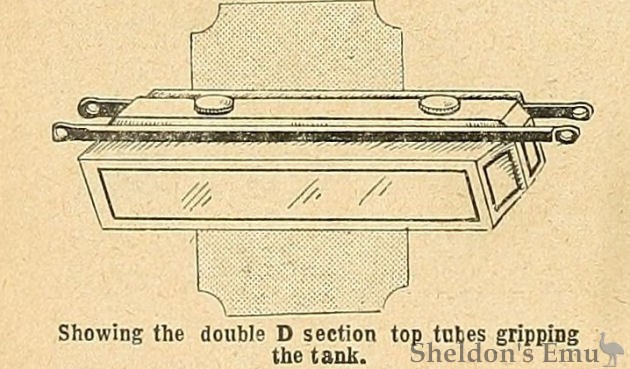
Showing the double D section top tubes gripping the tank.
LAST week we were permitted to inspect a 2½ h.p. motor bicycle which has just emerged successfully from a thousand miles test on the road. Its chief novelty is the built-up frame, the invention of Mr. F. T. Robb, but the mount was assembled by the Roulette Cycle Co., of Gosford Street, Coventry, who are in a position to grant royalties for the use of the frame. The machine illustrated was built for experimental purposes, and is somewhat shorter than is proposed for the final design. The chief point of divergence from standard practice is that all tubes, usually single, are duplicated, and that, instead of being brazed, they are bolted together. This plan, if it can be carried out without the joints becoming loose (and the machine has run 1,000 miles or so without this happening), has the very obvious advantage over the usual method that any tube can easily be replaced in a few minutes if damaged by an accident without taking the whole machine down for re-brazing, which also necessitates re-enamelling, and is a matter of several days.
Light Weight Considering Horse-power.
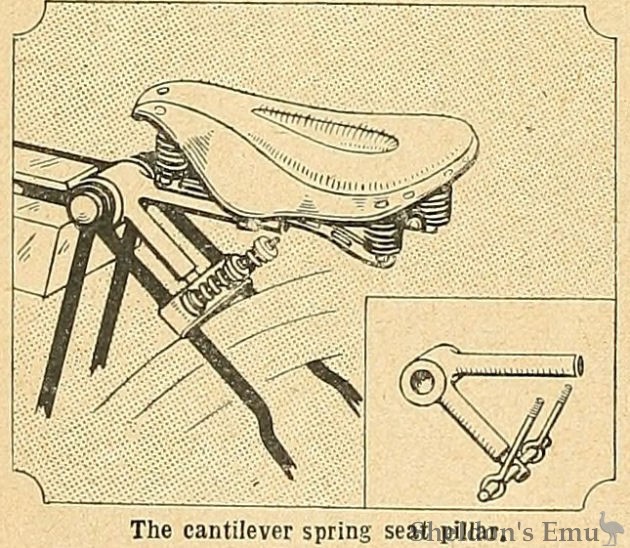
All tubes are 20 gauge, and the weight of the machine, with a 2½ h.p. J.A.P. engine as illustrated, comes out at the surprisingly low figure of 122 lbs., in spite of the increased number of tubes. An interesting feature of this construction is that it renders the use of special tank fastenings — always a possible source of trouble — quite unnecessary. The tank is clipped tightly between the twin top tubes and needs no other fastening. It can be, taken out if necessary by the removal of one of the horizontal top tubes in the space of five minutes. The cantilever saddle spring is very neat and effective, the saddle pillar being hinged where it joins the frame. Its action will be easily seen from the sketch. The engine is held very rigidly by no less than four bolts, which rigid system of suspension is considered by many to add considerably to the efficiency of the engine. We are given to understand that the option of using the frame on 1912 models is under the consideration of one or two leading manufacturers. It may be possible for our readers to inspect the machine at the Olympia Show, as should the negotiations at present proceeding fall through, the Roulette Cycle Co. anticipate exhibiting the machine direct at that exhibition. It is further not improbable that the design will be standardised.
The Motor Cycle September 21st, 1911, Page 990.
Roulette Cycle Co., 84, Gosford Street, Coventry.
Note: The frame design later appeared on the Francis-Barnett.
Sources: Graces Guide, The Motor Cycle