Debenham Sisters
Betty and Nancy Debenham, with their dog, Poncho, were keen motorcyclists. Nancy won a Gold Medal at Brooklands in 1926.
The Debenham Sisters

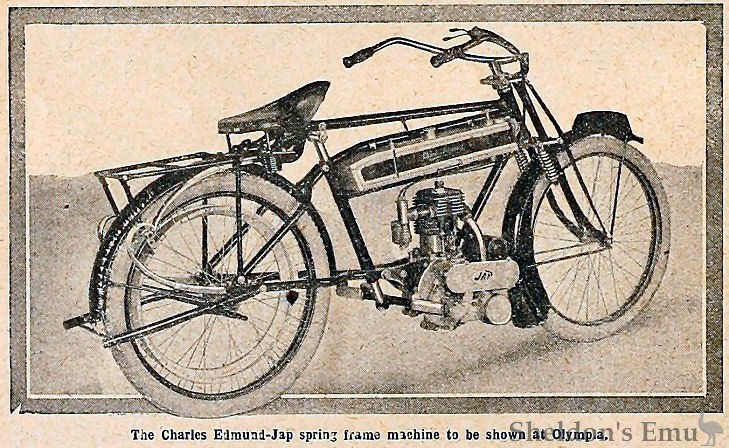
Edmund Spring Frame.
This machine, which was exhibited last year, will again be shown by Charles Edmund and Co., of Chester, at Stand 100. The spring seat has been designed to enable both saddle and footrests to work in unison, both being supported by laminated springs. The saddle is attached to an upper member pivoted at the front to the head of the rigid frame nearest to the rear wheel axle. The footrests are attached to a member which passes through the seat tube of the rigid frame and are connected by means of link motion to the seat tube. The luggage carrier is situated on and supported by laminated springs, and by means of an adjustable link motion the tension of the springs against the carrier can be increased or diminished.
1911 Olympia Show - The Motor Cycle November 16th, 1911. Page 1210
CHARLES EDMUND, No. 100.
Charles Edmund and Co., Chester. – The chief feature about this machine is the spring frame. This consists of a separate top tube hinged at its forward end, while at its after end there is a shackle to which a tube is fixed running through the saddle tube, and at the lower end of this the footrests are fixed. The saddle is attached to an extension of this top tube, and at this point the latter forks and terminates in threequarter elliptical springs which are rigidly fastened at the extremities of the chain stays of the machine. The shackles of these springs are adjustable, so that they may be made to suit riders from nine to sixteen stones. It is also interesting to note that the luggage carrier is hinged at its forward end, while the rear end is attached to the shackles of the springs, so that whatever is carried, either passenger or luggage, it is partially sprung. In this machine, it must be pointed out, not only the saddle but also the footrests are sprung.
1911 Olympia Show - The Motor Cycle November 23rd, 1911. Page 1281