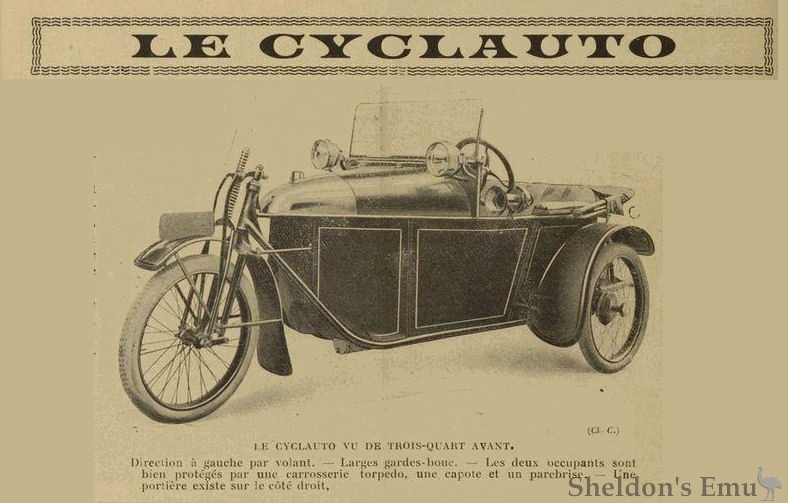

Charles Rouquet began developing his cyclecar in 1911, and displayed the result at the 1919 Paris Salon. Powered by a 496 cc SICAM two-stroke twin, both rear wheels were driven, with the single front wheel controlled by a steering wheel in the cabin.
With the aid of some high-profile investors he formed a company in March 1920 and a factory was established at 100 rue Rouget-de-l'Isle in Suresnes. Production continued until 1923 using a variety of engines including the 750cc Anzani.
Cycleauto, 1919
A three-wheeler with a single steering wheel in front is by no means a new proposition, but the lay-out of the Cycleauto is unusual in many respects. A heavy motor cycle type spring fork is employed for the front suspension, and long semi-eliptic springs attached to the tubular frame are responsible for absorbing the road shocks at the rear. The engine is a two-cylinder water-cooled two-stroke, having side-by-side Vertical cylinders. Transmission is by chain to an epicyclic gear on the countershaft, and two long belts running over large front pulleys provide the final drive. Driver and passenger are accommodated side by side in a comfortable body, provided with hood and screen. Steering is direct through a wheel and link motion. A radiator is placed in front of the engine.
Paris Salon, reported in The Motor Cycle, October 1919
(The article spells the marque's name "Cycleauto")
Sources: The Motor Cycle; patrimoineautomobile.com