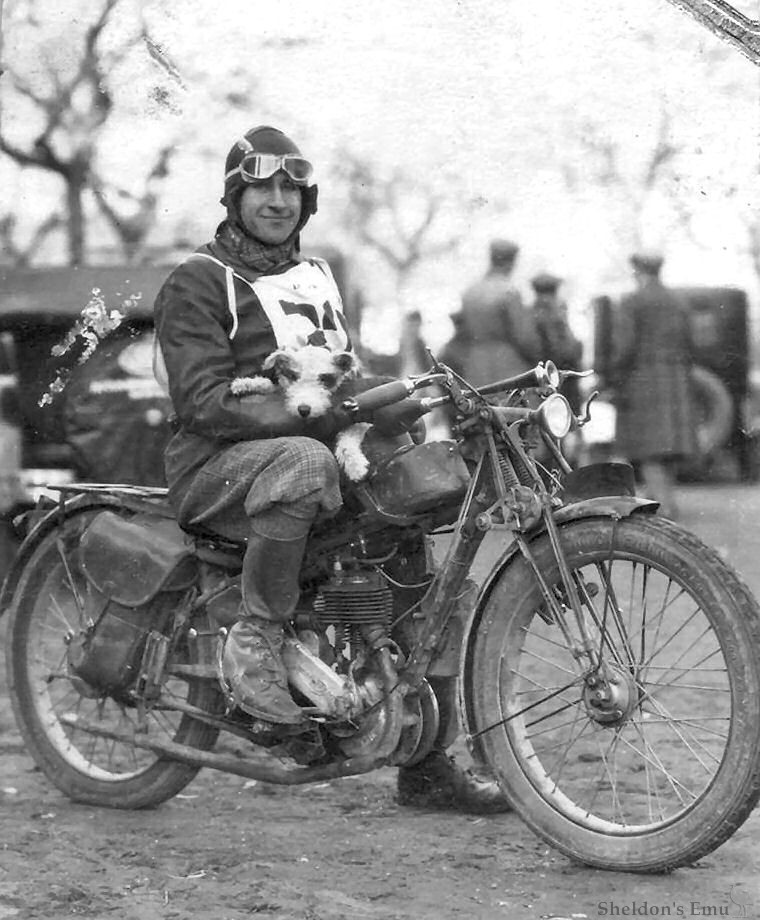


Lóránd Méray-Horváth (1892-1968) and his brother, Endre (1893-1966) were the first Hungarians to build motorcycles in any quantity.
The Méray Motorcycle Company was, in all honesty, a very small workshop was set up in May, 1923. By that time Lóránd already dabbled in motorcycling. His father frowned upon his interest in two-wheelers so Lóránd quit the family business and set up his own company. A few motorcycles, clearly showing British influence, were assembled. The major hallmarks were a triangle frame and the installation of Blackburne and Villiers engines. In 1925 two things happened: Lóránd won his category at the Hungarian TT race and subsequently the bank which financed their operations got them together with Magyar Acélárugyár (Hungarian Factory of Steel Goods), which was able to produce tubes for frames in larger quantities.
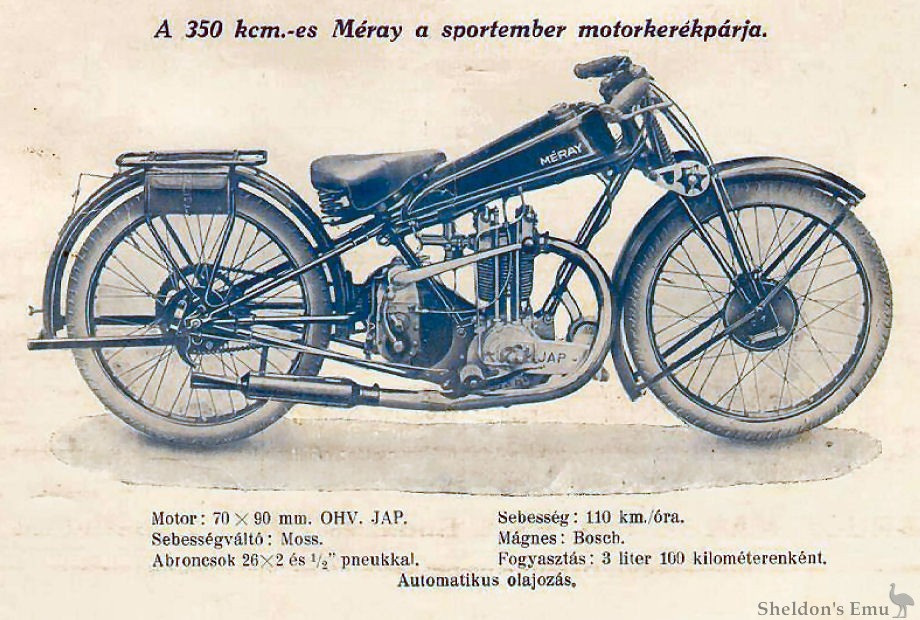
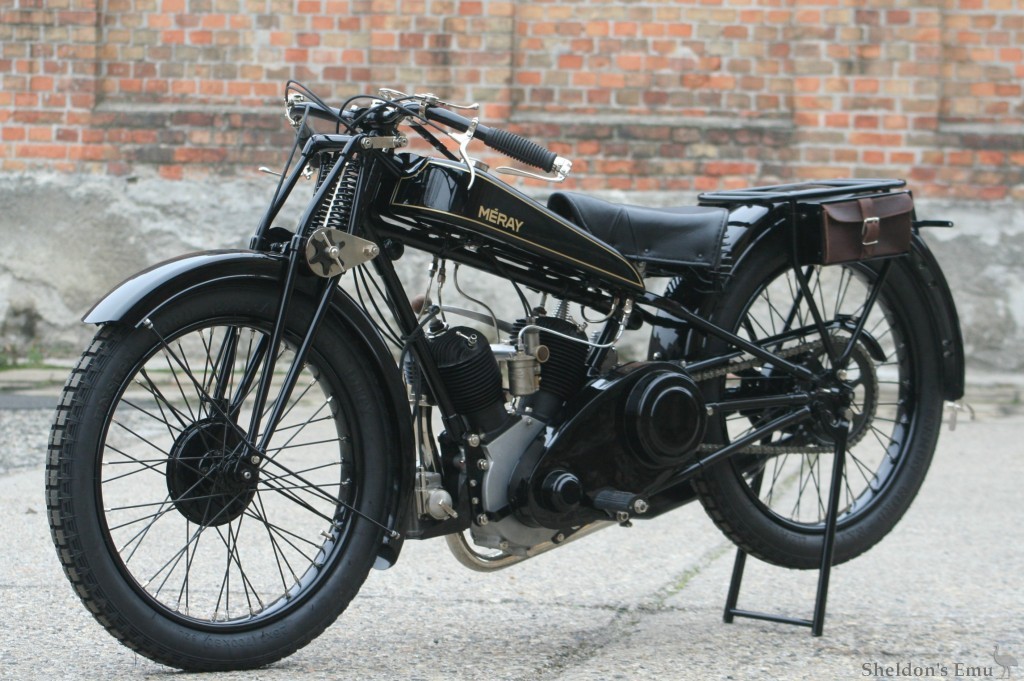
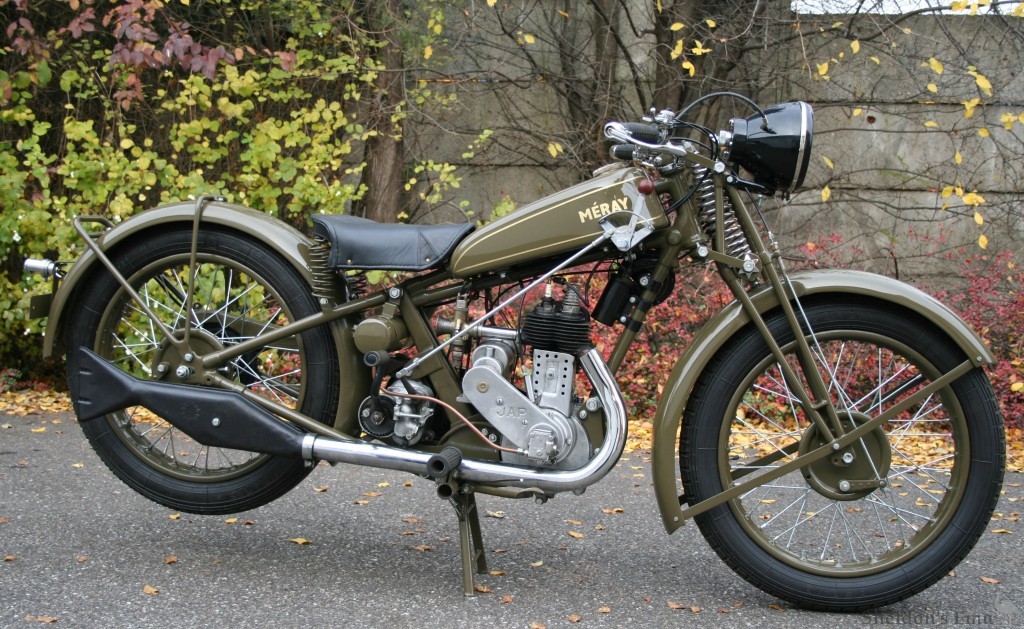
By 1926 the Méray motorcycleoperations moved to the premises of Magyar Acélárugyár. Méray motorcycles were built at the Acélárugyár's facility, while still being developed by the Méray brothers. These Méray motorcycles were fine sporting machines - but in Hungary the market wasn't big enough for such vehicles. The 1927 range used 350, 500 and 680 cc JAP engines, Sturmey-Archer or Burman transmissions, and for a while the spring handle bar developed by Austrian engineer, Antonie Gazda.
In order to expand the business a motorcycle derived, three-wheeler van powered by a 350cc JAP engine was introduced in 1926, and proved to be rather popular. Several state-owned agencies including the Hungarian Post, the Police, the Fire Brigade and the Budapest Electricity Co used Méray motorcycles and/or vans. The Méray company developed its highest capacity motorcycle in 1928 powered by a 1000 cc JAP engine. Though the triangle frame was modified, it still couldn't cope with the strain.
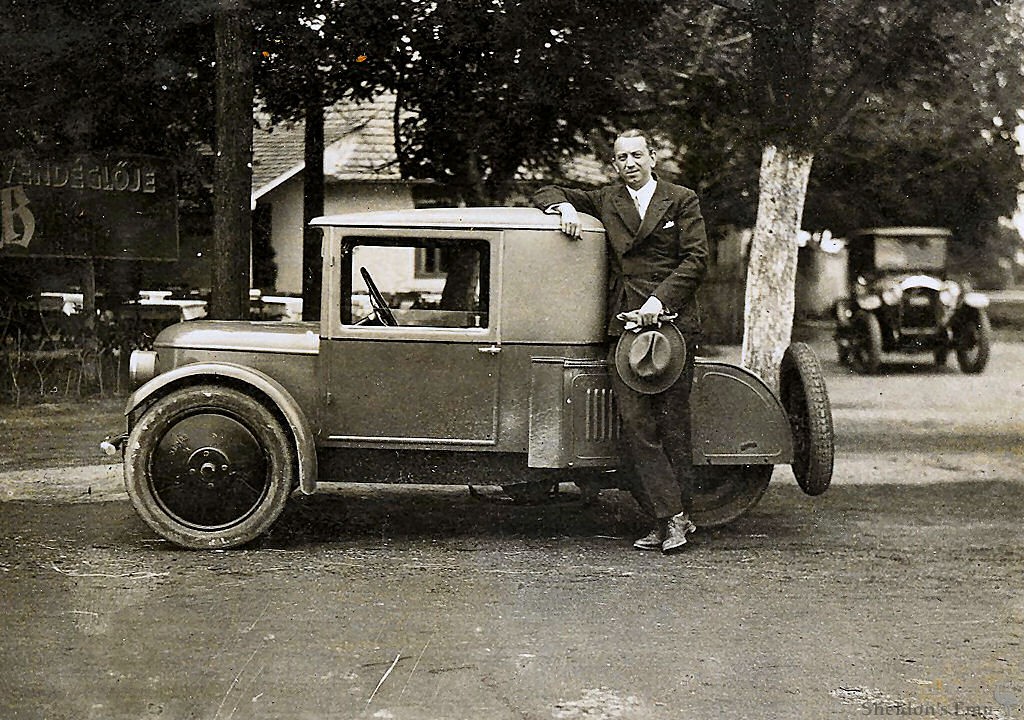
The other day we had the opportunity to gain an insight into the large-scale work that is going on at the Magyar Acélárugyár plants, where the Méray machines are manufactured.
From the new motorcycle type, which is now available to Hungarian customers, to the large machines of the 1000 series, the factory's sensation today is undoubtedly the "new transport vehicle", which was built on the foundations of the past. The old Méray transport wagon had two fundamental faults. One was that the engine heated up due to the heavy use, the other was that the wheel spokes kept breaking.
These two shortcomings are primarily compensated for by the new transport vehicle, which has solid and interchangeable wheels and a turbo fan to help with cooling. In addition to the above, a much lower frame, rubber pads on the springs that act as bumpers, and a wide leather-padded, comfortable two-seater seat can be seen on the new vehicle. Instead of the device intended for starting the engine, we now see a more comfortable starter. The huge 20-litre petrol tank is behind the seat, which was previously attached to the box. Now the buyer can order a box of any size, width, or shape, this does not affect the fuel tank. Instead of the previous small-sized motorcycle brakes, we find much larger brakes on the new machine that are twice as powerful. Propelled by a 500cc Jap engine it will have a load capacity of 4—500 kg. From the above, it can be seen that Hungarian products are constantly improving. We can whisper to our readers that the factory is preparing a big surprise again in the near future, which will also have a great impact on Hungarian motoring.
Automobil Motorsport, September 15th 1928.
Contemporary statistics are hard to come by, but it is known that in 1927 Méray sold 278 motorcycles, in the first-half year of 1928 they sold 186 vehicles and 251 vehicles in 1929. It is also known that in 1930 there were 1145 Méray vehicles (motorcycles and three-wheelers) registered in Hungary. A year later this number peaked at 1308 units and decreased afterwards.
Correspondence between the mighty Weiss Manfréd factory and Magyar Acélárugyár gives us a clue on how the Méray business was perceived. When word got out in 1929 that the Weiss Manfréd company, one of the largest industrial concerns in Hungary was experimenting with motorcycles, the directors of Magyar Acélárugyár begged not to destroy them, the smaller party. They had not to worry: WM eventually ended up with mopeds.
But the 1929 economic crisis took its toll on the weak Hungarian market. In the early 1930s Méray had to rely on its transportation business in order to survive and utilized the 3-wheeler vans they had built to carry all kinds of goods for customers.
Motorcycles had to take a back seat, though new developments occurred, the biggest being the creation of an all-Hungarian Méray motorcycle, powered by a 350 cc engine. By 1934 there was a 500 cc version. Accounts differ, but it seems that János Csonka, a Hungarian engineer and one of the most prominent figures in Hungarian pre-war motoring offered his small engine to the Army, which then convinced Magyar Acélárugyár to install it in a Méray frame. Later these motorcycles were referred to as Méray MARA. Though only a few were built with chrome-plated fuel tanks and the signature triangle frame, about four such motorcycles are still around.
In 1934 Magyar Acélárugyár signed a deal with the Hungarian Steyr-Daimler-Puch trading company. This led to the birth of the Méray-Puch 200. This was an Austrian Puch 200 motorcycle, sold by the Méray company. But contrary to popular belief, this was not assembled in Hungary. Later there were Méray-Puch 350 motorcycles, used by the Army. According to some accounts these may have been assembled in Hungary.
From 1936 the Méray company mostly focused its energy on the distribution and repairing of Adler cars.
After the 2nd World War, the Méray company restarted its operations as a repair shop and they also tried to revive their car sales business. In 1948 as with all private businesses in Hungary, the Méray company was nationalized.
Lóránd stayed in Hungary. Endre and his family also stayed until the 1956 revolution. Endre jr. helped developing the Berva scooter.
It is not known how many Méray motorcycles were built, but probably between 1500 and 1700.
Information above courtesy Pal Negyesi
Meray used engines by Blackburne, JAP, Moto-Reve, Puch, Sunbeam and Villiers, and after about 1935 built their own engines. There is also a report that they used Zedel engines.
Models include:
1939 Puch Meray 200cc
Source: Pal Negyesi
phalas32<at>gmal.comi
My father was racing
meray meray puch
MY Father Halasz Karoy was racing Meray motor bikes
HAMILTON
Mon Nov 09 2009
haluvator at yahoo dot com
Méray Puch 200
Hi!
I'm interested in this type of cycle, but unfortunately I don't find any kind of sparepart's list and catalogue. Is anybody able to help me?
Thank you: Pisti from Hungary, Üllés
Hungary, Üllés (Szeged)