At the age of 12 Bruno Rossati began working eleven hour days.
"Now, approaching 91, I find myself reminiscing about my youth, still riding my motorcycle every day.
Letter re Ladetto

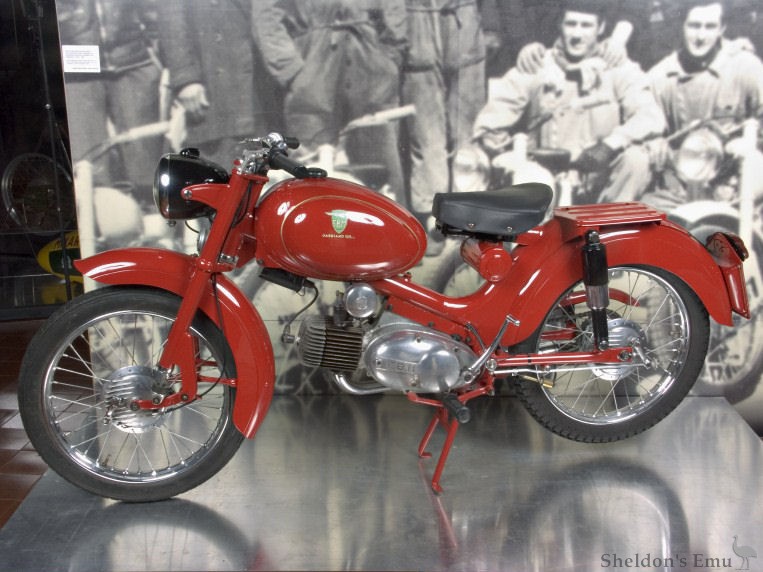
After studying at the Aldini-Valeriani Institute, Franco Morini (1924-1984) had been an apprentice designer at Ducati and, subsequently, at his uncle Alfonso's Moto Morini. In 1951 he founded, in partnership with Vittorio Minarelli, F.B.M. (Fabbrica Bolognese Motocicli) based in Via Saffi, starting to produce motorcycles, first on behalf of third parties, then on its own. The Gabbiano 125 cc light motorcycle, officially presented at the Milan Exhibition in 1952, was followed by the Vampir 200 cc capable of exceeding 120 km/h. However, the two partners soon realized that the company's activity could be better directed by building engines. This resulted in the Pettirosso, a robust and reliable 48cc single-cylinder engine which secured them numerous orders, establishing the company in what would become a successful market sector for decades to come..
Franco Morini had contributed to the success of FBM, whose market had expanded from Italy to Europe, not only as a designer but also through his far-sighted production decisions. In 1956, the end of the relationship with Minarelli had led to the creation of FB Minarelli (later Minarelli Motori) and Morini Franco Motori. The latter, initially on Via Battindarno, then on Via Triumvirato, and finally, from 1958, on Via Porrettana in Casalecchio di Reno, had begun offering a varied production of engines with different displacements for both road and racing applications. A cornerstone of its production was the 50 cc, two-stroke, three-speed engine that reached 60 km/h. Franco Morini engines had found favour with many Italian and foreign brands, from Mexican ISLO to Aprilia, from Dutch Jamathi to Malaguti, establishing itself as a leader in the sector. In 1999, the company attempted to address the industry crisis by acquiring Moto Morini, beginning production of large-displacement motorcycles under the historic brand. It entered bankruptcy liquidation in 2010 and was sold the following year to the Eagle Bike company.