

Motorcycle Licencing and Taxation
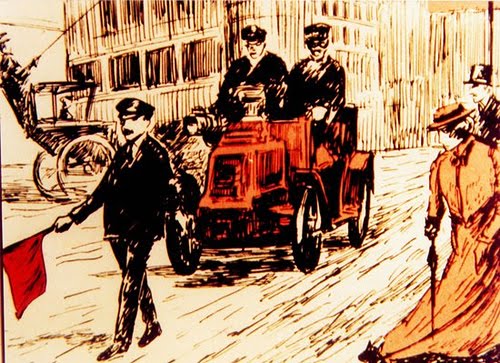
Red Flag Act
In 1865 the British Government passed a law that required that any self-propelled road vehicle must be preceded by a pedstrian at least 60 yards ahead carrying a red flag.
The law stipulated that the speed limit was 4mph in the country and 2mph in towns, with a £10 fine for speeding. It was repealed in 1896 and the speed limit was raised to 14mph.
In Pennsylvania a law was proposed in 1896 requiring all drivers of horseless carriages, "upon chance encounters with cattle or livestock to:
November 27th, 1907. Motor cyclists should note that the L.G.B. has granted the application made by the East Sussex County Council for a ten miles speed limit on the Brighton Road at Handcross, between the 33rd and 34th milestones. The Brighton Road, however, is no longer a special favourite with motor cyclists. There is too much car traffic to be pleasant. Only recently a motor cyclist had a very narrow squeak on this road, a car driven by a lady rounding a bend on the wrong side, forcing him to scrape the hedge to avoid a collision.
Germany 1920s
The tax on motor vehicles as well as high costs for petrol and related commodities as a result of import duties and other taxes had made most motorcycles prohibitively expensive for the average German houshold.
The Reich goverment introduced a tax regulation in 1922 which made small capacity motorcycles tax-free and, after 1923, required no riders's license. These were designated as having less than three "tax horsepower", with a distinction being made between two- and four-stroke engines. This applied to four-strokes up to an engine capacity of 210cc and two-strokes of 150cc. In 1928 the regulations were simplified, with all engines up to 200cc being tax-free.
Article by Professor Reinhold Bauer: Motorcycles in Germany between the World Wars
If you have further information or a query related to this page, please contact us