


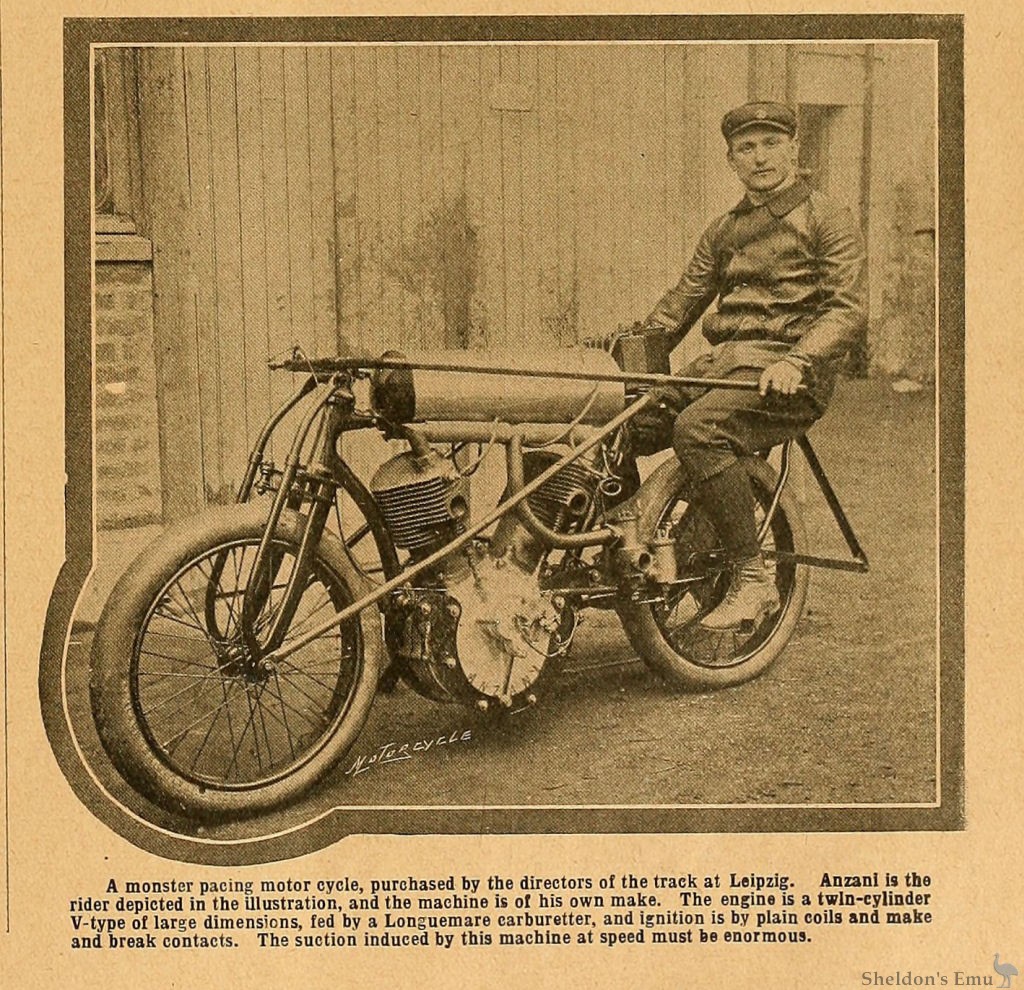
A monster pacing motor cycle, purchased by the directors of the track at Leipzig. Anzani is the rider depicted in the illustration, and the machine is of his own make. The engine is a twin-cylinder V-type of large dimensions, fed by a Longuemare carburetter, and ignition is by plain coils and make and break contacts. The suction induced by this machine at speed must be enormous.
THE science of motor pacing, perfected by the continental riders, is practically unknown in this country, although we have many expert motor cyclists capable of holding their own in the best of company as regards racing and record breaking.
Therefore, in view of the fact that motor cycle paced events promise to figure to some extent in the sports programmes at home this summer, and as a result many motor cyclists will be making their debut as pacemakers, the following hints, from the pen of a correspondent who has been closely connected with motor-paced racing abroad, will no doubt be appreciated. For all-round purposes a two-cylinder engine is to be preferred, the great secret being to have the motor running evenly, and it is absolutely necessary that the machine should start with the utmost ease.
To obtain this result the carburetter and ignition should be most perfectly adjusted. It often happens that a two-cylinder will be firing without even a miss, yet it may be pulling irregularly, but this must be remedied, as if a motor is at all faulty in this respect it will " kill " the finest pace follower in the world. Ignition and lubrication are the principal causes of this fault. The timing of the two cylinders must be perfect, every part of the ignition must be spotless, and the oiling must be regular and given in small quantities, "little and often" being the motto. It is a decided advantage to have the spark advance fitted on the handle-bar, which for pacing purposes is considerably lengthened, so that the rider can sit well back and upright, and then it is not necessary to let go the bar when changes of speed are necessary. The method of fitting this by Bowden wires is very simple, and can be adopted with advantage.
Feet on the Ground.
The position of the saddle should be exceptionally low, so that either foot can be placed upon the ground, or if this be not possible a powerful brake should be fitted, but the combination of the two is preferable. The advantage gained by this is that the pacemaker when picking up his man is able to dash up at full speed, and suddenly slow up in a few yards, obtaining, if possible, the inside position so as to be able to get his man away first.
A good "pick up" in a short distance race and half the battle is over, so it is advisable to practice this together in training. If it be possible to touch the ground with the feet as soon as the rider is "hooked on" the feet can still rest upon the ground for a time so as to steady the motor at this critical moment when the cyclist has quickly to work up his speed. The wind is one of the pacemaker's chief annoyances, as the speed of the machine has to be carefully regulated with and against the wind in order that the pace may be uniform the whole of the lap, and it is here that the handle-bar spark control comes in. In motor pacing machines, contrary to racing machines, weight is of little consideration; in fact, up to a certain point, the heavier the machine the smoother it runs.
When travelling at full speed the pacemaker, in the straights, should be able to watch his man by glancing over the right shoulder, and for this, purpose again it is advisable to practice alone, as the natural tendency when looking behind is for the steering to follow the turn of the head — a point which can only be overcome by practice. The pacemaker should be able to converse with the rider, but on no account should the rider be allowed to converse much with the pace-maker except in brief, just giving instructions, such as "steady," "faster," "pass," etc.
It is better to travel a good even pace and go right through than to indulge in "gallery riding." All nuts and terminals should be secured by insulating tape. Every care and attention should be paid to details.
Finally, there is the question of protection, which counts for so much, so after the regulations have been carefully considered, the resourceful pacemaker then sets to work to have himself and his machine equipped so as to shelter his man as much as possible as regards wind resistance, without infringing the pacing conditions.
J.S.
The Motor Cycle May 23rd, 1912.
If you have further information or a query related to this page, please contact us
Classic European Motorcycles
Thousands of pages...