
Kent
The following is from Terry Parker of the VCCSA:
The development of the very successful Kent conversion is one of the South Australian success stories, told in fragments from time to time in motoring circles.
Lindsay Stewart Eglinton was a Norwood boy, born in 1888. He excelled at technical drawing during his education at the SA School of Mines, winning prizes from 1900 over several years. First mention of him in business is at Rundle Street, Kent Town, hence the 'Kent' name to his innovation. 'Eglinton & Stevens', motor engineers appeared at 105 Angas Street. They built cycles named 'Rova', and like many cycle builders, also assembled motorcycles from imported kits.
In 1915 Eglinton modified a circa 1909 NSU motorcycle for Laurie Western, a friend who was involved in competition. The overhead inlet valve became the exhaust valve and the original exhaust connection, the inlet. In addition, an auxiliary exhaust port was created at the bottom of the piston stroke so that the expanding exhaust gas could escape under pressure. The overhead exhaust valve allowed whatever was left to escape before the next inlet stroke.
The principle was not new, being used by Indian and JAP competition engines around 1910. In those cases there were holes drilled radially around the cylinder at the bottom of the expansion stroke so the flames and gas escaped, at some risk to the rider. The outward flow under pressure was said to prevent air being drawn in as the piston commenced to rise. Having witnessed one of these running, the urge to ride it dissipated. The refinement of the Kent valve was just that: there was a one-way valve incorporated which exhausted into a second exhaust pipe. That prevented ingress of air, dust and anything else nearby, and would have aided starting where extra air might be a problem.
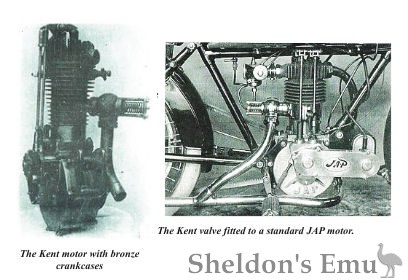
The next development of the idea was the manufacture of a complete motor using gunmetal crankcases and incorporating the auxiliary valve in the cylinder casting. There were double overhead valves, which helped raise the compression ratio. The motor was immediately successful, outperforming machines with larger motors. The business was bought in 1915 by Leslie Pinder from Naracoorte, who had gained the Italian Aquila car agency, hence the business was 'Aquila Motor Works'. Eglinton and Stevens remained on as staff. Expensive to produce, the Kent motor was replaced with a simple conversion for existing motors.
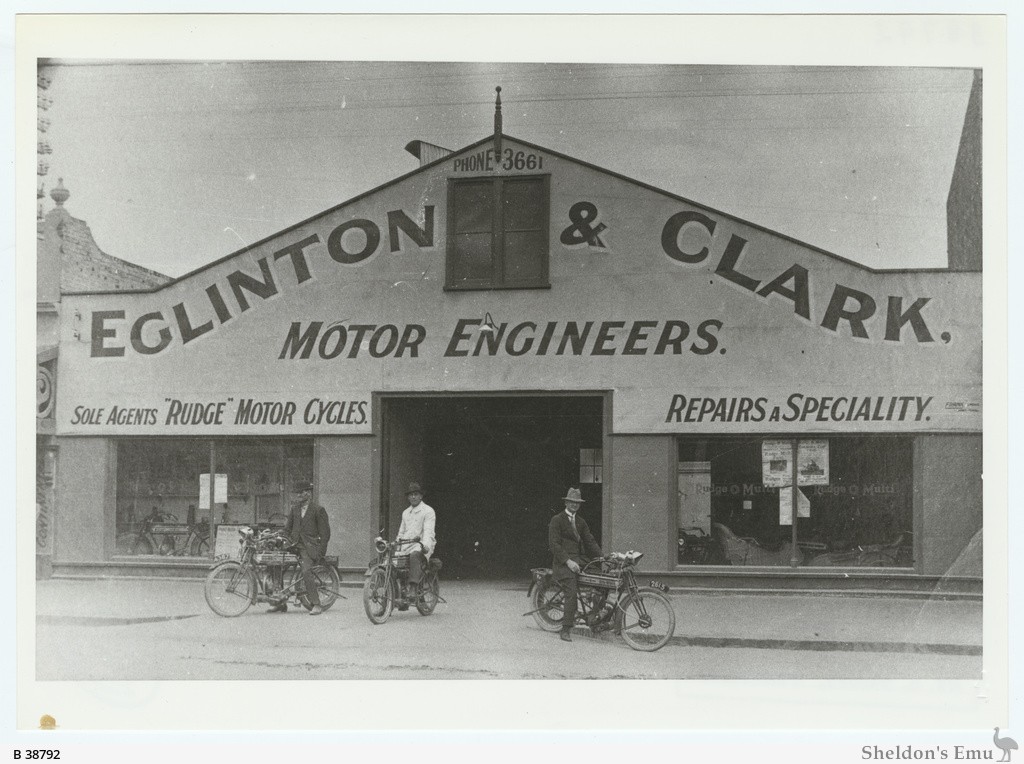
'Eglinton & Clarke' commenced in Pultney Street, photos of which were often seen in motoring publications. They became agents for Rudge motorcycles, and by now were adapting the Kent valve to Rudge, JAP, and others. They worked well. Often all category winners in competitions were Kent equipped.
Patents were secured and a Kent motor was shipped to USA for assessment in 1919, but rapid development of engine technology during the war made it redundant.
Excerpt from Motor Cycles South Australia, by Terry Parker. Bob Eglinton, son of Lindsay, provided Terry with much of the information.
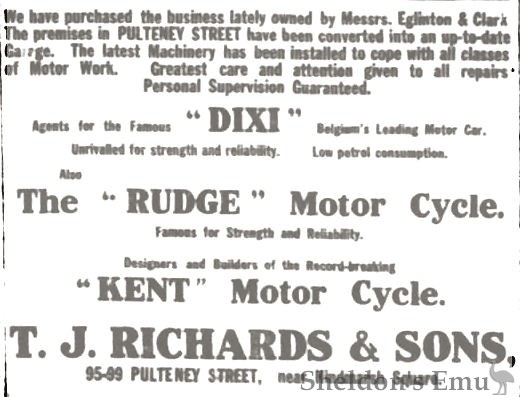
"T.J. Richards and Sons, Pulteny St Adelaide. Designers and Builders of the "Kent" Motor Cycle." Trove 1914.
A newspaper article from 1916 states:
"L. S. Eglinton again showed that his locally produced Kent is a side-car mount of sterling qualities by winning the side car class. This Kent machine was entirely designed and manufactured here by the rider. Even the castings were done here. It is a truly Australian machine, with Australian tires and Australian 'Copper King' belt."
A report states that a 500cc OHV Kent "covered the flying half-mile at 69.8 miles per hour in 1913."
One new Kent motorcycle registered Jan 1917. Trove.
Kent motorcycles appear in the SA Registry records for 1920, for instance:
17535, G. H. Fidge. Prospect. 3½ (h.p.) Kent. - Oct 1920
Source: Trove NLA
Rova-Kent
Manufactured by Eglinton & Clarke, 93-97 Pulteny Street, Adelaide
The Rova Kent was designed and constructed by Messrs. Eglington and Clarke, two prominent members of the Motor Cycle Club. The engine is of the overhead valve type, and has two exhaust and two inlet valves. The four valves are actuated by two long, adjustable tappet rods, extending from the top o£ the cylinder to the timing case. Those tappets work the overhead rocker arms, each one of which is fitted with a compensating device which ensures each pair of valves acting in perfect unison. The cylinder head is separate from the cylinder proper.
One of the most noticeable features of this engine is the cylinder itself, which is fitted with an auxilliary exhaust port. Practically the whole of the exhaust gas is carried away through the this exhaust port, and into a long TT pattern pipe, which extends past the rear axle of the bicycle. The cylinder is also fitted with non-return valves. The tact of the exhaust gas passing through the auxiliary port means that the heat, which is inseparable from a motor engine, is greatly reduced. The two overhead valves act as scavengers to the rest of the cylinder.
The crankcase is of polished gun-metal, as is the timing case. The timing, wheels and cams are of the outside class, end the unique construction enables any desired valve setting to be secured. A chaindriven Bosch magneto is fitted, and the tertiary type of B and B carburetter. The machine proved itself in the hill climb, held at Golden Grove on October 5, 1912, and on this latest occasion it more than fulfilled the expectations of the designers.
What the Rider Thought.
Korner, who rode the four-valve, stated after the ride that it was one of the fastest machines he had ridden, and in that respect his opinion counts for something, as he is the present holder of the Australasian record for the flying half-mile. "It was a bit strange to me at first," he remarked, "as I have been used to other makes of motor cycles. I only had it out for a few rides, but I found that it waa full of pace. It compares very favourably with the imported machine. The engine is extremely flexible, and is remarkably quick in picking up on the hills.
Trove NLA: The Journal (Adelaide, SA) Fri 14 Mar 1913
Rova
Manufactured by Eglinton & Clarke, Adelaide
Boy wanted. Eglinton & Clark, Rova Motor and and Cycle Works, Rundle Street Kent Town
The Register (Adelaide, SA) Mon 29 Nov 1909
2 3/4 H.P. MINERVA Motor Cycle, perfect order, spares, £23 10/- Eglinton & Clark, Rundle-st., Kent Town.
The Advertiser (Adelaide, SA) Tue 21 Dec 1909
If you have a query or information about this Australian motorcycle please contact us