



It will be observed that very large combustion heads are used whilst the crank case anchorage, though somewhat unusual, allows the engine to be removed with ease.
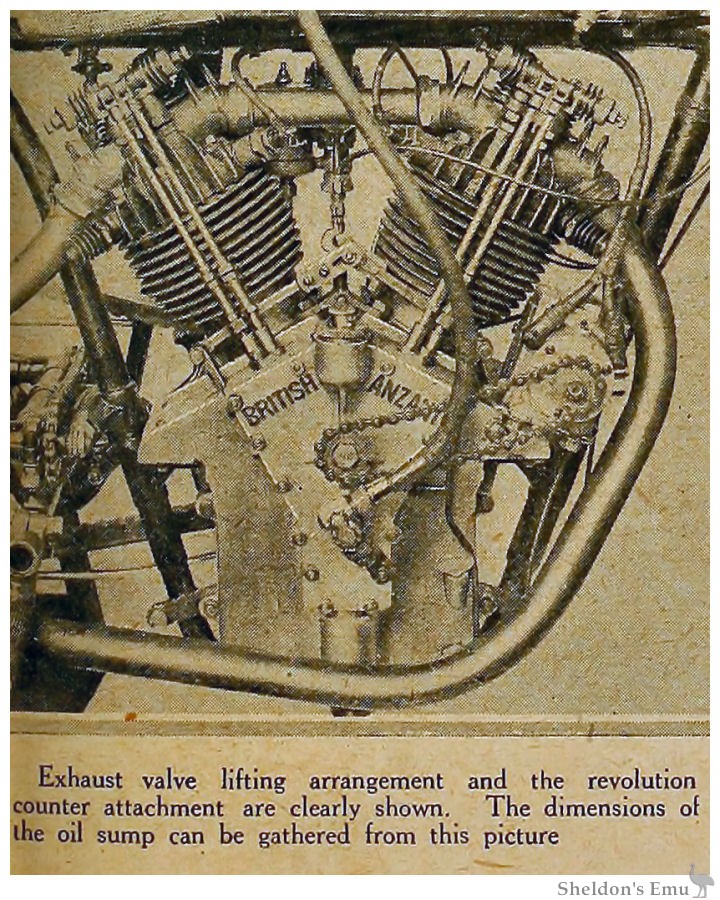
Exhaust valve lifting arrangement and the revolution counter attachment are clearly shown. The dimensions of Ine oil sump can be gathered from this picture
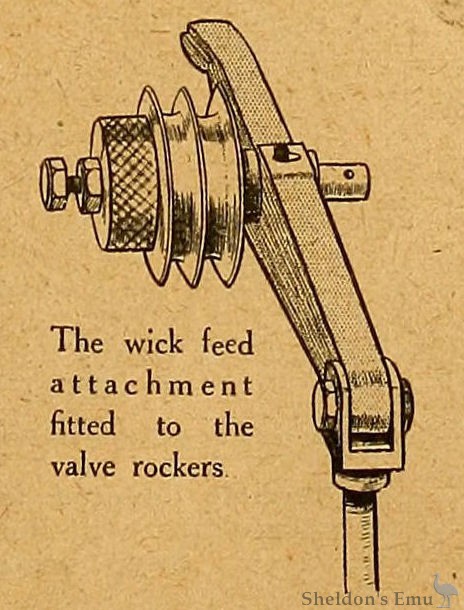
The wick feed attachment fitted to the valve rockers
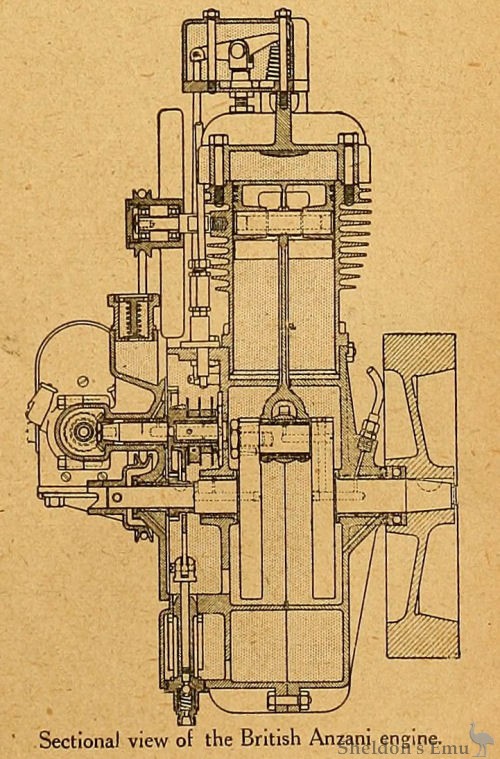
Sectional view of the British Anzani engine.
OF several engines which made their debut at the recent five hundred miles race at Brooklands, the British Anzani, mounted in a Zenith motor bicycle, gave a very promising performance.
We recently inspected this engine, which had not been interfered with since the event, and we were at once impressed by its condition. Externally, it had kept remarkably clean, whilst internally all the bearing surfaces were as new.
Two cast iron cylinders, which have a bore and stroke of 83x92 mm: (998 c.c), are provided with detachable heads, which accommodate the overhead valves, the rocker arms for these being pivoted in brackets mounted on twin lugs. The rocker bearings are lubricated by wicks fed from a cup filled with grease, which liquefies when the engine gets hot. The engine, it is claimed, has developed 24.5 b.h.p. on the bench at a speed of 5,500 r.p.m.
Mechanical Lubrication.
Lubrication is carried out by means of a plunger pump located in the base of the crank case sump. The plunger has a lore and stroke of 6x5 mm., and delivers oil at the rate of just under half a pint per minute at 3,000 r.p.m. engine speed.
The plunger is driven from an eccentric located outside the two cam wheels on the crankshaft. The oil is led first to the timing side, and thence, by a Y-shaped connection, to the flywheel side mainshaft bearings.
The drilled crankshaft is built up from the flywheel side, and feeds the cams via a small hole in the crank case casting, and the magneto bevel spindle through another channel. The flywheel side of the crankshaft is drilled, and conveys the oil to Ihe white metal big end bearing.
An additional oil lead to the front cylinder is regulated by a sight feed drip lubricator fixed on the tank.
Aluminium pistons carry three rings of the deep and narrow variety, the lowest acting as a scraper and distributing the oil in the cylinder. The little end of the connecting rod floats on a hollow gudgeon pin, which is retained in position by brass discs at each end.
Tappet adjustment is effected in the usual manner, by nuts on the push rods, whilst a long guide is afforded by the use of a brass casting fitted on the top of the crank case.
A quart of oil is contained in the sump, which may be drained by removing a small plug at the base of the pump. The rocker arms, riding over the cams, are provided with Hoifmann rollers - a very effective fitting - whilst the efficiency of the engine relies to a large degree on the special form of cam.
The crank case is held in the frame by four bolts located in shoulders cast at the front and, back, while additional support to the engine is also given by two frame tube clips fitted lower down on the casting. A 1,100 c.c. cycle car engine is also made, and, but for the provision of two belt-driven fans in front of each cylinder, and aluminium cases for the overhead valve gear, is identical with this unit. To meet the special requirements of cycle car transmission, the heavy flywheel is arranged to receive a clutch cone.
These engines, which are designed by Mr. Hubert Hagens, are made by the British Anzani Engine Co., Ltd., 30, Scrubbs Lane, Willesden, London, N.W.IO.
The Motor Cycle, August 25th, 1921. p247
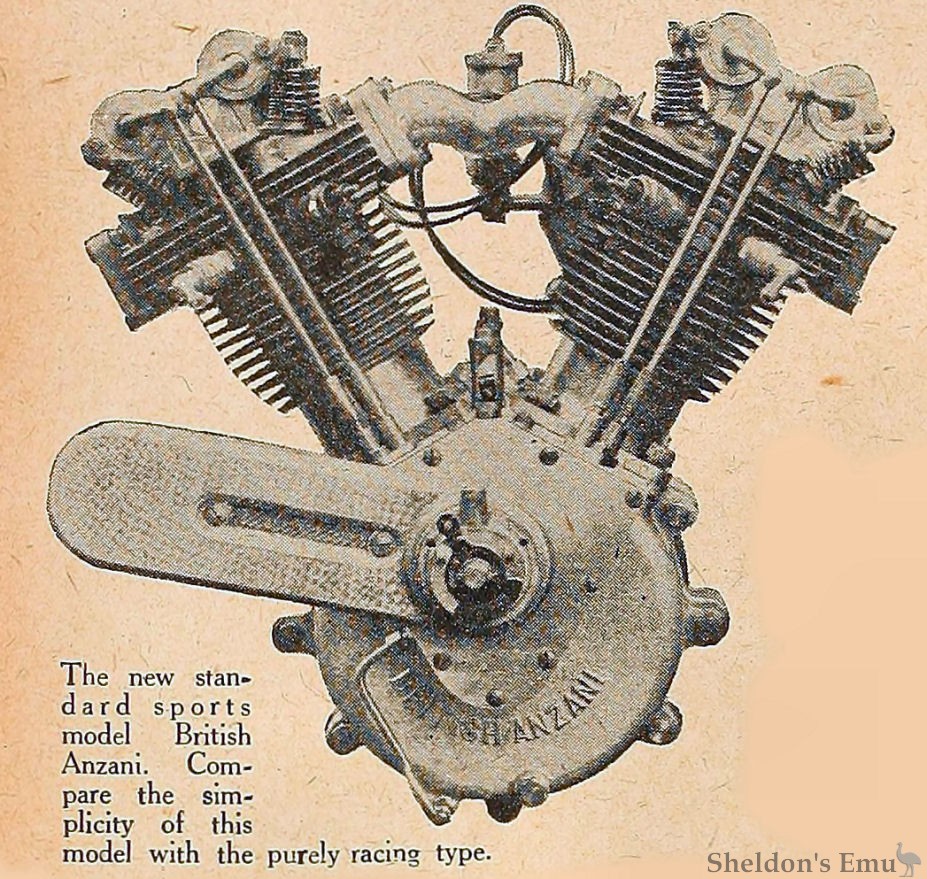
The new standard sports model British Anzani. Compare the simplicity of this model with the purely racing type.
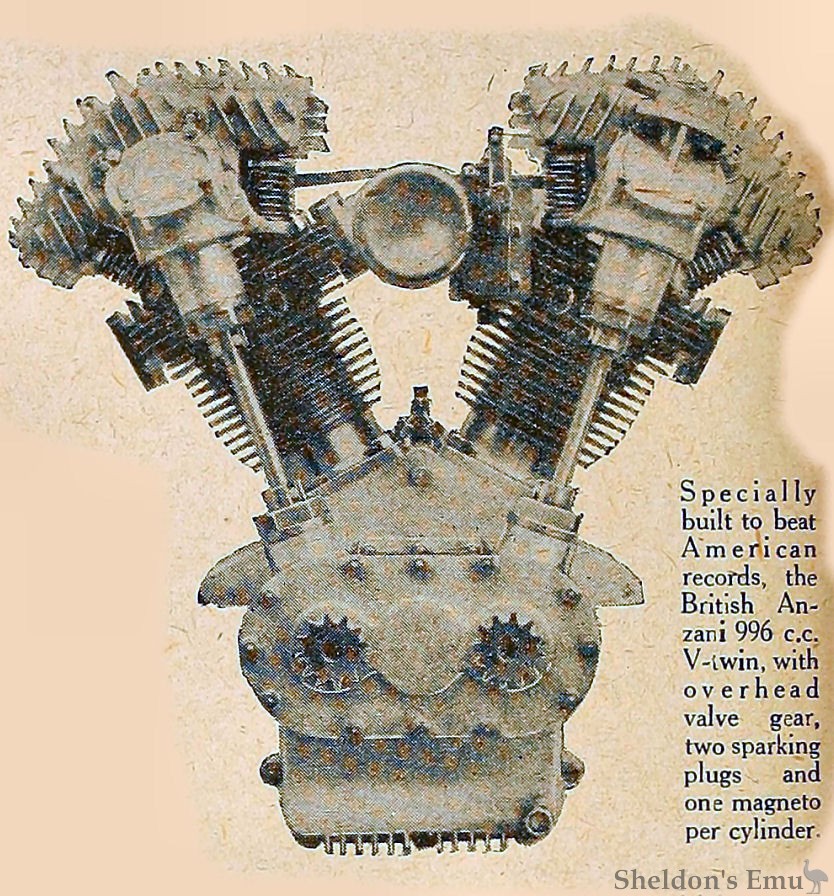
Specially built to beat American records, the British Anzani 996 c.c. V-twin with overhead valve gear, two sparking plugs and one magneto per cylinder.
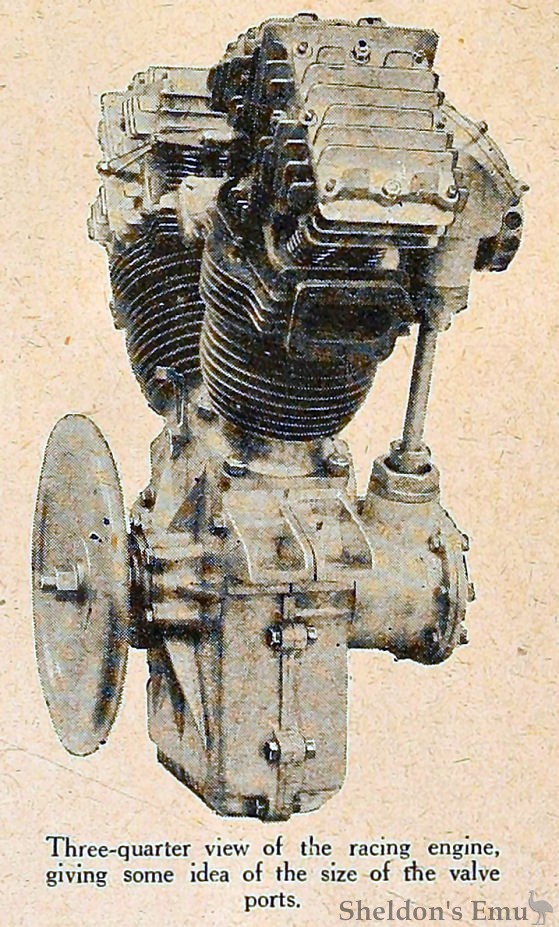
Three-quarter view of the racing engine, giving some idea of the size of the valve ports.
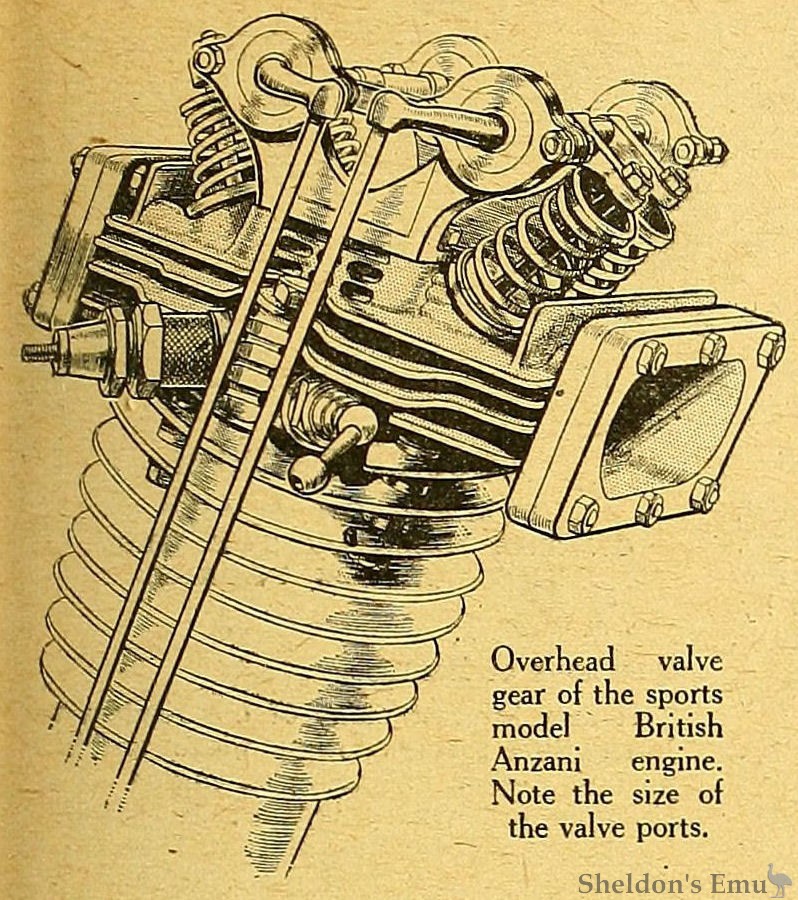
Overhead valve gear of the sports model British Anzani engine. Note the size of the valve ports.
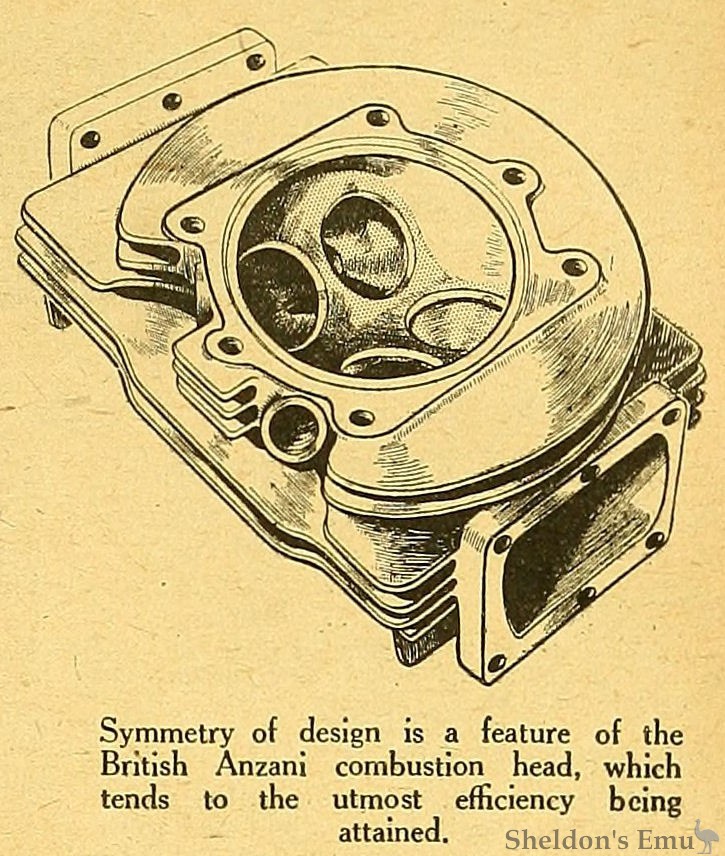
Symmetry of design is a feature of the British Anzani combustion head, which tends to the utmost efficiency being attained.
A British Anzani V-twin, built to attack the 1,000 c.c. Records, and a Standard Sports Engine on Similar Lines.
SPECIALLY built to win for England the high speed records at present held by America, the British Anzani racing engine (83x92 mm. = 996 c.c.) is a unit which promises to give an excellent account of itself as soon as it is ready for the track.
There are four valves in each cylinder, and these are actuated by means of a special cam gear in an oil-tight heavily ribbed aluminium case situated above the cylinder heads, each pair of camshafts being driven by two vertical shafts and bevel gearing. Universal joints of the pin type are provided at each end of these driving shafts.
In the case of the right-hand cylinder a Best mechanical oil pump is situated horizontally over the bevel gear camshaft driving case.
Aluminium Bronze Cylinder Heads.
In the racing engine aluminium bronze is the material used for the cylinder head, which is carefully machined internally, and is provided with ports of enormous size. Particular attention has been given to lubrication, oil being delivered by the Best pump to the oil-tight overhead valve gear case and to a Y-shaped union between the cylinders. The big ends and roller main bearings are lubricated by splash.
Side thrust on the valve stems has been eliminated by the insertion of a small separate tappet rod to take the thrust. Each valve gear casing is provided with an internal exhaust valve lifter, while each cylinder has two plugs fired by its own double-spark magneto.
An induction pipe of large size is bolted on to the cylinders and attached to it is a triple venturi tube Zenith carburetter of large dimensions. An external flywheel is employed. Altogether the engine is a very fine piece of design, and should be highly efficient.
This engine, it is claimed, has already developed 46 h.p. at 4,000 r.p.m., but even better results are expected.
A Standard Sports Model.
Of the same dimensions as the engine just described, the 8-10 h.p. sports model is built on somewhat similar lines to the special racing engine, but is a commercial proposition.
On each head there is a bracket supporting the rocker shafts, which run on ball bearings packed with grease; like the racing engine it has four inclined valves to each cylinder. Adjustment for the tappet clearance is provided, but the rods actuating the valve gear are not adjustable. The detachable heads, which are of the same design as those fitted to the racing engine, are in this case of cast iron, the valves opening into common ports, but being fitted with a baffle in between the two.
Differing from the racing model, which has a large ribbed sump at the bottom of the crank case, no oil is carried in the crank case of the sports engine, oil being delivered by a Best mechanical lubrication pump from the oil compartment in the main tank to the Y-connection between the two cylinders. This oil pump is situated on the magneto chain case. There is only surplus oil in the crank case, the Y-pipe delivering lubricant to a space round baffles on the top of the crank case, whence it is picked up by the piston, the moving parts being lubricated by oil mist.
Aluminium Pistons.
Die cast aluminium pistons fitted with a scraper ring and strengthened by internal ribs are employed, while there is a groove below the third ring which is drilled to prevent oil reaching the combustion chamber. The gudgeon pins are a driving fit in the pistons, the cylinder walls being protected by brass pads.
The main shaft runs on ball bearings, while the big ends are an interesting piece of design. The forked big end is strengthened by means of a strap at its base preventing the fork from splaying, and quadruple roller bearings are employed - two for each bearing.
Reverting to the lubrication system, there is a deflector plate at the base of the crank case which forces the oil through a lug in the crank case base, up a short pipe into the timing case. Here it is picked up by a thrower ring and distributed over the timing gears.
So far as bearings are concerned, practically the same arrangement for the cam rockers is adopted as on the connecting rods, one of these being forked, a long bush being used, the centre rocker running on the centre of the» bush and the forked rocker bearing running on the outside of the bush. The point of contact with the cam is provided with a single Hoffmann roller, these rollers being kept in by shroud plates adjacent to the cams, and they should go far towards reducing friction.
We are naturally looking forward to seeing the performances of these engines on the road and track. From the ingenuity displayed in their design and the excellence of the workmanship, they will, no doubt, give an excellent account of themselves. These engines are manufactured by the British Anzani Engine Co., Ltd., Anzani Works, 30 Scrubbs Lane, Willesden, London, N.W.10.
The Motor Cycle, March 30th, 1922, Page 402