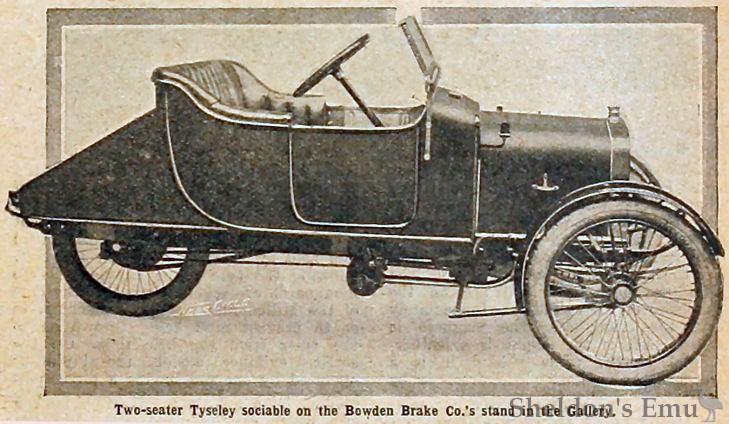


TYSELEY TRICAR, No. 290.
The Bowden Brake Co., Ltd., Tyseley, Birmingham. – This machine is driven by an 8 h.p. engine, with V-type cylinders set at 60°. It has mechanically operated valves. The magneto is accessibly placed in front and driven by a short shaft off the timing gear. Gas is supplied by a Zenith carburetter. The engine and gear box are of the unit system. The gears work on the sliding principle, giving two speeds and reverse. The clutch is of the multiple disc type. Behind the gear box is a short cardan-shaft universally jointed at each end, and behind this is a bevel drive, whence power is transmitted to the wheel by means of a single chain. The control is arranged on car lines; an accelerator pedal is provided with two notches, the first allowing the throttle to be opened enough for starting and slow running. The body is coach-built and provided with high side door. The radiator is in front, following car lines. A runabout is also manufactured with four wheels and worm transmission.
1911 Olympia Show - The Motor Cycle November 23rd, 1911.
Tyseley The fact that the Tyseley runabout is manufactured by the Bowden Brake Co. Ltd. (Tyseley, near Birmingham) is a good augury for its practicability. It was perhaps the most car-like of all its class. Indeed, a balanced geared back axle was shown for use in a similar vehicle but running on four wheels, and no one would think of calling this anything but a motor-car. A two-cylinder V type water-cooled engine of 8.4 h.p., according to the R.A.C. rating, was mounted under a bonnet and behind the radiator. The Bosch magneto and forced lubrication were quite on carlines. A plate clutch conveyed the motion at either of two speeds to a short cardan shaft and thence by bevel gearing to a chain running to the rear wheel. The frame was of pressed steel mounted on laminated springs fore and aft. The wheels were wire-spoked and the front ones were set well forward, so as to get extra weight on the rear one for driving. The control was effected by a three-notch accelerator pedal. A comfortable high-sided, two-seater body was carried amidships, and the steering was, of course, by wheel, The brakes were both expanding bands on the rear wheel. [We] understand good business was done with the Tyseley, the price being distinctly moderate.
C.T.C. Gazette, January 1912.