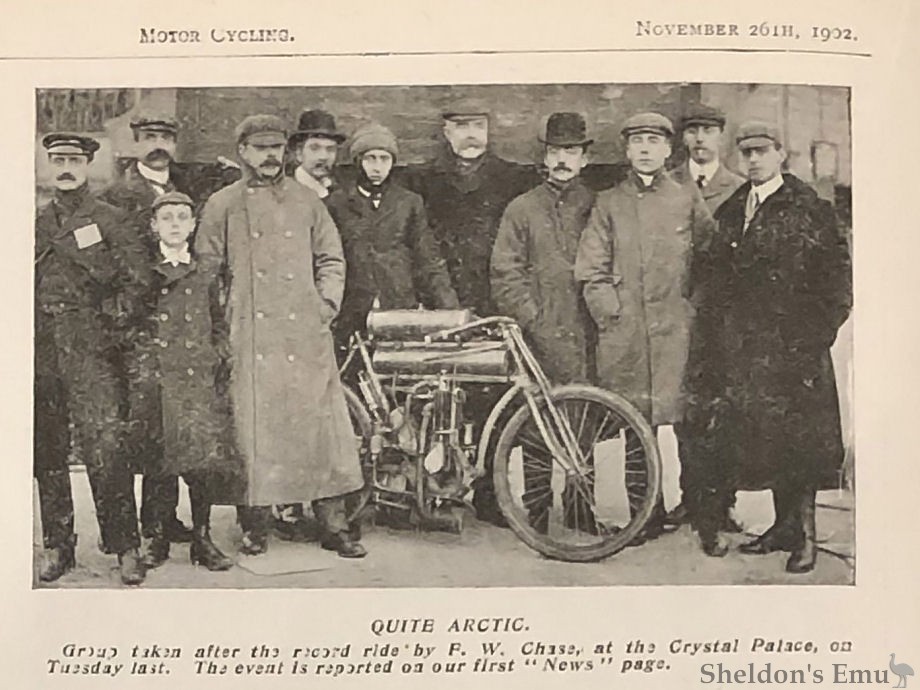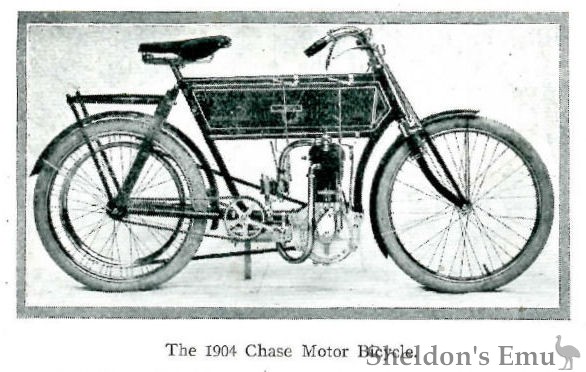
Chase motorcycles were produced from 1903 to 1906 by successful bicycle racing brothers, A. A. and F. W. Chase of Anerley, London.
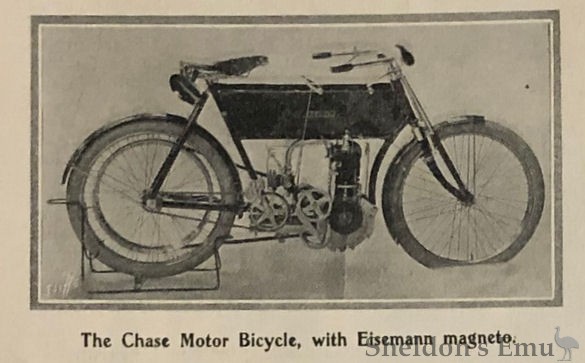
1904 Power increased to 4hp, and they added magneto ignition to some machines. They also offered a forecar with air scoops to aid engine cooling.
In 1905 a racing model with a 6hp engine was listed, along with a 7hp twin-cylinder forecar with fan cooling.
1906 was their last year of production.
Report from the Stanley Show 1902
The Chase Cycle Co., Birmingham, show a motorcycle, 2.25 horse-power, fitted in a vertical position, within a loop of the frame, of which one side forms the double top bar, and the other joins the loop for motor. Automatic petrol regulator and carburetter, one lever control for exhaust valve and advance sparking. The engine is placed in front of bracket to ensure a long belt drive, and an outer ball-bearing on the driving pulley is provided, which prevents straining of the crank shaft.
Motor Cycling, 26th November 1902
Chase Motor Cycles.
The speciality of the Chase Motor Co. is the constructing of a well-designed series of machines, to which practically any type or make of engine maybe fitted, and examples are shown on Stand 103 fitted with 2¾ h.p. and 3½ h.p. M.M.C. engines as well as that beautifully made engine, the 3 h.p. Ariel. The identical machine which Mr. F. W. Chase rode so successfully through the 1,000 miles motor cycle reliability trials is also shown. The exhibit as a whole deserves attention. (Stand 103.)
Among other novelties Chase Motors, Ltd., are exhibiting one of their excellent motor bicycles fitted with the Eisemann high-tension ignition. The dynamo is driven by means of two spur wheels on the engineshaft, one of which is constructed of fibre. The Chase forecar, which is shown fitted with two capacious toolbags and a pair of voiturette acetylene lamps, presents a very handsome appearance.
Report on the 1904 Crystal Palace Show
Chase Motors, Ltd., Anerley, S.E. (Stand 141).–
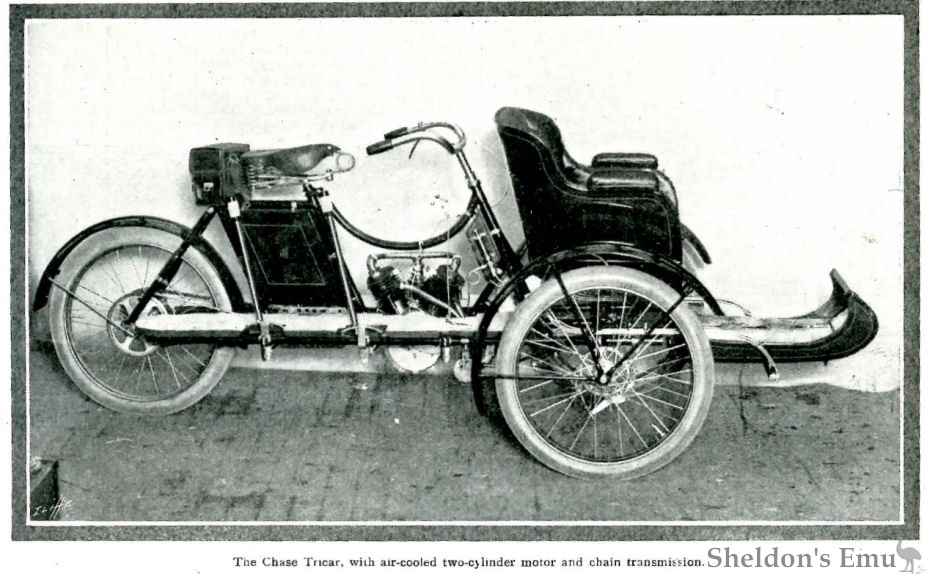
(The fan-cooling mentioned in the text is not visible)
Several types of the Chase motor bicycle from the 2¾ h.p. touring machines to the 6 h.p. single-cylinder racing machine are to be seen here. All these are fitted with a new pattern of Longuemare carburetter. The engine is carried well forward in the frame, giving the advantage of a long belt drive, and consequent efficient transmission. Most of the machines shown are fitted with high tension ignition, and one is to be seen fitted with the Simms-Bosch high tension magneto ignition. The special feature of these machines is the backpedaling brake, a well constructed and simple piece of mechanism acting upon the interior of the belt rim. The machine still retains its distinctive appearance.
A very fine tricar is exhibited with a two-cylinder air-cooled 7 h.p. motor. Air-cooling is assisted by means of a fan, which directs a strong current of air on to the heads of both cylinders. The carburetter here is also of the latest type of Longuemare. The transmission is by means of an Oppermann three-speed gear, which is described elsewhere in this report. The change speed gear is operated by means of a lever placed on the right of the driver, where is also found a lever actuating a band on a large diameter drum on the back wheel hub. Both front wheels are fitted with band brakes, these being applied by a foot lever on the left of the driver, the right-hand pedal operating the friction clutch. The machine is well designed throughout, and bears evidence of good workmanship, and its appearance is distinctly pleasing.
Report on the 1904 Stanley Show, The Motor Cycle, November 28th.
A correspondent writes:
The Chase brothers were leading bicycle racers of the day who built a limited
number of motorcycles using Minerva, MMC and Precision engines.
Source: Graces Guide
If you have further information or a query related to this page, please contact us.