There appear to be two different firms, some 2½ miles apart.
Forward Cycle Co of Edmund Street, Birmingham, builder of Forward motorcycles
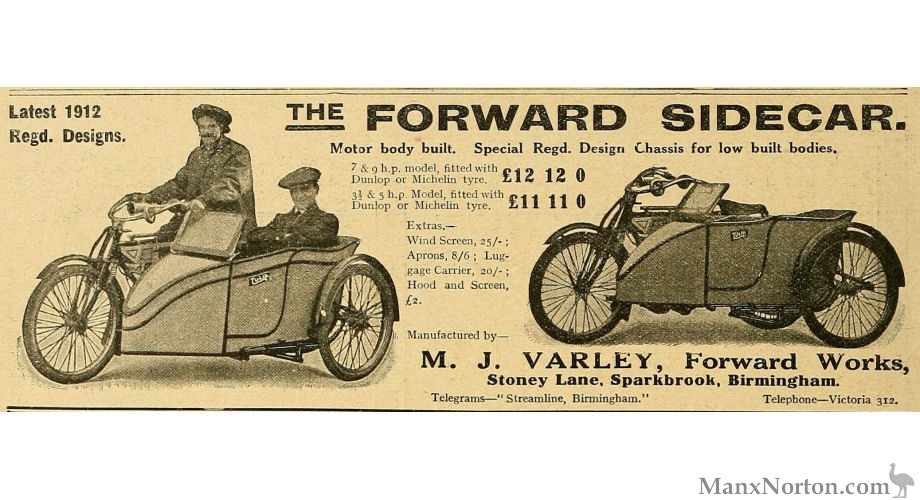
M.J. Varley, Forward Works, Stoney Lane, Sparkbrook Birmingham, builder of Forward sidecars from about 1911.
Forward Cycle Co of Edmund Street, Birmingham
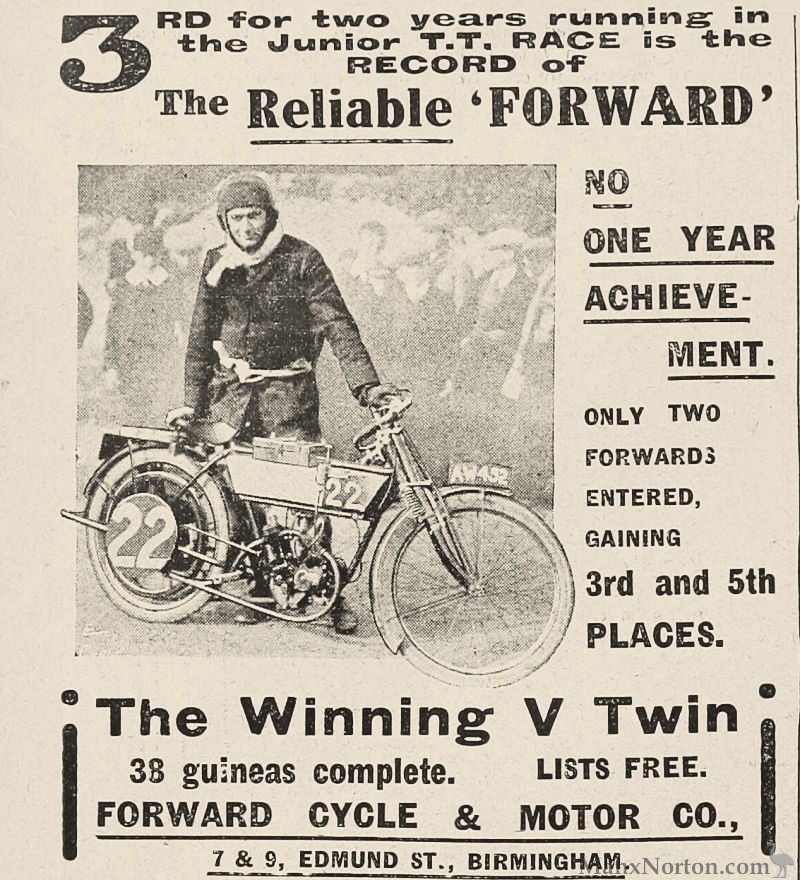
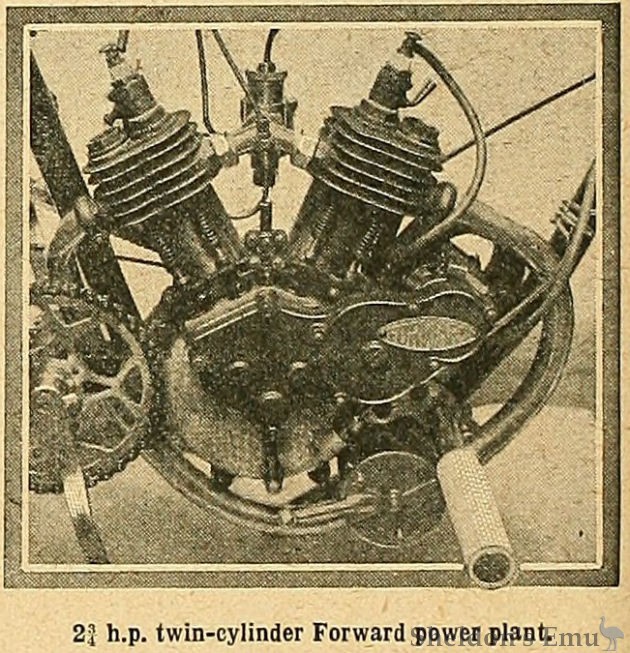
1911 - This bicycle firm moved into the motorcycle trade with a 2¾ hp model powered by a 345cc V-twin engine with a basic specification that was typical of the era. There was success in the Junior TT that year, when Harold Cox finished third and was the first private owner home.
Built their own V-twins of 339cc and 479cc
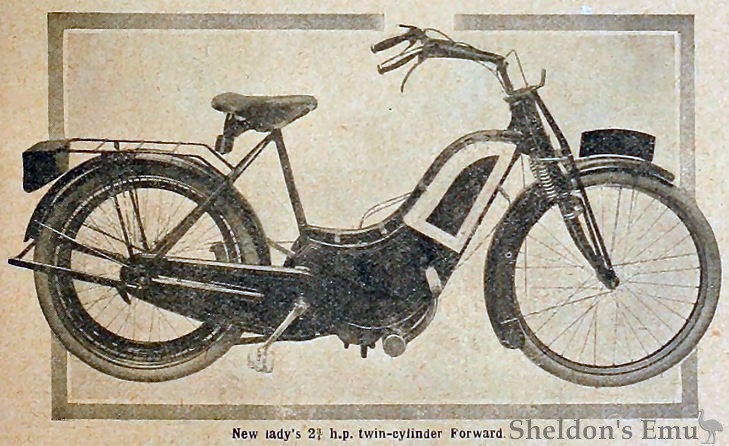
1912 - Cox repeated his success by coming third once again and P. W. Owen rode a second machine into fifth place. A ladies' model was offered that year.
1913 - Three machines were entered in the TT, but all retired early.
1914 - A larger, 3½ hp V-twin was added.
1915 - Production of the range continued for that year and then ceased.
A New Sidecar Stand.
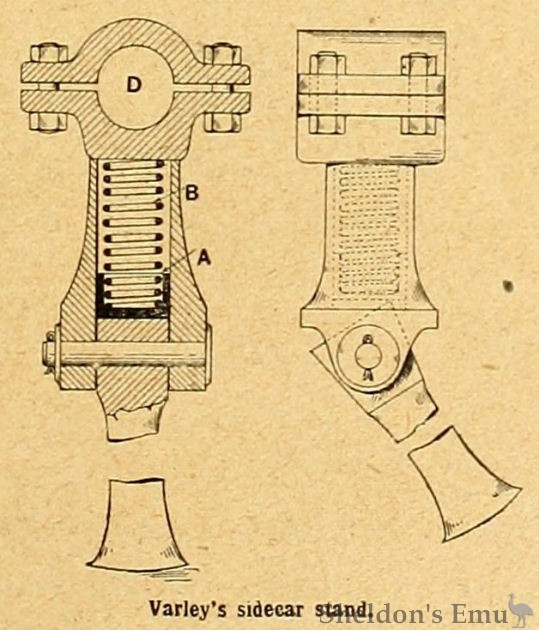
Mr. J. Varley. 57, Stoney Lane, Sparkbrook, Birmingham, has sent us particulars of a sidecar stand which we illustrate. The stand is clipped to the sidecar axle and is put into operation by placing one foot against the leg of the stand at the same time pulling the sidecar back. It will be noticed on reference to the illustration that the top of the stand is provided with a spring and plunger. When the sidecar is supported by the leg it inclines at an angle of seven degrees, thus making a support, and when out of use the spring prevents any possible chance of the leg falling. It will be exhibited on the Calthorpe stand at Olympia, as will the Forward sidecar which will be fitted with a canopy hood, luggage carrier, tyre carrier, petrol carrier, and refinements in the way of toolboxes, etc.
1911 Olympia Show - The Motor Cycle November 2nd, 1911. Page 1157
Forward.
The 1912 twin 2¾ h.p. Forward will have several minor improvements. Instead of having a dropped top tube, the whole frame has been lowered and a straight top tube is employed. The tank, which has been redesigned and made considerably neater, is now carried on two lugs brazed solid to the lower tube. The inlet pipe has a more direct How than previously, and the Amac carburetter is employed. The machine will be fitted with a larger saddle (Brooks 130 size 3) and the wheels are shod with 26in. x 2in. square tread rubber studded tyres. A ladies' model (which we illustrated) will also be shown for the first time at Olympia.
With reference to the paragraph in a recent issue respecting the Enfield Cycle Co.'s gear, the firm is not selling the lightweight two-speed and free engine device, but is willing to supply the heavier type of Enfield two-speed and free engine gear suitable for machines up to 8 h.p.
1911 Olympia Show - The Motor Cycle November 9th, 1911. Page 1181
FORWARD, No. 95.
The Forward Cycle and Motor Co., Edmund Street, Birmingham. – This is a particularly neat-looking lightweight, which follows standard lines throughout. We may mention that the magneto is handle-bar controlled, and the machine is well equipped, Druid spring fork, a wood saddle, stand, luggage carrier, toolbag, and reflex light being fitted.
The mechanical features of the lady's model are the same as the above, but the chief point about the machine is the particularly neat way in which its working parts are enclosed. The petrol tank is carried in the top portion of the loop frame. The engine is entirely protected by a shield, the front and rear portions of which are open, and so designed that a strong draught of air impinges on the cylinders. The pedalling chain is carried in a gear case, and a proper skirt-guard is fitted over the rear wheel. This is one of the most neatly designed ladies' motor bicycles we have yet seen. Another gentleman's model shown is fitted with the Armstrong three-speed hub.
1911 Olympia Show - The Motor Cycle November 23rd, 1911. Page 1269
M. G. Varley, Sparkbrook, Birmingham.
Eight different models of the Forward sidecar. The latest pattern is provided with a step at the side, and an apron of Cape cart hood material, which is fastened by means of spring fasteners.
Another model has a special frame made to support a suit case behind, and at the side of this there is a subsidiary frame carrying a specially constructed spare petrol can. On the luggage grid there are springs to prevent the box from rattling. A further model is provided with an efficient double folding wind screen, whilst the type illustrated on page 1316 of our issue of November 14th is also exhibited. Yet another model is provided with a screen and hood.
Sources: Graces Guide, The Motor Cycle