W. King and Co of Bridge Street Cambridge produced motorcycles from 1901 to 1905.
1901 The firm initially produced tricycles but soon moved to motorcycles.
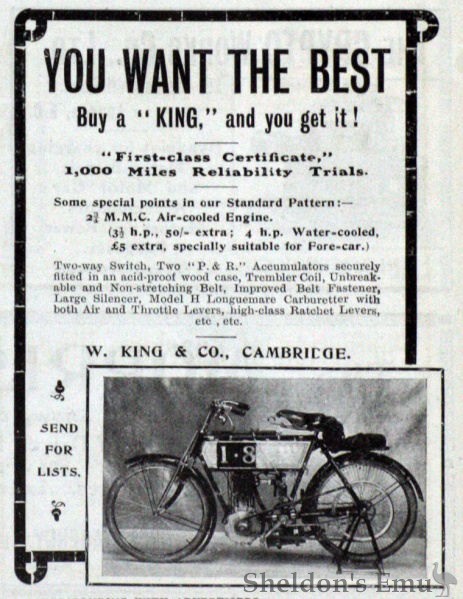
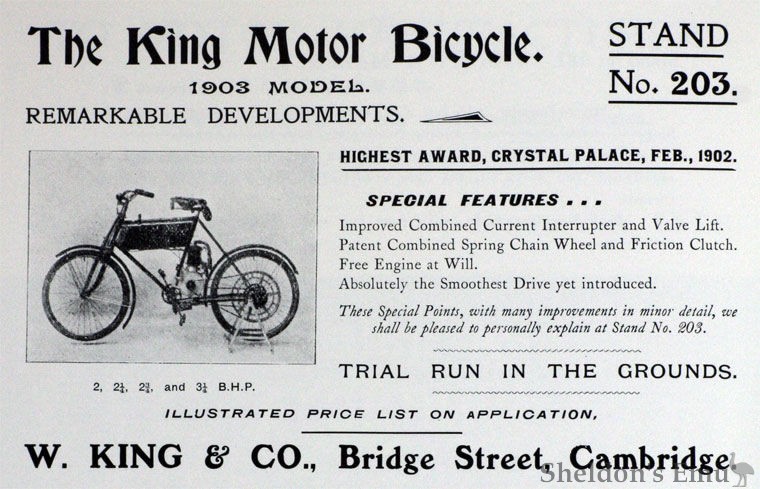
1903 They built a model that was a typical primitive. It had a 2¾ hp MMC engine mounted vertically, driving the rear wheel by belt. They also offered the option of 3½ hp or 4hp water-cooled engines.
1904 The engines for that year were 2¾ hp to 3½ hp from either Daw or MMC. Direct-belt drive or two speed and chain were available, and a forecar was listed.
1905 The company was short lived and nothing further was heard of it after that year.
Reports from the 1903 Stanley Show:
W. King and Co., Cambridge,
will exhibit six machines. All King machines are fitted with M.M.C. and Daw motors from 2¾ to 3½ h.p., and two P. and R. accumulators connected with a two-way switch. The accumulators are neatly and securely fitted in an acid-proof wood case, breaking and short circuiting being impossible. To ensure a perfect and sufficient supply of gas the 4 h.p. Longumare carburetters are fitted both with air and throttle levers, also a very large and effective silencer. Powerful back-pedalling and front rim brakes are provided. The transmission is by means of a very strong V belt, but a chain drive with a two-speed gear can be fitted to order. Bassee and Michel large contact breaker, and a trembler coil are fitted. The forecars supplied to suit are of the very latest design.
The Motor Cycle, November 18th 1903
Stanley Show 1903
The Cambridge firm has a good display of the King motor cycles, one of which was entered in the 1,000 miles trial, and was, greatly to its credit, awarded first-class certificates by the Auto Cycle Club judges. A fine motor bicycle, specially built for Mr. E. J. Watson, is shown with a water-cooled Daw engine, the radiator being fitted in a curved form in front of the starting socket. All the other machines on the stand are driven by M.M.C. engines both air and water cooled—the latest pattern forecarriage having the radiator on the left side of the basket seat. One machine is shown with pedal footrests bolted to the front portion of the crank chamber of the engine. These should afford a convenient change of position to those who are inconvenienced by the usual fore and aft pedal rest. (Stand 113.)
The Motor Cycle, 25th November 1903
Stanley Show 1903
King and Co., Cambridge
(Stand 98).–
Three motor bicycles and two trailers are exhibited here. The centre of the stand is devoted to the motor bicycle with which the firm won the Brown trophy and the 1,000 miles trial. Even without this, one would see from the machines how thoroughly practical and substantial they are. Plenty of power is one of the firm's mottoes, and the motors are in no case less than 3¾ h.p. They are fitted with either mechanically operated or automatic inlet valves, and Brown and Barlow's spray carburetters. The tanks contain all the usual components, and the oil and petrol reservoirs are fitted with glass gauges. The batteries are arranged between the liquid compartments, and have wooden linings to prevent short circuiting. The silencers are of special construction, and should be worthy of their name. Back pedalling hub brakes are employed, but they are fortunately free from the usual objection of preventing the machine being wheeled backwards. 2¼ in. tyres are fitted as standard pattern. The simpler of the two tricars is of the same general construction as the standard pattern motor bicycle, but the frame is sprung in front.
The larger tricar is fitted with a two-cylinder motor having the crankshaft arranged transversely to the machine. Water-cooling is employed, and the combined tank and radiators are secured to the frame in front of the engine. On the motorshaft is mounted a two-speed gear of the epicyclic type, also the clutch. The power is transmitted through one chain to a countershaft in the bottom bracket, and thence by a second chain to the back wheel. The machine was not quite complete at the time of the exhibition, but it is to be fitted with two levers of the car type for actuating the back brake and two speed gear. The lubricator has a transparent body, and instead of the usual type is fitted with two automatic valves, so that when the plunger is lifted the lubricator fills from the tanks, and on depressing the plunger the oil is forced through the pipe into the crank case. The frame is of the open type, and is sprung in front. The back seat is of the bucket variety, and is carried on double elliptical springs. The machine certainly looks both powerful and comfortable.
Report on the 1904 Stanley Show, The Motor Cycle, November 28th, page 1161
Sources: Graces Guide, The Motor magazine, The Motor Cycle.
If you have further information or a query related to this page, please contact us.