

Wincycle Trading Co of Great Saffron Hill, London.
1910 The first machine was listed using a 3½ hp Precision engine, B and B carburettor, belt drive and Druid forks.
1910 Stanley Show Report
The Wincycle Trading Co. London.
This exhibit will consist of one 3 H.P. motor-cycle, which will he sold under the name of the "Win" motor-cycle. The specification is as follows—Precision engine, mechanically-operated inlet valves, Brown and Barlow carburetter, 7/8 in. belt transmission, fitted with stand and carrier, spring forks, Dunlop tyres, Brooks saddle, the list price being £45 10s.
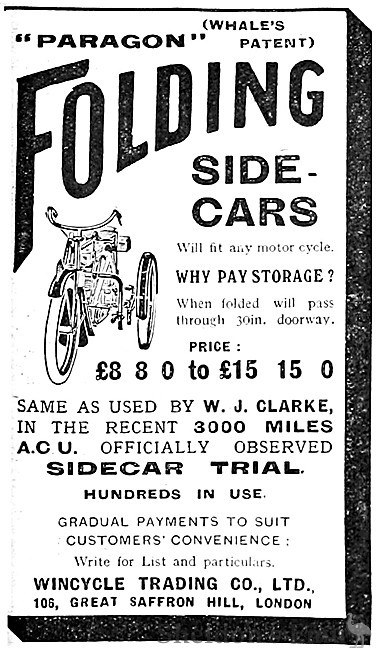
1912 "The Wincycle Trading Company, Ltd., of London, will exhibit the new Paragon folding side-car to overcome the storage difficulty." ~ The Clarion, Friday 22 November 1912
1913 They added 2½ hp and 4¼ hp models, still using Precision engines.
1914 The range reduced to 499cc 3¾ hp and 599cc 4¼ hp machines, with Precision engines.
1922 Wincycle presented the Paragon Folding Sidecar at the 1922 Olympia Show held in November. The following appeared in The Motor Cycle July 6th, 1922:
The advertisement above appeared numerous times in July to December 1922.
Paragon of Essex built motorcycles until 1921/1922. There is no evidence that they built the Paragon sidecars.
Win-Precision.
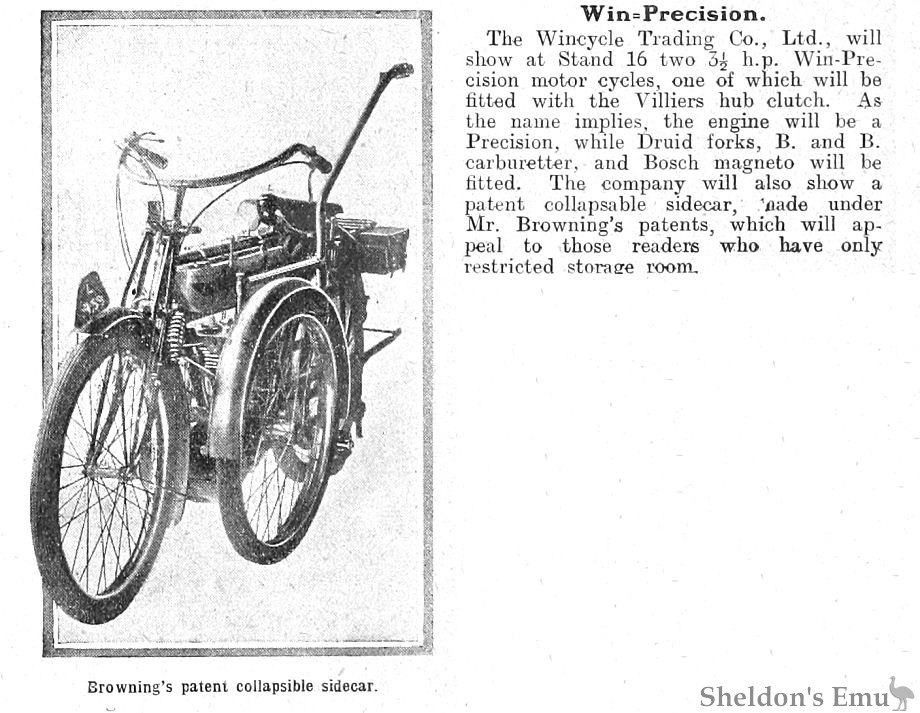
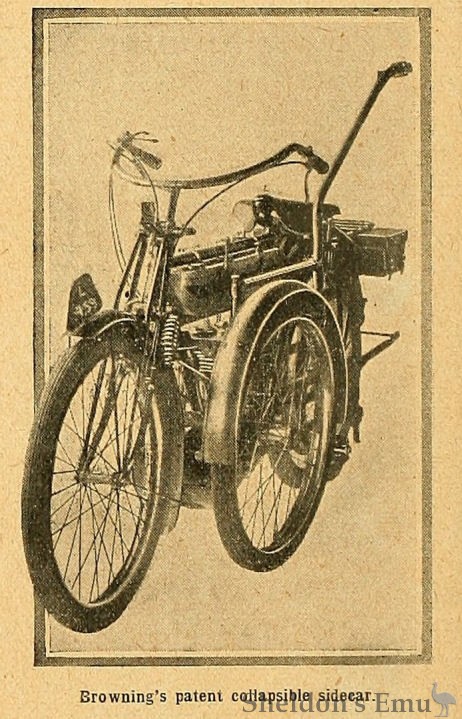
The Wincycle Trading Co., Ltd., will show at Stand 16 two 3½ h.p. Win-Precision motor cycles, one of which will be fitted with the Villiers hub clutch. As the name implies, the engine will be a Precision, while Druid forks, B. and B. carburetter, and Bosch magneto will be fitted. The company will also show a patent collapsible sidecar, made under Mr. Browning's patents, which will appeal to those readers who have only restricted storage room.
1911 Olympia Show - The Motor Cycle November 16th, 1911. Page 1215
WIN-PRECISION, No. 16.
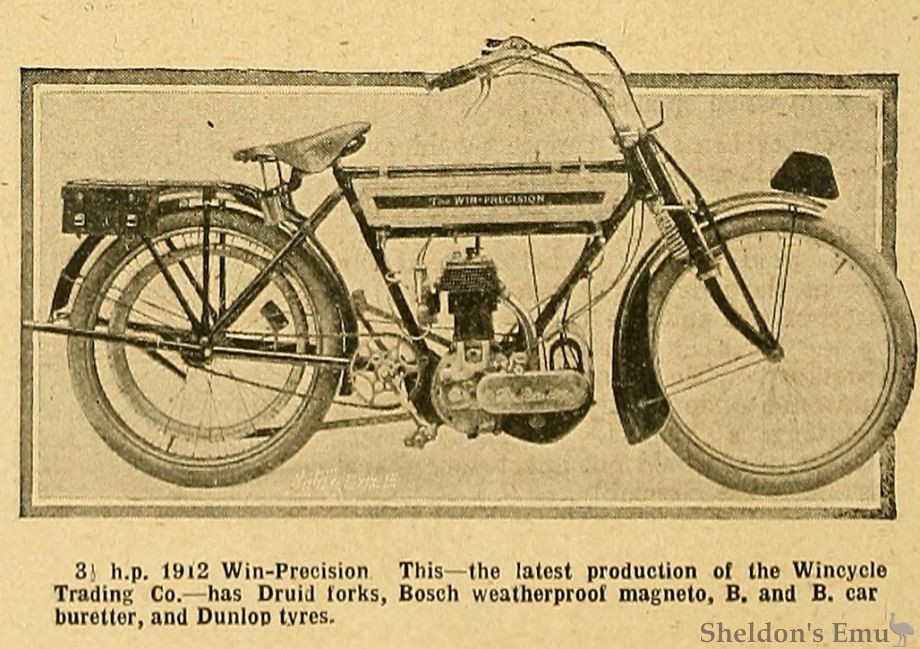
3½ h.p. 1912 Win-Precision. This - the latest production of the Wincycle Trading Co. - has Druid forks, Bosch weatherproof magneto, B. and B. carburetter, and Dunlop tyres.
The Wincycle Trading Co., Ltd., 106 and 107, Great Saffron Hill, London E.C. – Two models of the Win-Precision motor cycle are shown – one of the fixed engine type, the other with two-speed and still a third, to which the Armstrong gear can be fitted at option. The frame and fittings are on standard lines throughout. A straight top tube is used, Druid forks, mud flaps on the front wheel, and a large shield is fitted over the Bosch magneto which lies in front of the engine. An ingenious foot-board is being shown which can be attached to the footrest quite simply. The rear end is suspended either by cable or a system of links and springs. The chief object of this idea is that if It becomes necessary to use pedals, the boards may be lifted up with the toe, and will remain in a vertical position until they are required. The Browning folding sidecar is also an item of interest. To detach the sidecar it is only necessary to undo two locks under the foot of the sidecar body, and the latter with the springs still attached can be slid forward and lifted off. when it can be hung on the back of the machine or moved to a convenient spot. One of the front corners of the frame is then detached by loosening a spring, clip attached to the front down tube of the cycle, and the front bar of the sidecar is then swung backwards and upwards on the rear bar until the sidecar frame has the appearance of a gate at right angles to the machine. The next movement swings the sidecar frame round on to a vertical pivot on the rear of the machine until it lies parallel against it. The wheel of the sidecar is then allowed to swing freely when it lies close and flat against the machine. When detached and folded the sidecar has a width of 7in., so that the machine can be wheeled through a doorway like a motor bicycle.
1911 Olympia Show - The Motor Cycle November 23rd, 1911. Page 1269
Source: Graces Guide