Debenham Sisters
Betty and Nancy Debenham, with their dog, Poncho, were keen motorcyclists. Nancy won a Gold Medal at Brooklands in 1926.
The Debenham Sisters

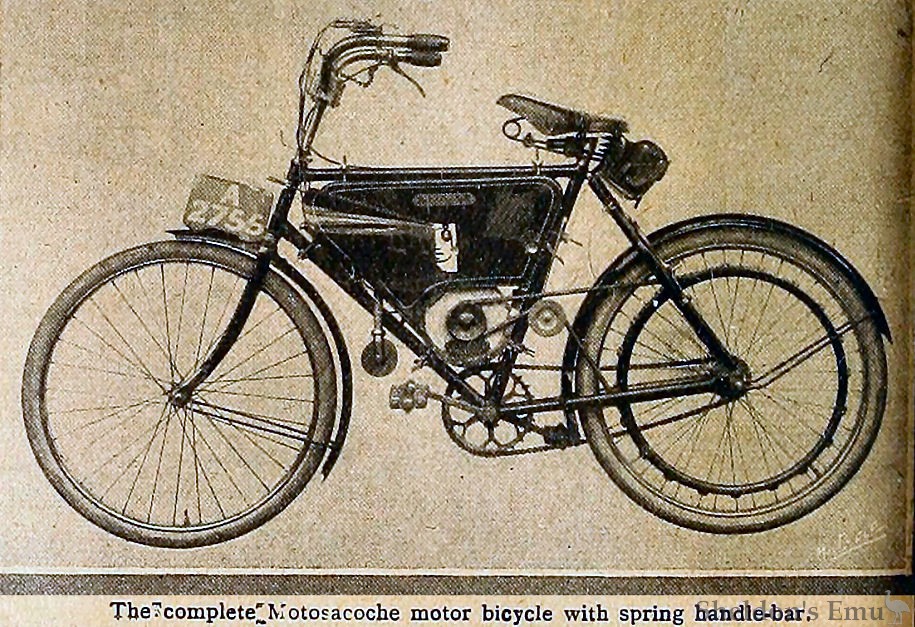
The complete Motosacoche motor bicycle with spring handle-bar.
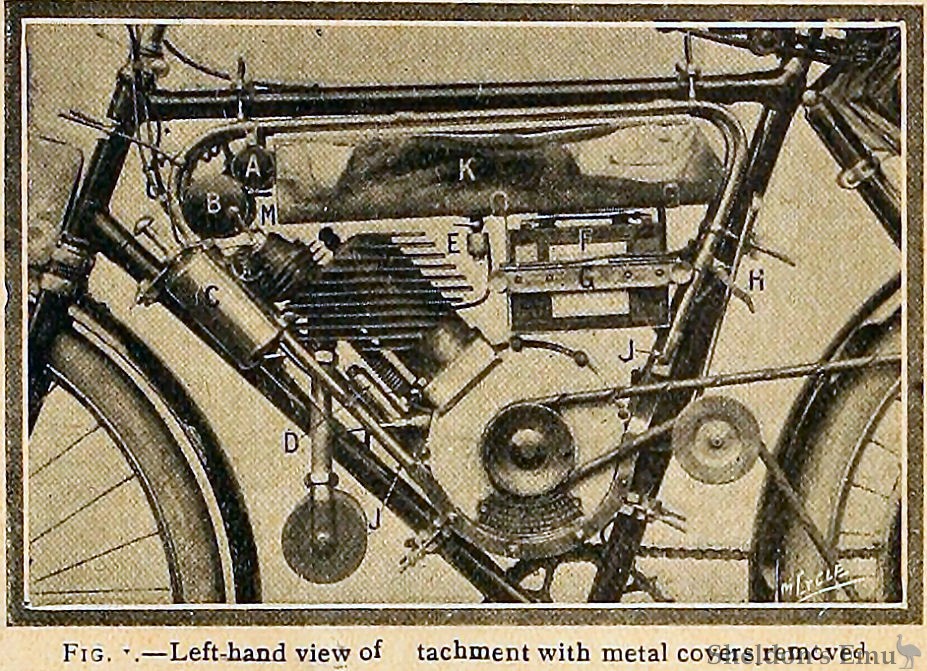
Fig. 1. Left-hand view of attachment with metal covers removed.
A FEW weeks ago we inserted a short paragraph describing our experiences with the Motosacoche motor bicycle which had been sent us for trial by Messrs. H. and A. Dufaux, 65, Holborn Viaduct, E.C. At the time we promised to give our readers a few particulars of the details in connection with the design, more particularly those which differed from standard practice. Owing to pressure on our office, these particulars have been crowded out of the first two issues, and will now be read with considerable interest by those who contemplate the purchase of one these lightweight machines.
Reference to the illustration (fig. 1) shows the left-hand side of the machine with the metal cover removed. The principal feature of the Motosacoche is that the engine and all the motor accessories are enclosed within a double tubular frame connected at the points J J by a stamping, to which is bolted the crank chamber of the engine. The whole of the attachment can be fastened by clips to an ordinary bicycle frame, provided there is sufficient clearance at the bottom bracket bridge and back stays. K is the tank, which holds about half a gallon of petrol. E is the petrol cock and filter, the petrol pipe leading therefrom to a special type of carburetter fitted on the right-hand side close up to the inlet valve. This carburetter is similar in outward appearance to a spray carburetter, but in reality it is of the surface type. The body A (fig. 2) is provided with two openings B and C, and within the body A is placed the float chamber with the float E. The petrol enters along the small pipe at the bottom, and passes the conical valve D until the float rises sufficiently to cut of off the supply at about the point F F shown by the dotted line. The petrol passes out at the point K K into an annular space provided at the junction of the float chamber. Air drawn in at C by the suction of the engine along the gas pipe B is drawn over the liquid at points K K, the carburetted mixture passing up the pipe B to the engine. Additional air is drawn in through the hand actuated rotating valve L. When the position of the handle of valve L which gives the best mixture has been found there is seldom any necessity to alter it.
The Ignition.
Owing to the extremely high speed of the engine, it has been found necessary to provide a special form of induction coil B and separate condenser A to reduce the current consumption. These are fitted in the front portion of the frame. From the high-tension terminal of the induction coil a small coil spring M goes to the sparking plug, the end of the spring being simply pushed over the insulated terminal. The method of holding in the batteries is an excellent one. In place of the usual terminals and screws, which always give trouble through corrosion, the Motosacoche battery has flat copper conductors on the side of the battery. These are connected to a bar G, which serves the double purpose of holding the battery firmly and making an attachment for the low-tension wires. The centre of the bar is, of course, insulated in such a manner that the positive and negative conductors are not connected except at the proper period. The oil pump is fitted in the centre of the oil tank C, and a special relief valve is provided at D. The jockey pulley can be raised or lowered by means of the rod, which is kept in place by the trigger H. This latter is provided with a hardened jaw, which bites into the soft metal of the rod, no ratchet teeth being necessary. The handle-bar control is reduced to two levers...
The Motor Cycle February 20th, 1907. Pages 145, 146
N.B. Article abbreviated.