
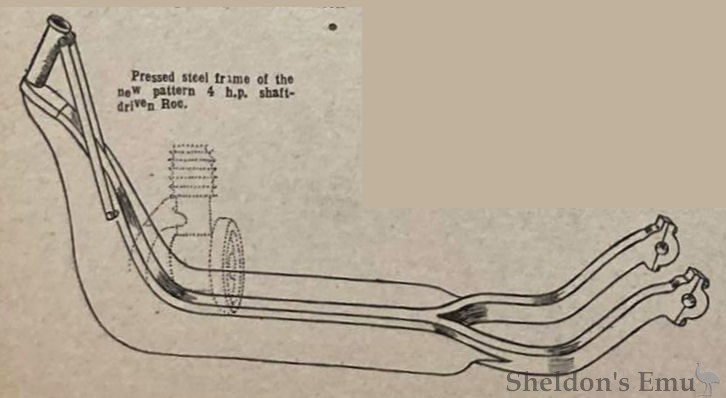
Pressed steel frame of the new pattern 4 h.p. shaft-driven Roc.
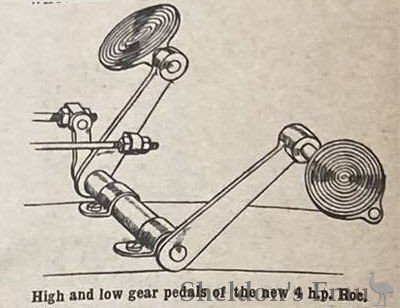
High and low gear pedals of the new 4 h.p. Roc.

Piston and deflector of the Roc two-stroke engine.
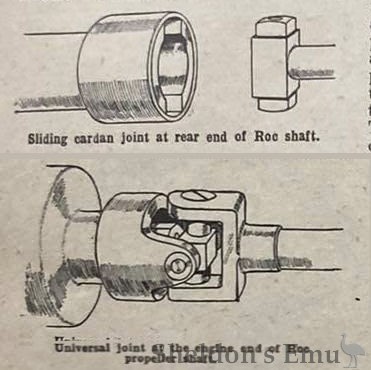
Sliding cardan joint at rear end of Roc shaft. Universal joint at the engine end of Roc propeller shaft.
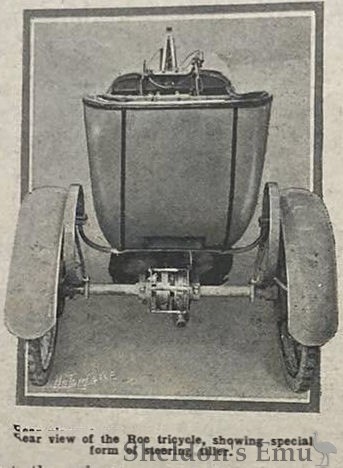
Rear view of the Roc tricycle, showing special form of steering tiller.
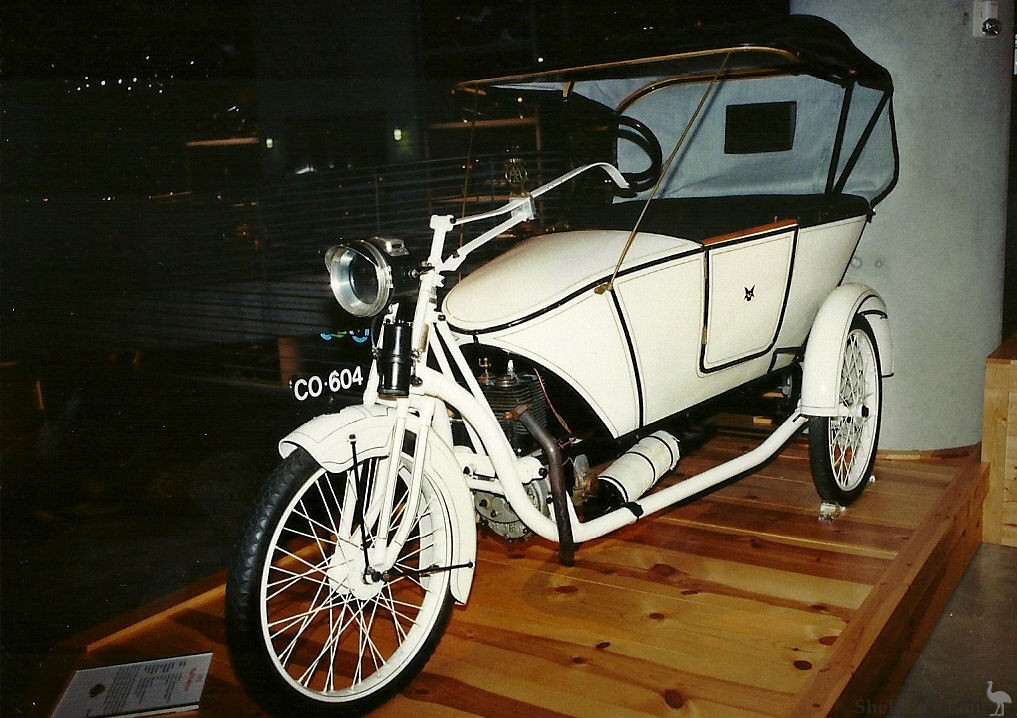
The new pattern Roc open-frame motor bicycle and the newly-designed tricycle were described in our Forecast number of last week. They are commanding a great deal of attention at Olympia, and it must be admitted that the illustrations do not do justice to the machines, for they are particularly handsome looking.
Referring first to the tricycle, which, by the way, has exactly the same chassis and engine unit as the open-frame bicycle with the addition of a back axle, it is steered and controlled by means of a tiller connected directly to the fork top tube. The two-stroke engine is enclosed in the foremost part of the body, the front being cut away to allow the necessary amount of air to pass to keep the engine cool. At the back of the engine there is a mahogany dash, so that the driver is kept perfectly clean in his comfortable surroundings. Nicely curved mudguards of large size are fitted to the rear wheel, and two pedal-operated band brakes are provided. The tank is said to hold sufficient fuel for a 200 miles run. This machine should prove a great attraction to professional men and others who have to be about in all weathers. It is simple in design, and should great require great attention to keep in order. Originality is the outstanding feature of the Roc exhibit.
Referring now to the open frame bicycle, this has the same size of two-stroke engine as the tricycle, with outside flywheel and cardan shaft drive back wheel, in the hub of which is a two-speed gear of new design. A steel frame is used, and the pan seat looks most comfortable on large C springs. The patent Roc spring forks are used, which are claimed to operate in a vertical and horizontal direction are yet devoid of side play. The pedals for operating the two-speed gear are neatly arranged in a convenient position. They are interconnected, so that when the high speed is engaged the low speed is automatically released. Thus it is impossible for a novice to damage the working parts of the gear. A kind of expansion chamber is formed at the exhaust outlet of the cylinder, and two large pipes conduct the burnt gases away. Drip feed lubrication is used. Besides the above machines, there are half a dozen two-speed gear sets (Roc live axle patent) for fitting to standard pattern machines. This gear set has now won its spurs, and is to be seen on a large number of motor cycles.
Six Wall Auto-wheels, which made their first appearance at the Stanley Show last year, are also exhibited in their improved form. Again a two-stroke engine is used, this time with opposed cylinders, having a bore and stroke of 15/8in. The flywheel is placed in a horizontal position, the crankshaft being vertical and below the flywheel. The drive is taken to a spiral gear. giving a reduction of 2½ to 1, and thence to a bevel gear, which drives the bell-shaped drum, to which the rim is spoked through a second reduction of 2½ to 1, the combined reducing gears giving a ratio of 62¼ to 1 from engine to driving wheel.
See also: Wall 1912
If you have further information or a query related to this page, please contact us