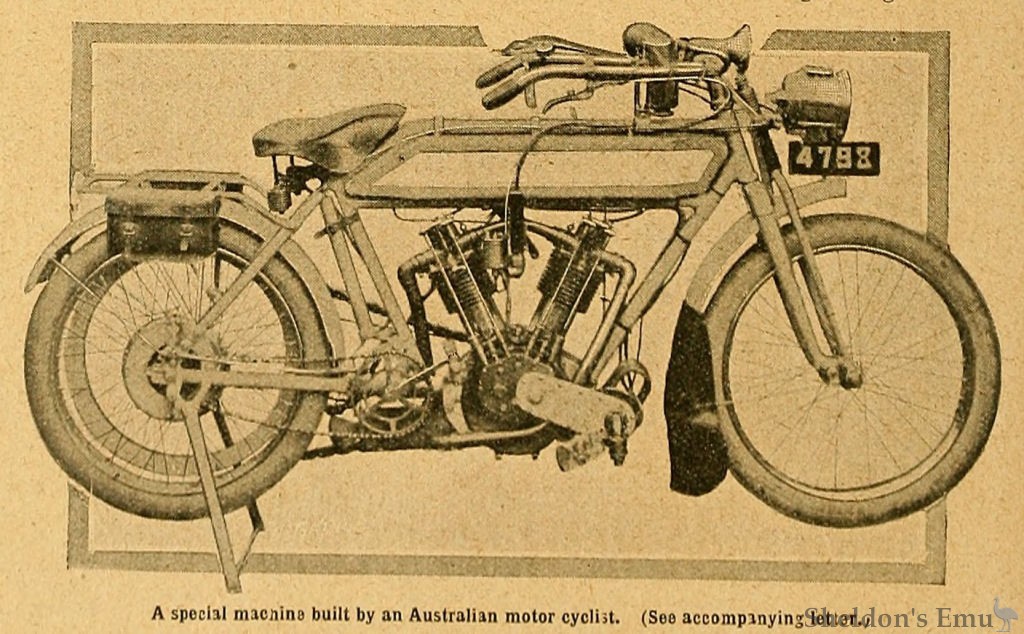


An Australian Engineer's Mount.
Sir, I have been a constant reader of The Motor Cycle for many years, and have always thoroughly enjoyed it. Thinking you would be interestea. I enclose a photo- graph of my new free engine two-speed gear motor cycle, which I have recently completed. In reference to the engine, the cylinders are 3in. bore by 3 ½in. stroke. The radiators are machined out of the solid; the body of cylinders below the radiators is machined and polished. The combustion space is larger than the bore of the cylinder; this allows of large diameter valves. The cylinder heads are detachable, and are secured to the eylinders with six studs. The undersides of the valve heads have 3/16 in. diameter pins projecting.
These work through a spectacle plate which is secured to the detachable heads. If the valve heads break off they cannot fall into the cylinder, as they are caught by the spectacle plate. Up to now these pins and plates have not caused pre-ignition.
The crank case is of gun metal, machined and polished; the flywheels are of cast iron; the crankshaits of cast steel (hollow), lin. diameter; the crank pin cast steel (hollow), 1 1/8 in. diameter, hardened and ground; the main bushes are patent metal; the connecting rods are mild steel, machined out at the sides to form an H section; the big ends have phosphor bronze bearings, and the small end bearings are cast-steel hardened and ground; the gudgeon pins are of mild steel, case-hardened; the levers for working the tappet rods are fitted with rollers running on the cams; the exhaust lifts are so arranged that the back cylinder is cut out first - this is handy for traffic; the magneto is chain-driven; and the chain runs in an oil bath.
The back wheel hub is the same as is fitted to the V.S. machine: this two-speed and free engine gear has given me every satisfaction. I am using a Whittle belt for transmission top gear 3.3 to 1, low gear 6.6 to 1. The machine has two stands (the front one, not shown in the photograph, is just under the magneto), and weighs 2 cwts. My weight is 15 ½ stones.
The tyres were specially made by the Barnet Glass Rubber Co., having square treads ½ in. thick at the centre of the tread, The frame is of Chater Lea parts altered as shown. I designed and built the engine throughout.
In conclusion, I may say that it took me eighteen months to build the compete machine, which was done in spare time in my private workshop.
Wishing The Motor Cycle every success.
Victoria, Australia.
V. E. E. GOTCH.
The Motor Cycle, March 7th 1912
If you have a query or information about this Australian machine please contact us