

De Havilland was a motorcycle produced from 1911 to 1913 at Warwick Row, Coventry.
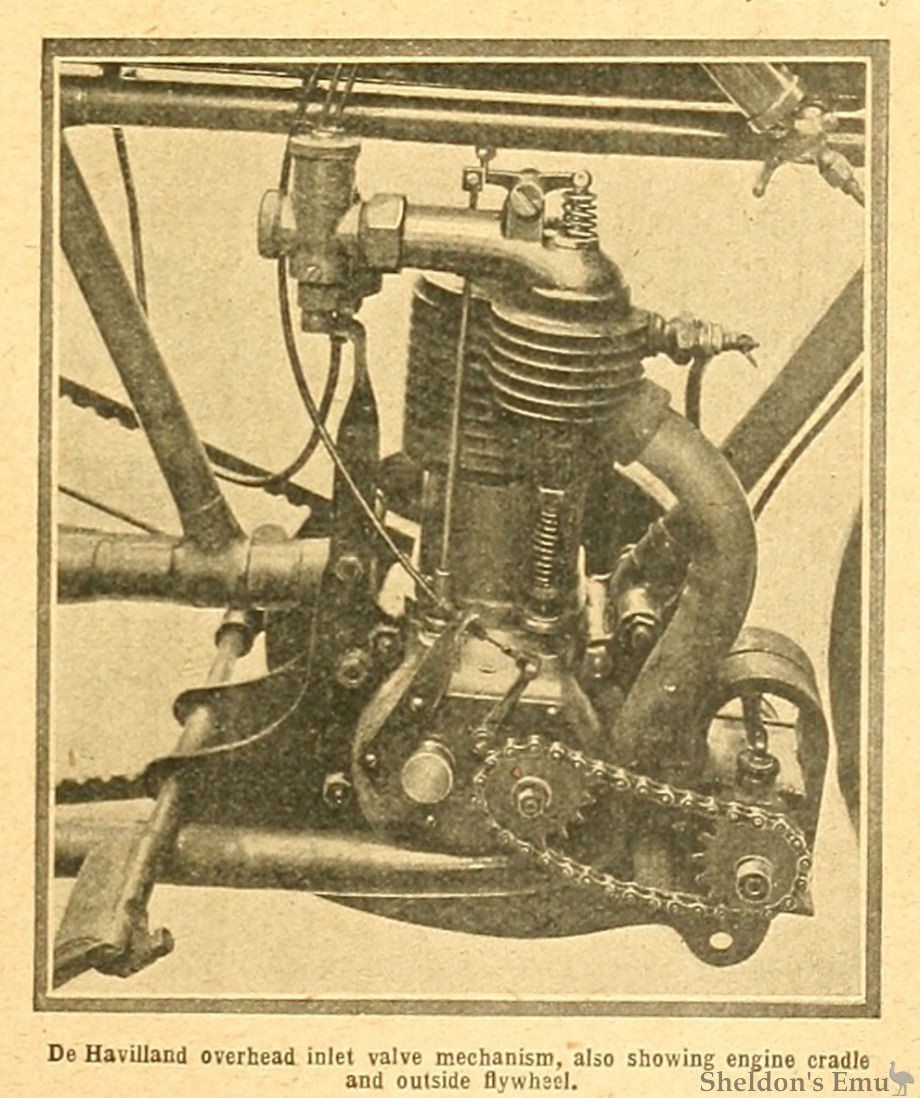
1911 Privately built for several years prior to 1911, the machine was publicly sold that year. The engine had an overhead inlet-valve with a push-rod running through a tube. An outside flywheel and belt drive were used.
1913 De Havilland sold the drawings and patterns for £5 to two fellow students who went on to form the Blackburne motorcycle company.. The de Havilland Group was acquired by Hawker Siddeley in 1960. Harry Hawker, the Australian founder of the aviation company famed for the Hawker Hurricane, had been a motorcycle manufacturer.
In the 1960s, the EMC racer was built in the De Havilland workshops.
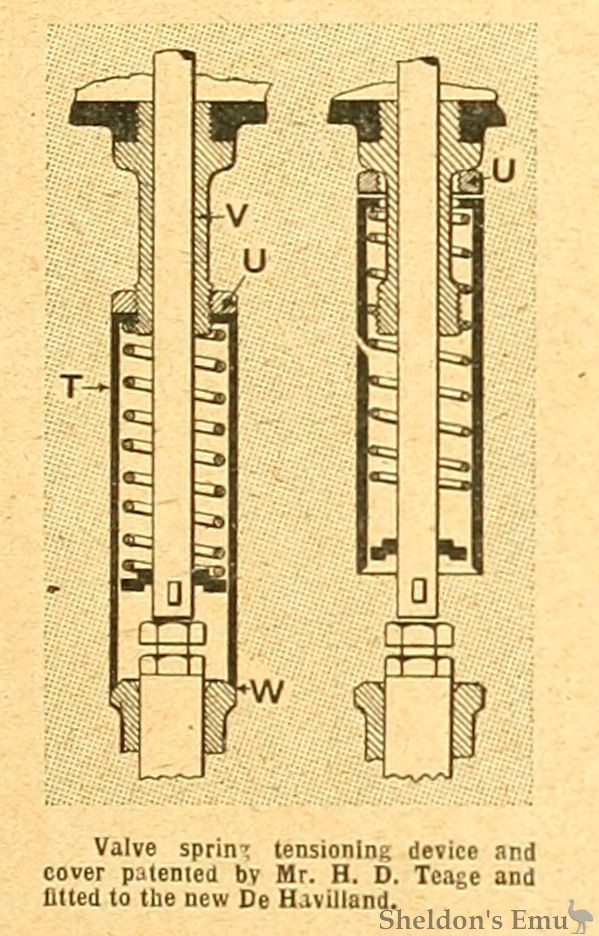
Valve spring tensioning device and cover patented by Mr. H. D. Tease and fitted to the new De Havilland.
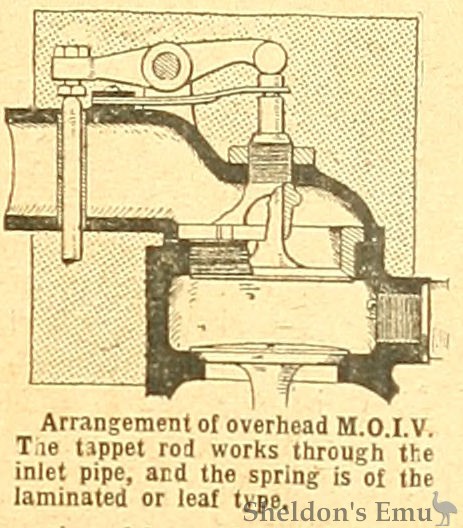
Arrangement of overhead M.O.I.V. The tappet rod works through the inlet pipe, and the spring is of the laminated or leaf type.
THE motor bicycle bearing the above name has figured in several competitions during recent years, probably its most notable performance being the win in the Herts County A.C. open climb at Aston last June. Up to the present these machines have only been built privately but it is the intention of a small syndicate to accept orders for delivery to the public at an early date.
The principal improvements which have been made to the latest model are an adjustable pulley between the ...ine and the outside flywheel.
Another feature is the overhead inlet valve. Previous models have had both side by side and overhead valves, but this new model has the exhaust only at the side. The valve seating is screwed into the cylinder, and the gas inlet dome is fitted over a threaded portion of the top part of the seating, a nut being screwed on afterwards to hold it in place.
It will be noticed that the spring used to close the valve is of the leaf type and carried on the outside ; coil springs will, however, be supplied if preferred. The engine plates go right from front to back in one piece, carrying the platform for the magneto at one end and the footrest bar at the other.
The magneto can be fitted at front or rear of cylinder, and if the latter position is adopted the exhaust timing gear spindle can be changed for the inlet, the spindles and cams being so made that they are interchangeable.
Enquiries for the present respecting this machine should be addressed to Mr. H. D. Teage, 29, Warwick Bow, Coventry.
The Motor Cycle, April 13th, 1911. Page 367.
N.B. The first 10mm of the left column of the magazine page was not scanned. One image and the accompanying text has been omitted.
Sources: Graces Guide; The Motor Cycle.
If you have further information or a query related to this page, please contact us