
Manufactured by Job Day and Sons, 1912-1915, 1919-1924
Beeston Royds Works, Ellerby Lane, Leeds, Yorkshire
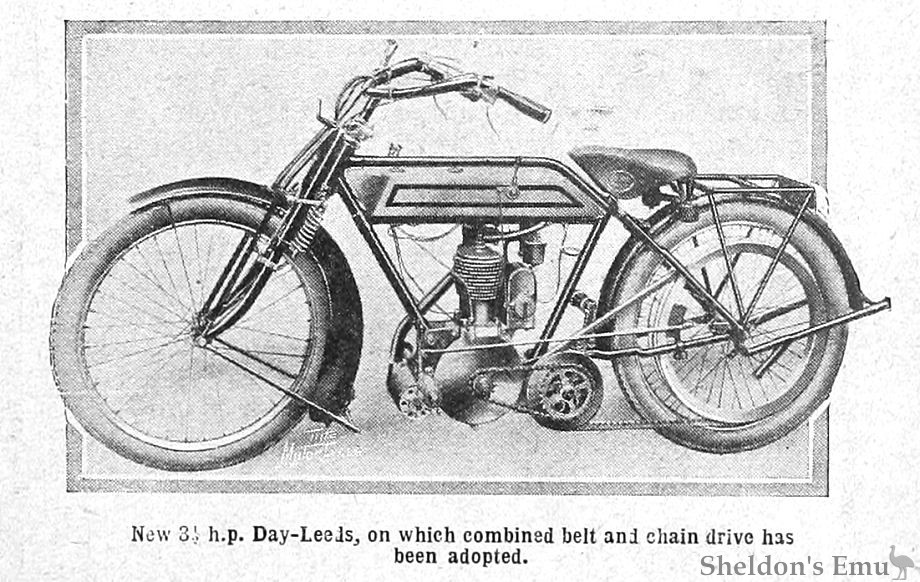
The firm marketed motorcycles under the brands Day-Leeds and Eclipse. These were produced from around 1912 until the beginning of the Great War and were developed by William Henry Day, son of Job Day. The firm was well established and built a variety of machinery for food processing and packaging. Their packaging machines were later exported internationally.
William Henry, who had taken out a patent for a motorcycle engine in 1895, began the firm in 1886 after his father lost an arm in a farming accident, in order to support the family. He was joined by his brother Albert.
In addition to motorcycles they built cyclecars, all powered by their own engines which were somewhat advanced for the day having overhead inlet valves.
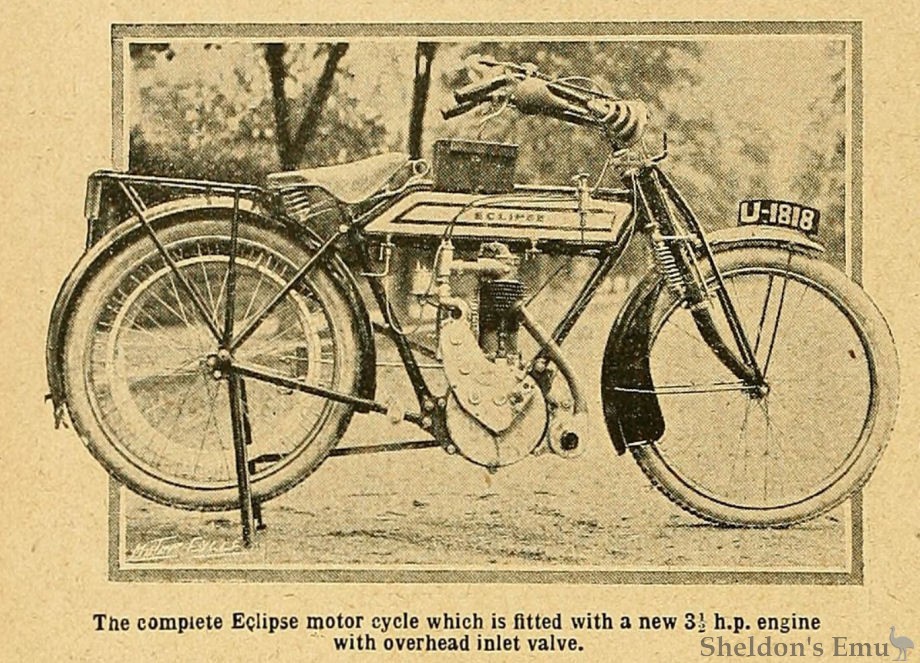
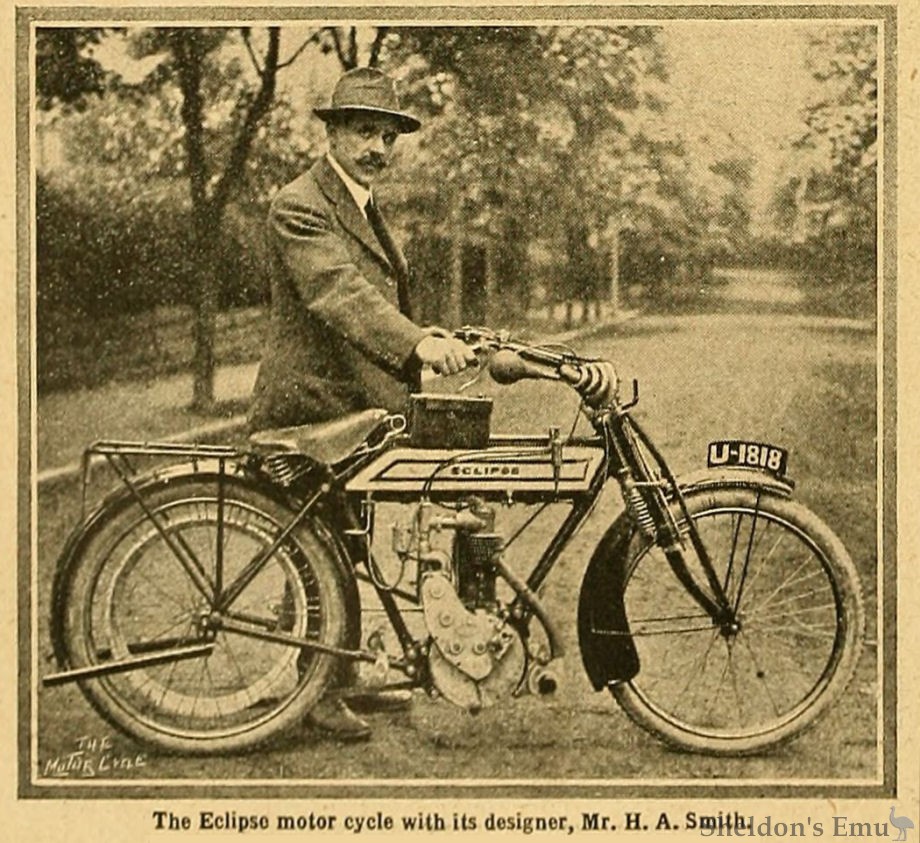
The Eclipse was probably very similar to the Day-Leeds, with a 499cc engine, Edlin frame, Druid forks, Bosch magneto, and a compression release. The motorcycles, designed by H. A. Smith, came in direct belt drive or two-speed versions.
The firm built their first cyclecar in 1906, powered by an 804 cc twin-cylinder engine, and by 1912 they had had two factories in Leeds, an office in Clerkenwell Lane, London, and a branch in Cologne.
By 1915 they had produced over a 100 motor cars. After the war the automobile factory moved from Ellerby Lane to the Beeston Royds Works, Leeds. They ceased producing cars in 1926 after building some 300 units, and concentrated on packaging machinery.
IF you imagine your motor cycle starts easily and runs slowly it would be advisable, before being absolutely satisfied on the point, for you to compare its capabilities with those of a new machine which is being manufactured by the firm of Job Day and Sons, Ltd., engineers, Leeds. A representative of this journal had the pleasure of meeting Mr. H. A. Smith (the designer of the machine in question), the other day, and was initiated into the various novel features of the engine, for it is the engine which the firm in question intend to supply.
Upon the machine being taken out of its shed, and without doing anything more to it than turn on the petrol and give a very slight push when wheeling it along, the engine commenced to fire and to continue firing quite regularly at a very slow walking pace. It was, of course, an easy matter to get comfortably into the saddle, and by releasing the half compression device (which is worked bv the same handle-bar lever as the exhaust lifter) to get immediately into full swing. The engine dimensions are 85 x 88 mm.
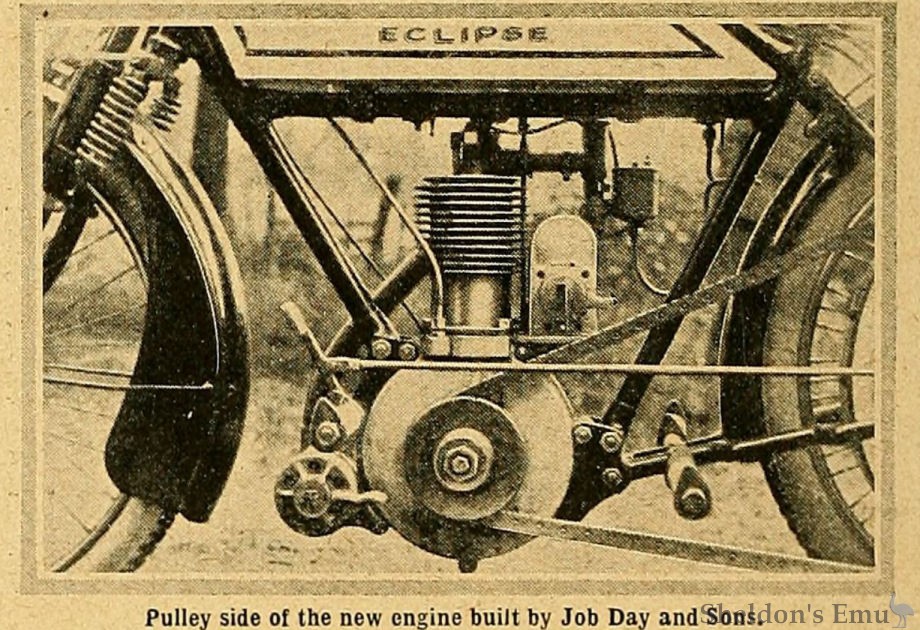
As made at present the engine is not intended for racing, and although it has an overhead mechanical inlet valve, the compression ratio is somewhat lower than standard practice, being about 75 lbs. per square inch. However, owing to the low compression ratio it is found possible to employ very light connecting rod, gudgeon pin and piston (13 ozs. in all), and it is partly due to these light reciprocating parts that the engine proves capable of fast speeds.
The overhead inlet valve, which is worked by the usual style of tappet rod and rocking arm, is capable of being removed from the cylinder in an easy manner. &madash in fact by the undoing of one large nut the valve and its seating come away en bloc. The exhaust valve, which gives an effective opening of approximately one-tenth of the piston area, is of the usual type.
An unusual feature is the system of lubrication. Feeding by means of a Best and Lloyd pump, the oil flows into a well, in which the lip of the piston dips at the end of each downward stroke, thereby raising a supply of oil at each upward stroke and depositing it on the cylinder walls, and so lubricating tie cylinder most efficiently. One pumpful just fills the well, and the piston, in addition to lubricating the cylinder, scatters the recquired quantity into the crank case to lubricate the bearings and big end, but never in such quantity as to cause friction between flywheels and crank case; thus again free running is obtained.
The sparking plug is located in the centre of the cylinder. The silencer is neatly fitted with a cut-out. the whole being so get-at-able that it is only necessary to undo one nut to take it all to pieces.
The cylinder is fitted with the usual type of radiating fins, and the pattern has been so designed that uniformity of the metal allows for equal expansion and contraction due to heat.
The ignition is by a Bosch magneto driven by a train of gear wheels, and the carburetter is a B and B. The motor bicycle frame, which is made by Edlin Sons, Ltd., is fitted with Druid spring forks and Edlin's patent detachable carrier and mudguard. The complete machine weighs, without oil or petrol, 168 lbs.
The Motor Cycle June 13th, 1912.
Sources: Tragatsch p112; Graces Guide; Autopasion18.com; The Motor Cycle.
N.B. There was an earlier Eclipse made in Birmingham, Eclipse, and another made in the United States.
If you have a query about these vintage British motorcycles please contact us.