


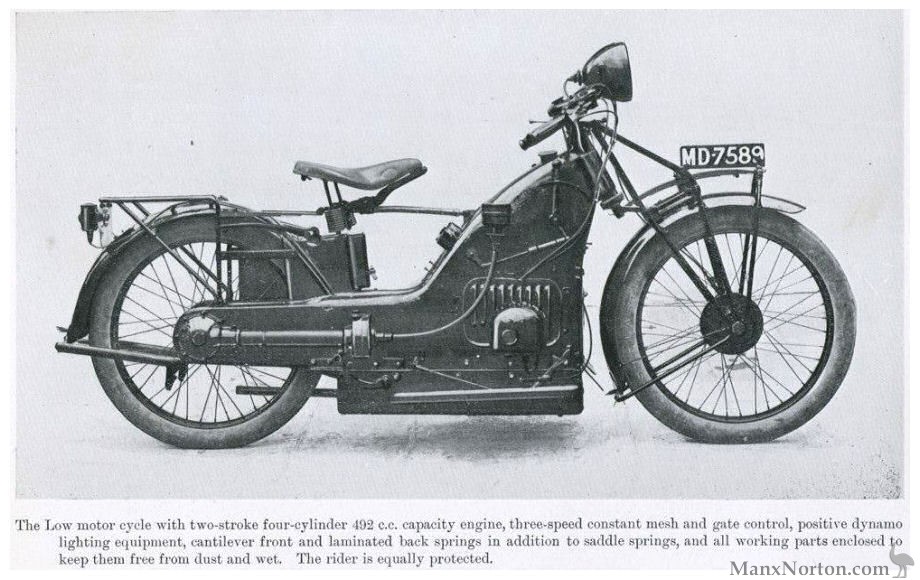
Designed by Professor Archibald Montgomery Low.
His design was an 'ideal' machine with a pressed-steel frame, enclosed working parts, shaft drive, and a 493cc four-cylinder two-stroke engine. Cylinders were air-cooled in a monobloc casting and set in-line with the frame. It had coil ignition through a skew-gear-driven distributor and a single Binks carburettor. There was also a Rotax dynamo, gear-driven from the one-piece crankshaft, to provide battery charging for the electric lighting. There was also a three-speed gearbox in-unit with the engine.
By February of that year, the machine had covered 1,500 miles and modifications were planned. It was claimed to be the first ever four-cylinder two-stroke motorcycle. However, the Low did not progress any further as it was thought to be far too costly to put into production and it would have been a very expensive model to buy.
A FOUR-CYLINDER TWO-STROKE.
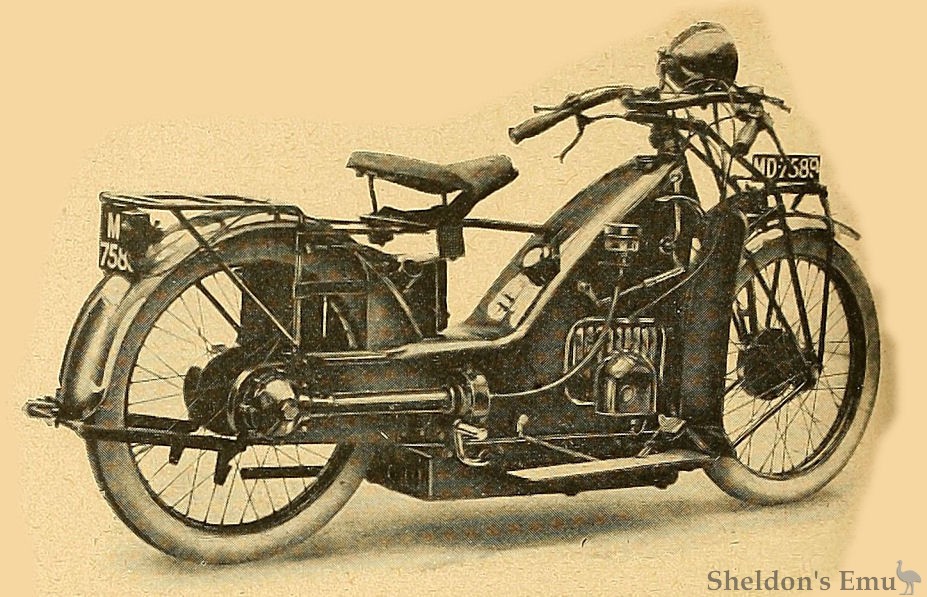
Off side of the Low four-cylinder machine, showing the enclosed transmission and the speedometer drive from the propeller-shaft. There are no decompressors, but the clutch is controlled by the left Bowden lever and the front brake by the right Bowden lever. The left-hand pedal controls the back brake and the right-hand one the clutch, for which there is a dual control. The change speed lever will be noticed adjacent to the top tube.
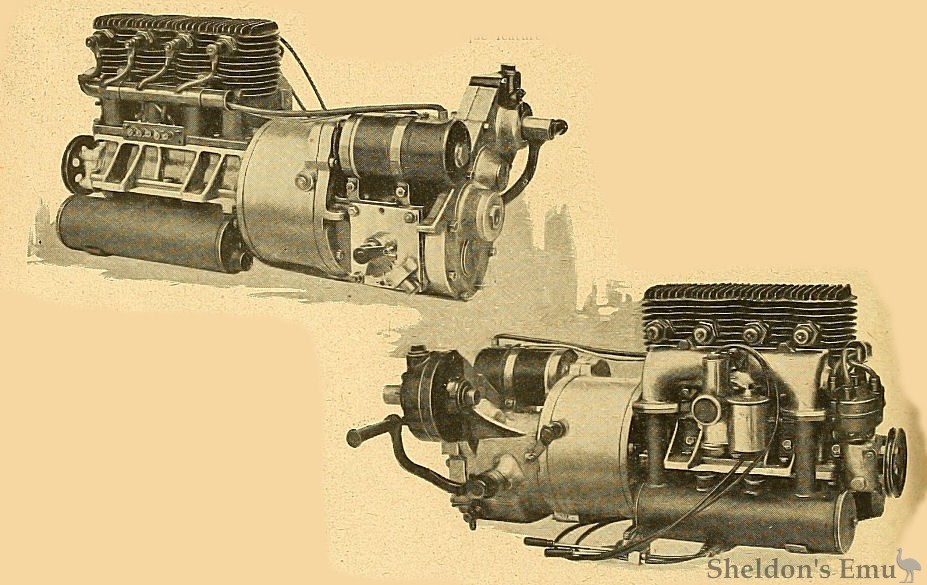
Four-cylinder two-stroke power unit of the Low motor cycle. Note the high tension distributor, the Rotax dynamo mounted on the gear box, the clutch casing forward of it, the drive to the propeller-shaft and the kick-starter. It will be seen that a fan pulley is shown in the lower illustration but it has been found that a fan is unnecessary.
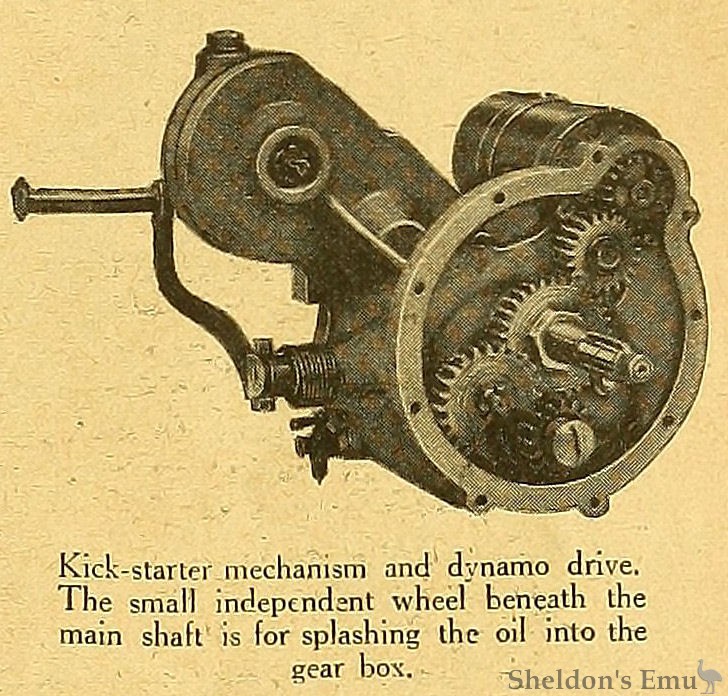
Kick-starter mechanism and dynamo drive. The small independent wheel beneath the main shaft is for splashing the oil into the gear box.
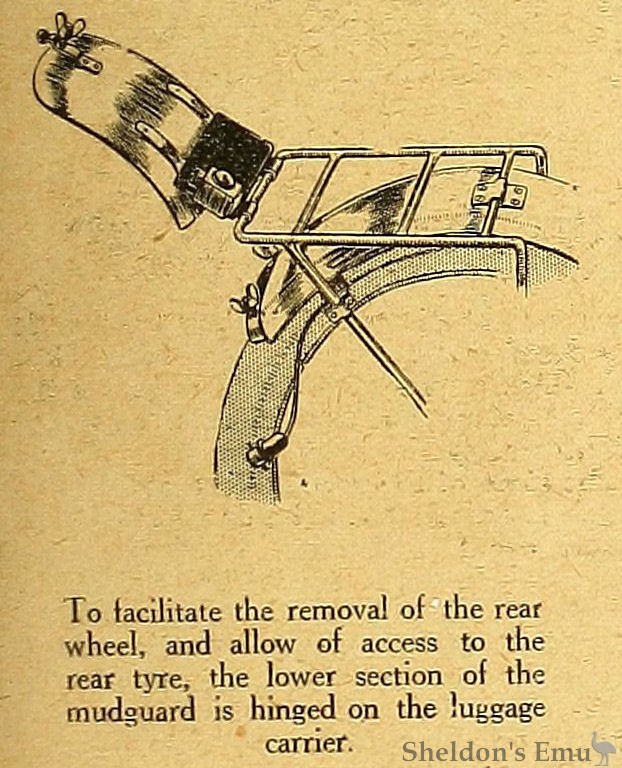
To facilitate the removal of the rear wheel, and allow of access to the rear tyre, the lower section of the mudguard is hinged on the luggage carrier.
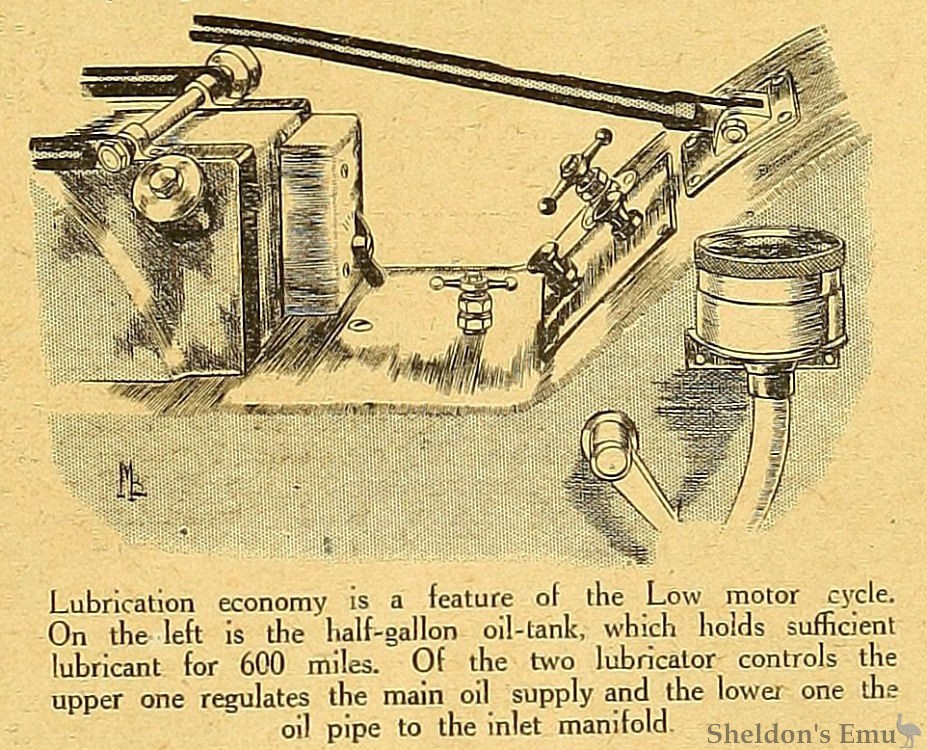
Lubrication economy is a feature of the Low motor cycle. On the left is the half-gallon oil-tank, which holds sufficient lubricant for 600 miles. Of the two lubricator controls the upper one regulates the main oil supply and the lower one the oil pipe to the inlet manifold.
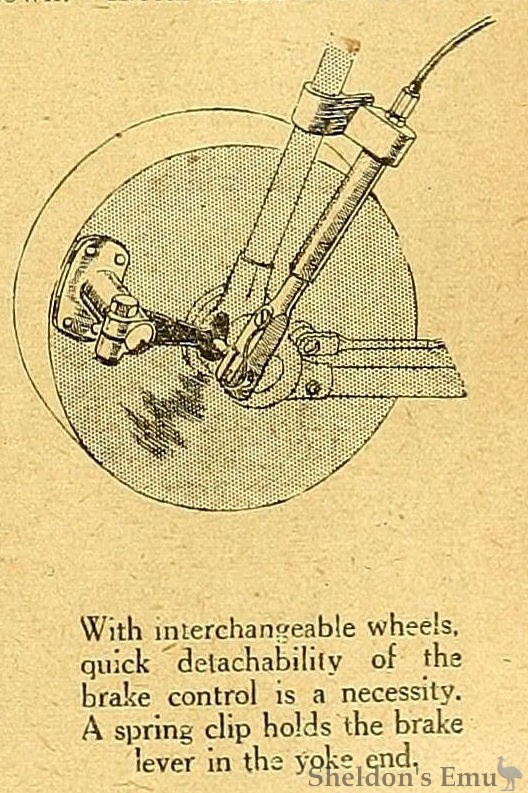
With interchangeable wheels, quick detachability of the brake control is a necessity. A spring clip holds the brake lever in the yoke end.
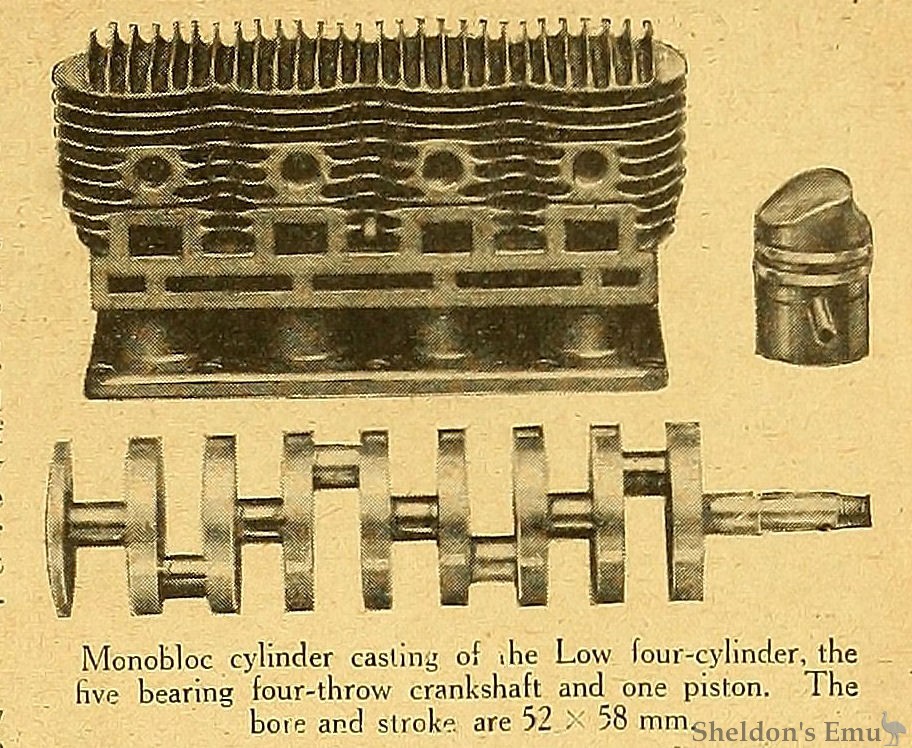
Monobloc cylinder casting of the Low four-cylinder, the five bearing four-throw crankshaft and one piston. The bore and stroke are 52 X 58 mm.
Advanced Design Exemplified in the Low Motor Cycle; Much Originality and Many Commendable Features.
PRACTICAL and enthusiastic riders have given much thought to the ideal motor bicycle, which has been comparatively easy to conceive, but insuperably difficult to produce on account of expense. The machine described below is the " ideal " of Professor Low, who has been long connected with the motor cycle movement, and has made a careful study of motor cycle design ; in fact, his association with the Auto Cycle Union as a judge has placed him in close relationship with all types of machines.
His production is of thoroughly sound design and bristles with novel points.
All Mechanism Concealed.
A certain section of potential purchasers of motor cycles require a mount which can be ridden in white flannel trousers to the tennis club, or in dress clothes, as well as in everyday garb. Many riders have also expressed a wish for a machine with shaft drive, an even torque, and which could be hosed after a muddy ride. Such a machine is the Low four-cylinder two-stroke.
Not Available on the Market.
It is a great pity, however, that it should have first seen the light as the production of a clever inventor who has made it as an experiment to prove his ideals and to give him useful data for the future. It cannot be supplied to the public, and even if some enterprising manufacturer arranged to produce it tomorrow it would be months before it would be in a fit state to be placed on the market. Still, the dreams of the imaginative enthusiast have been fulfilled, and the machine is actually, so to speak, in the flesh and running, if not perfectly, well enough to promise great things in times to come.
The charm of the Low machine is that engine and transmission are entirely enclosed, while the general lines are graceful, though unconventional ; in fact, though brimful of originality it is devoid of any grotesque features.
Pressed steel is used for the frame construction, and serves to enclose engine and gear, box units and the two and a half gallon petrol tank, . tubes being employed only in the forks and carrier. No attempt has been made to embody rear spring suspension in the design, but the saddle is mounted on duplex laminated springs and a linked stay, while the cantilever type forks are of light, but strong construction, employing a laminated spring.
Four-cylinder Three-port Two-stroke.
For the first time in the history of the motor cycle movement a four-cylinder two-stroke engine forms the power unit of a single track vehicle. Though of the three-port variety, the engine design shows originality; the cylinders form a ribbed monobloc casting, but with air passages between each, and Prof. Low took considerable trouble in designing them, beginning operations by making a set of dummy cylinders with glass sides, and pumping in smoke so as to see how the gas whirled and mixed with the incoming charge. The inlet and exhaust manifolds are one casting, so that the incoming charge is adequately heated by the exhaust. On the inlet side of the engine are shown compression release valves, but these have been discarded. as they have proved to be useless in actual practice.
Four-throw Crankshaft.
The crankshaft is machined out of a solid bar, and has the cranks set at 90°, while the pistons have been carefully designed so as not to break up the incoming charge and cause condensation.
Lubrication is effected by pressure in the oil tank, about 4 lb. per sq. in. being attained after a few revolutions when the oil is forced through to every the engine, while there is also a connection from the crank case to the inlet pipe so that a small amount of oil mist is introduced into the cylinders, producing much the same effect as petroil lubrication. The oil also serves to form a seal between the crankcase divisions, oil flowing between each partition, and thus helping to retain crank case compression.
The flywheel is rather small, being but 6in. in diameter, yet it contains a multi-disc clutch, which consists of alternate Ferodo and steel plates ; the clutch fork is similar in design to that usually employed in motor car construction.
Engine and three-speed gear box form a complete unit, the gear box being of standard design with constant mesh wheels, the change being effected by means of dog clutches. The gear ratios are 4.75, 8.35, and 13.5 to 1, while the gear shafts run on Skefko ball bearings. The lubrication of the gear is carried out by splash from a sump in the gear box, a special idler pinion driven off the layshaft being provided for this purpose.
Shaft Transmission.
As the final drive is by shaft and bevel, the drive to the shaft universal joint is through a train of gear wheels with one intermediate idler wheel, the final drive pinion terminating in a square, and there being pot universal joints at each end of the propeller-shaft. The propeller-shaft is enclosed by a telescopic sleeve, a portion of which can be slid backwards to allow disconnection with the drive in the event of the rear wheel requiring to be withdrawn. Mounted on the face of the crown wheel is a plate bearing a series of steel pegs, which engage with holes in the wheel flange, consequently if the withdrawable spindle is removed and the distance piece unscrewed the wheel may be instantly changed, both front and rear wheels being interchangeable, while if a sidecar should be fitted the wheel of this will also be interchangeable.
Intended to Pull a Sidecar.
Though only 492 c.c, the machine is designed to take a sidecar, and cup-shaped threaded holes are provided in the frame construction into which a ball joint may be inserted. This ball joint is secured by a threaded collar and fastened by a spring clip to prevent it unscrewing.
A Rotax dynamo is mounted over the gear box, and is driven by a train of gear wheels. The dynamo supplies current for ignition as well as for lighting; a coil and accumulator being used in conjunction with a distributer mounted at the forward end of the crankshaft. A thermostatic switch is employed, which switches the current off automatically if the driver has omitted to do so after stopping. This prevents the accumulator being run down. Metal boxes are carried on each side of the lower portion of the rear guard, that on the right holding the tool kit, and that on the left the accumulator.
Accessibility of Power Unit.
As we have mentioned before, the power unit is carried on detachable beams bolted into the frame, the undershield being attached to the beams, so that accessibility has not been neglected. For the purpose of carrying out ordinary adjustments to plugs or distributer, it is only necessary to open the doors in the frame.
The weight of the machine is 290 lb.; 26x2 ½ in. tyres are fitted on wheels built up of 12 gauge spokes, with barrel hubs carried on large size Skefko ball bearings, and each is fitted with an internal expanding brake, which comes away intact with the wheel; front and rear brakes are interchangeable. The steering head is fitted with 3in. ball races.
Despite its rough state, the experimental machine ran extremely well. There was no silencer fitted at the time of our brief test, but the exhaust made a delightful hum reminiscent of a miniature aeroplane, while the acceleration was all that could be desired, and the engine ran with the smoothness of an eight-cylinder, there being four impulses per revolution.
Experiments relating to carburation are still in their infancy, and though the machine was not perfect in this respect it showed great promise, and when once the proper adjustment has been effected it seems as if the flexibility would be considerably superior to that of other two-strokes we have tried. The saddle suspension and forks were most comfortable, but it is admitted that the rake of the steering was a quarter of an inch out, while the design of the handle-bars was not ideal. Still, these are but trivial points, and for an experimental model its behaviour was quite remarkable.
Cycle Car Engine Foreshadowed.
Prof. Low is quite confident that the faults of which he is fully aware can be entirely eradicated, and that the weight may be considerably reduced. Altogether, the experimental machine has run a distance of about 1,500 miles. We understand that experiments are being carried out with an engine on similar lines for cycle car use.
The Motor Cycle February 23rd, 1922. PP 228-230
Further reading: A. M. Low, The Rocket Man
Sources: Graces Guide; The Motor Cycle.
If you have a have further information about this progressive British engineer please contact us.