

Fabrique Nationale, Avenue Malakoff, Paris, show the standard F.N. motor-bicycle with all the recently introduced features. The new F.N. four-seated car is an object of great interest. It is a splendidly finished vehicle, the dark green finish and burnished brass work showing off to advantage.
Paris Salon 1902 in Motor Cycling, December 17th, 1902.
W. R. McTaggart, Ltd.
Here will be found the latest patterns of F.N. motor cycles. The engine will be 2¾ h.p., and the construction of the machine has been studied so as to obtain the highest possible efficiency. The driving belt will be V-shape Lincona, and will be 3/8in. longer in the drive than this season's 2 h.p. F.N. The lubricating arrangement will consist of a feed lubricator fitted between the diagonal tube and the back stay. The whole front of the new machine is strengthened by a liner running through the fork stem, branching at the crown right down through the fork blades. The petrol tank itself has been very much improved, being made of oxidised brass. All jointing is avoided as much as possible, one side only being soldered. Two brakes are fitted, acting on the rim of the rear wheel, one of which is worked by back-pedalling, the other being the usual Bowden brake. All the leading features of the 2 h.p. F.N. will be retained, especially as regards the position of the engine in the frame. There is a special arrangement, by which the exhaust valve is in a manner separated from the cylinder, thus precluding the possibility of overheating. The tyres on the new machine will be 2¼ in. Clincher A Won. The tubing used in the construction of the F.N. machine will be nickel steel, which is sixty-four per cent, stronger than the ordinary cold-drawn steel tubing. All the joints, lugs, etc., including the fork crown, will be made from solid steel forgings, which are one hundred per cent, stronger in some strains, and from twenty-five to fifty per cent, stronger in others above malleable iron castings. The crank case bearing will be of the well-known turbine grooved type, which obtains the best results by perfect distribution of the lubricating oil.
The Motor Cycle, November 18th 1903, p796
Stanley Show 1903
W. R. McTaggart, Ltd., Dublin
(Stand 140).–
A most interesting exhibit here is the new four-cylinder F.N. motor bicycle, two patterns of which are shown. One of these has a spring fork, and the other has the ordinary type of front fork. The spring fork type appears to be of a very simple description which should be efficient in its working. Illustrations in the forecast showed the complete machines, and also right and left hand views of the engine. This has four small cylinders (air-cooled) which normally develop 3 h.p. Of course, this is somewhat exceeded when the speed of the engine is increased. A modified type of F.N. carburetter is fitted with a disc form of throttle valve. The ignition is by high tension magneto, the distributer being carried on the end of the valve camshaft. The exhaust valves alone are mechanically operated, the inlets being automatic. The base chamber is very neat in appearance, and is of cast iron, which we should say would be a distinct advantage in this type of machine. On the rear end of the crankshaft is placed a form of spring drive which communicates the power to a short shaft carrying on its end a gear wheel. This gear wheel intermeshes with another carried on the side shaft in a hollow-back fork on the right hand side of the machine, the ordinary pedaling chain gear being on the left hand side. On the end of what may be termed the propeller shaft is a small bevel pinion engaging with a bevel gear wheel attached to the rear hub. Both gears are entirely enclosed in oiltight cases. The magneto is placed at the forward end of the crank chamber, and is directly attached to the crankshaft. The control is of the usual type, and for the purpose of easy starting a valve lifter is fitted which operates equally upon the four valves.
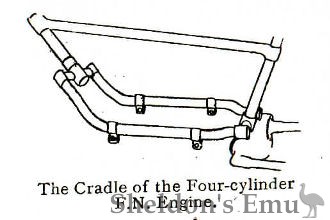
The engine is carried in a cradle formed in the machine in a very simple fashion, as shown by the appended sketch. On the left-hand side of the rear wheel is a large diameter brake drum, the band upon which is applied by back pedaling. A sight feed lubricator is fitted so that one may always he certain as to the quantity of oil which is being passed to the crank chamber. The speed at which the motor will run smoothly, and with comfort to the driver, is stated to be from five to fifty miles per hour. Possibly the latter figure is somewhat on the high side, though, of course, it should be possible to attain this speed under favourable conditions. Other samples of the highly successful F.N. motor bicycle are also exhibited on this stand, one of which is shown fitted with a flat belt and wooden belt pulley.
Report on the 1904 Stanley Show, The Motor Cycle, November 28th.