
Pierre Poinard of 54 rue E. Dolet, Cachan (Seine), builder of sidecars, three-wheel 125cc utility vehicles and, in 1952, a three-wheel 125cc microcar.
Poinard acquired the BCR firm in 1929, according to one source - another says that BCR began manufacturing Poinard sidecars in 1930.
Whichever is correct, it appears that the Poinard of the 1950s is closely associated with BCR.
Models include:
1930s 250cc Chaise (previously BCR)
1930s 350cc Chaise (previously BCR)
1930s 500cc Chaise (previously BCR)
1930s 1000cc Chaise V-twin (previously BCR)
Poinard
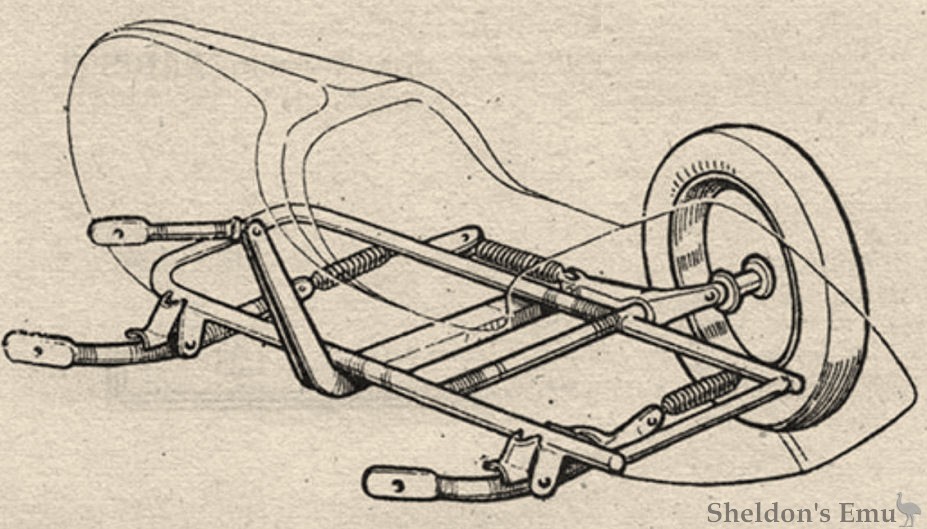
Le châssis et la suspension d e roue du sidecar Poinard sont étudiés pour le maximum de confort.
The chassis and wheel suspension of the Poinard sidecar are designed for maximum comfort.
Cette maison a mis au point un nouveau châssis qui remplacera le P. 27. D'une conception ultra-moderne, d'avant-garde, il fait l'objet d'un brevet. Le châssis en tube d'acier, sans soudure, fait corps avec la carrosserie, ne laissant d'apparent que les deux bras d'attaches inférieurs. Ceux-ci sont articulés sur silentblocs et ressorts à traction réglables faisant office de suspension du côté de la moto.
Du côté opposé, la suspension est assurée par un bras, articulé sur un axe monté sur roulements à billes, renforcé, servant de support à la roue. Le moyeu est monté sur roulement à billes à gorges profondes, indéréglable et inusable. A l'autre extrêmité du bras sont montés 1 ou 2 ressorts à traction, réglables suivant le poids du sidecar et de la force de la moto.
La 3 attache, sous la selle, est assurée par un support perpendiculaire relié à la chappe correspondante par une attache réglable articulée sur silentbloc. Cette conception rend le sidecar com plètement indépendant de la moto, puis que les chocs ressentis par celle-ci ne sont pas transmis au side, et, réciproque ment, puisque la liaison, comme nous venons de l'expliquer plus haut, est assurée par attaches souples et réglables.
This company has developed a new chassis that will replace the P. 27. With its ultra-modern, cutting-edge design, it is patented.
The seamless steel tube chassis is integrated with the bodywork, leaving only the two lower mounting arms visible. These arms are articulated on silent blocks and adjustable tension springs, which act as suspension on the motorcycle side.
On the opposite side, suspension is provided by an arm, articulated on a reinforced axle mounted on ball bearings, which supports the wheel. The hub is mounted on deep-groove ball bearings, ensuring stability and durability.
At the other end of the arm are mounted one or two tension springs, adjustable according to the weight of the sidecar and the force of the motorcycle.
The third attachment point, under the seat, is secured by a perpendicular support connected to the corresponding clevis by an adjustable attachment articulated on a silent block. This design makes the sidecar completely independent of the motorcycle, since the shocks felt by the motorcycle are not transmitted to the sidecar, and vice versa, since the connection, as we have just explained above, is ensured by flexible and adjustable attachments.
1947 Salon de la Motocyclette, Moto Revue.
Sources: Tragatsch; JLB Web; Cycle Memory; contemporary advertising.
If you have a query or information about these French machines please contact us.