
Reports from the 1903 Stanley Show
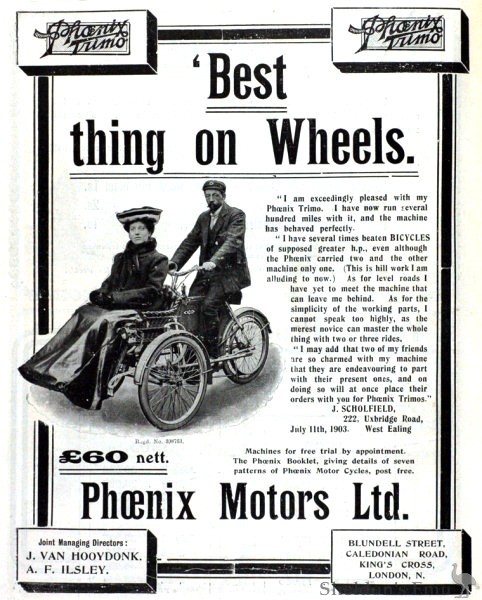
Phoenix Motors, Ltd.
This firm will exhibit the following motor bicycles and Trimos, which will constitute their types for next season: Motor bicycles — 2 h.p., belt drive. 2¾ h.p., with chain drive, two-speed gear, and free engine. (This will also be made with belt drive, to which two-speed gear can be fitted.) Trimos — 3½ h.p., with chain drive, two-speed gear, and free engine. 3½ h.p., with twin belt drive, to which two speed gear and free engine can be fitted. 2¾ h.p., with chain drive, two-speed gear, and free engine. 2¾ h.p., with single belt drive. (The 2¾ h.p. and 3½ h.p. machines will all be made with improved strengthened frame, wide bracket, obviating the necessity of setting out the crank. All motor cyclists should make a point of examining the Phoenix two-speed gear and free engine, which were fully illustrated and described in our issue of November 4th. Other interesting features will be the adjustable spraying nozzle to the carburetter, a combined stand carrier and mudguard, and petrol and oil gauges. The original Minerva inclined engine position will be a standard on all Phoenix motor cycles for 1904.
The Motor Cycle, November 18th, 1903. Page 797
Stanley Show 1903
Phoenix Novelties for 1904.
The new patent two-speed gear and free engine will be the firm's leading item in the way of novelties. This gear is claimed to be the simplest form of two-speed gear yet made. It is entirely dust-proof, but every part is easily accessible. In the many severe tests which have been given to the gear it has always kept absolutely cool: in fact, after a five miles' run on the low gear all the time the gear was cold. It is, of course, doubtful whether the gear would be continually run, under any circumstances, for such a period, but the test was given in order to prove the question of the heating of the gear.
In the "Phoenix" special spray carburetter it is impossible for any dust to penetrate to the interior. All the air necessary for the carburetter is drawn in through one gauzed funnel, running close to the engine. The adjustment of mixture and throttle is automatic, while the spraying nozzle is made adjustable. The petrol and oil gauges (registered) are let into the side of the tank, enabling the rider to see at once the quantity of oil and petrol in the tanks. The improved combined stand, carrier and mud-guard answers the usual purpose of carrier, but, when in use as a stand, it carries with it the top of the mudguard, thus leaving the tyre easy of access for repair. The improved paraffin injection valve will enable the easy starting of any motor, and affords a double check on loss of compression. Foot and hand applied band brakes and spring seat pillars will be embodied in the new machines. The two-speed gear was illustrated in "THE MOTOR" last week. The Phoenix machines will be on view at the Stanley, and the exhibit of this go-ahead firm will be full of interesting new features.
The Motor magazine, 18th November 1903
Stanley Show 1903
Report from the 1904 Stanley Show
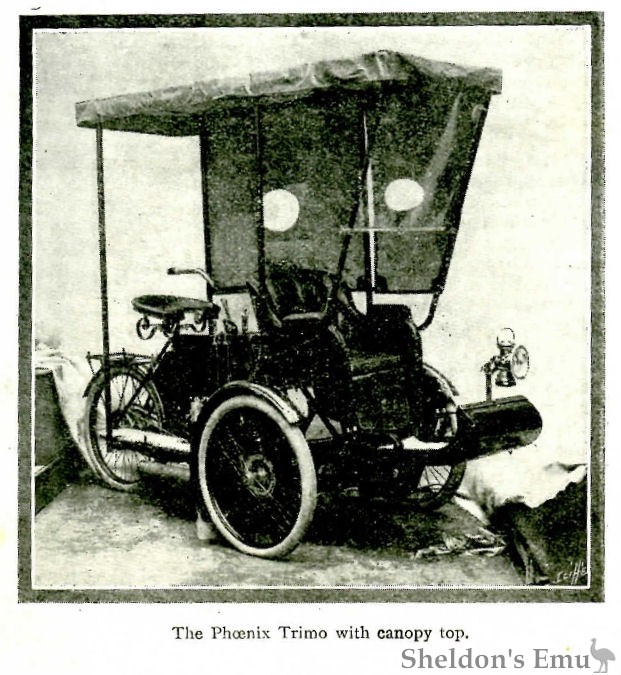
Phoenix Motors, Ltd., Caledonian Road, N. (Stand 147), are showing an attractive exhibit in the shape of a Trimo fitted with a canopy having a celluloid screen in front, which, when not required, will fold out of the way entirely. Side screens are also provided, into which celluloid panels are inserted, and these may be rolled up into small compass when not in use. For the driver a comfortable seat is fitted, this being slung on C springs. The footboards are mounted on hinges, so that any part of the motor is easily accessible. The ignition is the Simms-Bosch high-tension magneto, and is driven off the motor by chain. The silencer has a cut out, which can be put in action by the driver's feet. If necessary it can be retained by a catch, and released at a moment's notice by a touch of the foot. There is a powerful band brake fitted to the back wheel, worked by the driver's right foot. The front brakes command special attention, as they are of ample size and worked by a stout Bowden cable.
A leather apron extends over the lower part of the machine, protecting the most important parts from mud and dust. The side wheels are also guarded on the inner side with leather. Two motor bicycles are shown fitted with two-speed gears.
One of these is a 2¾ h.p. chain driven and the other a 2 h.p. belt driven. The latter machine is of reasonable weight, scaling only 120 lbs. A Phoenix tricycle fitted with two-speed gear and magneto ignition is also shown. A 2¾ h.p. chain-driven bicycle and a 3½ h.p. Trimo fitted with two-speed gear and high-tension ignition are also to be seen. With the exception of the 2¾ h.p. chain-driven machine all the Trimos and bicycles shown are fitted with the well-known Phoenix two-speed gear, which incorporates clutch and free engine. Besides these, two Trimo attachments are shown, one of which has a spring frame, while the other is of the ordinary type. There is also an interesting working model showing the Phoenix two-speed gear, which is worked by an electric motor. The makers of the Phoenix motors have good cause to be proud of their performances during the past year, and they exhibit a board above their stand, declaring the fact that they were the builders of the only Trimo to go through the London to Edinburgh run and the Auto Cycle Club's 1,000 miles trial.
Report on the 1904 Stanley Show, The Motor Cycle, November 28th.
If you have further information or a query related to this page, please contact us