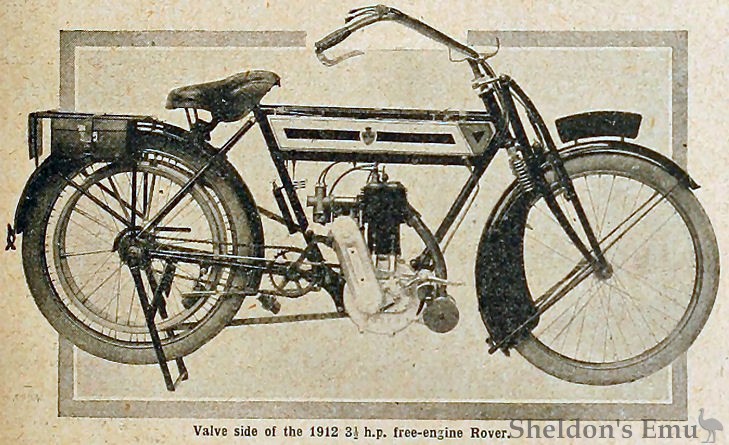

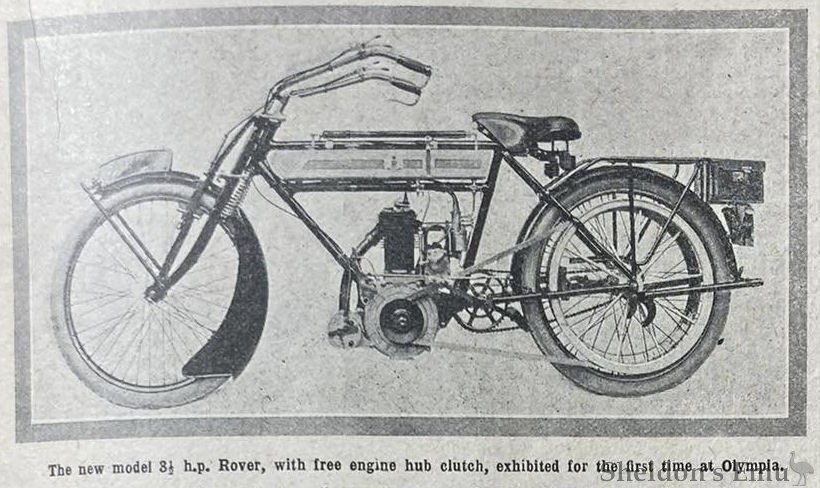
The new model 3½ h.p. Rover, with free engine hub clutch, exhibited for the first time at Olympia.

Rover engine unit, showing magneto at rear of cylinder.
Rover Co., LTD., Coventry.
The 3½ h.p. Rover machine, which has been so long expected, is a most attractive feature of the Rover Co.'s exhibit, and is a very elegant model on standard lines. The engine is a very neat piece of work, with side by side valves, and has the magneto immediately in the rear of the cylinder, and behind that again the carburetter.
The valve heads are of large diameter, and their tappets are furnished with damping springs, which largely eliminate noise and keep the tappets hard up against the valve stems. The silencer is of large dimensions, and is fitted with a most sensible refinement in the form of a hand-operated cut-out, the lever for this purpose being on the left hand of the grip.
Immediately above this lever is that for the spark advance, with which is also incorporated a magneto cut-out when the spark is in the fully retarded position. The engine-shaft is fitted with an adjustable pulley of special design, and the transmission to the road wheel is through a Triumph free engine clutch, operated by a sleeve locking pedal situated on the right footrest. Druid spring forks, powerful front and rear brakes, and a permanently fixed petrol primer complete the specification of a machine which is in every way attractive and practical.
The Rover Co., Ltd.
Meteor Works, Coventry. Stand No. 68.
Riders and agents alike welcome the return of the Rover Co., to the ranks of motor-cycle manufacturers. As might be expected, the Rover Co. have not restarted where they left off. Good as was the old Rover in its day, this new model is a great deal better. The engine has a single cylinder, with 85 mm. bore and 88 mm. stroke - very popular dimensions. The valves are operated mechanically, and the ignition is by high tension magneto, mounted vertically before the engine. The carburetter is Rover type, and is controlled from the handlebar. The engine pulley is adjustable to give different ratios of gearing between 4.5 to 1 and 6.5 to 1. A rubber belt conveys the motion to the rear wheel, which is built up with a plate clutch - by licence from the Triumph Cycle Co.
The wheels are shod with 24in. Dunlop studded tyres, and the front one is carried in a spring fork of the parallel ruler type. The top of the saddle stands 32ins. from the ground, and there is 4ins. clearance under the crankcase. The standard equipment includes pedalling gear, stand and carrier. The machine is rather over the average length, the wheelbase being 56ins. The weight is about 180 lbs.
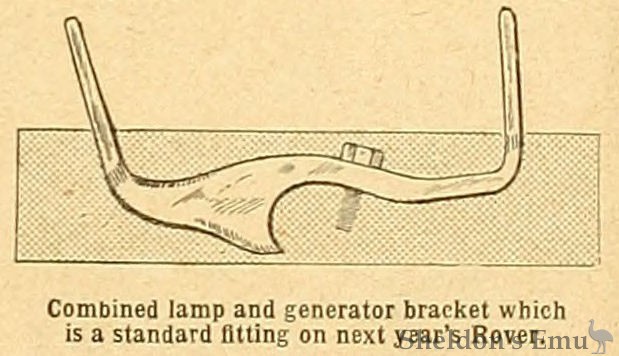
The timing of the magneto and the opening and closing of the exhaust cut-out are controlled from the handle-bar by a pair of levers, which is a duplicate of the carburetter adjustments. Two brackets are provided at the centre of the handle-bar, one for the lamp, and the other for the generator. A dummy belt rim is fitted for the pedal brake to act on. The front guard has closed sides, and the rear one an extension over the belt pulley. A fine machine truly.
The New Rover.
Rover motor cycles for 1912 will be improved in detail only, the general design remaining the same. The engine will have the same appearance, though it is now bolted direct to extensions of the rear lug, thus dispensing with separate cradle plates. The fly-wheels have been lightened in the webs, and extra metal has been put into the rims which should tend towards smoother running engine. The wearing surface of the cam gear has been increased as much as fifty per cent., and the adjustable tappets are now held up to the valve stems by enclosed springs. Neater clutch leverage is employed, the pedal having a direct pull on the operating bell crank lever. Ignition is by the new type Bosch magneto driven by a wide silent chain and controlled from the left handle-bar, while the cut-out is now operated by a pedal.
The spring fork is more compact, and is fitted with stronger springs than formerly. The tank has an extra supporting clip, both fillers are fitted with strainers, and this oil pump has larger valves. Neater front and rear wheels stands are employed and the former is kept in place by an improved clip. Both brakes have been improved, the rear brake being fitted below the chain stay and operated by more substantial connections. The wheelbase has been shortened two inches. The alterations generally have made the machine considerably neater in appearance. Three models can be supplied. A fixed gear, and a free engine model, and another embodying the Armstrong three-speed gear. As will be noted from the illustration the firm have reverted to an L saddle pillar, and use a frame of the ordinary diamond pattern.
1911 Olympia Show - The Motor Cycle October 12th, 1911. Page 1068
ROVER, No. 113.
The Rover Co., Ltd., Meteor Works, Coventry. – The 3½ h.p. Rover is much the same as last year, but the 1912 model possesses a number of minor improvements. Amongst these may be mentioned the shortened frame, the new stand, exhaust cut-out, new pattern Druid front forks with extra large springs, U shape of up-turned handle-bar with brazed on control lugs, and internal Bowden cables. The engine lugs have been very much neatened, and the machine has been certainly improved by the fitting of a front stand. The Bosch entirely closed magneto is carried immediately at the rear of the cylinder, and is well protected from mud and wet. The magneto is controlled from the handle-bar. Two variations in this model are made, namely, the free engine type with Triumph free engine clutch in the rear wheel, and single gear type with direct belt drive. In all patterns large toolbags are fitted to the carrier, and the rear brake, which acts on a belt rim, is considerably strengthened. In the engine the valve gear has been provided with bigger wearing surfaces, and the magneto is now driven by a silent chain which obviates the likelihood of backlash developing through stretch.
1911 Olympia Show - The Motor Cycle, November 23rd, 1911.