
1902 The company made their own frames to carry bought-in engines and other components. The machines were typical of the era, but of excellent quality. Gradually, over the years, they improved technically.
1908 At the late Stanley show they exhibited a lightweight, two-stroke model. It had a 143cc engine, Ruthardt magneto and the option of a drop frame to provide a ladies' model. They were still very conventional in style.
1910 Stanley Show
Victoria Motor and Cycle Co. Ltd. Glasgow.
Among the exhibits of this well-known Scottish firm will be a new 3 H.P. motor-cycle with magneto ignition. We understand that this is a first-class machine in every way, and is priced at a figure which will bring it within the reach of all.
1912 Precision engines were now being used, along with an Armstrong three-speed rear hub.
VICTORIA, No. 211.
The Victoria Motor Cycle Co., Glasgow. – This is a well designed lightweight following standard lines, fitted with the increasingly popular Precision engine. The machine is sold properly equipped for the road. The 3½ h.p. mount has also Precision engine of 85 x 88 mm. and N.S.U. two-speed gear. Pannier toolbags are attached to each side of the substantial luggage carrier, and, like the smaller model, this machine follows standard lines throughout. The design remains unaltered, as its excellence has been thoroughly proved in the past.
1911 Olympia Show - The Motor Cycle November 23rd, 1911. Page 1283
1914 A Precision V-twin, Villiers two-stroke and a 2hp lightweight were added.
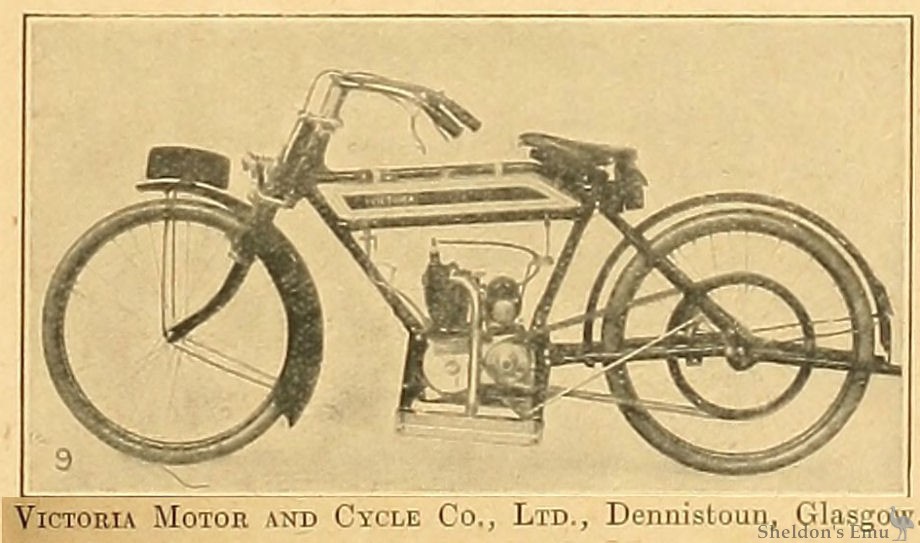
Victoria Motor and Cycle Co., LTD., Dennistoun, Glasgow.
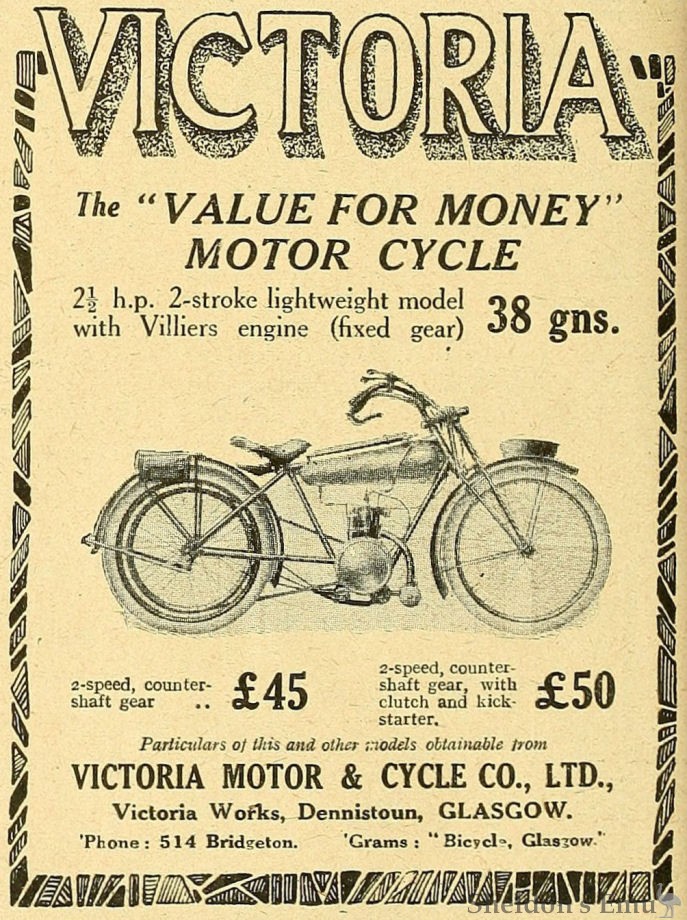
Post-war. They offered a small range using 147cc and 247cc Villiers engines, plus a choice of transmission.
1924 The range was augmented with the addition of four-stroke models using JAP engines.
1925 Engines used were Villiers 147cc, 247cc and 343cc, plus 293cc, 596cc JAP. All had three speeds, but only three had all-chain drive.
1928 The line ran on, little altered, until this year.
Sources: Graces Guide, The Motor Cycle