
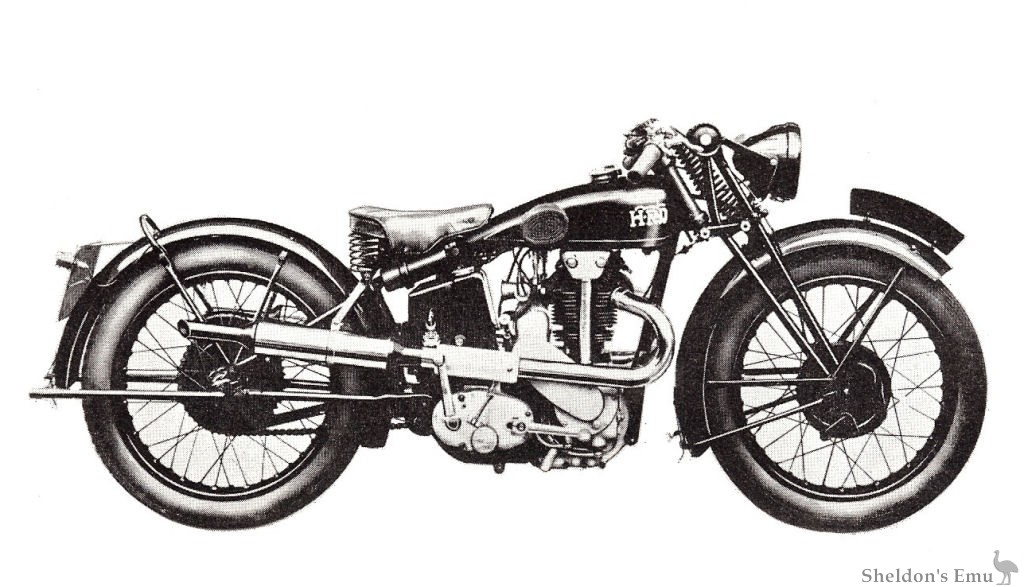
The 1933 model 499 cc. Vincent H.R.D. The ultra-neat frame springing system - located beneath the saddle anchorage, was designed by Phil Irving, another Australian at present in England.
February weather in England is not generally expected to be warm, or even fine, but I will admit I was not at all pleased to see heavy frost when I remembered I had arranged to road-test that day a 499 Vincent H.R.D. spring frame motor cycle. However, by 9.30 a.m. I was successfully disguised by waders (incidentally, a great idea - winter time Aussie riders should take to them), a beret, goggles, leather coat, two neck mufflers, and gloves.
I had decided on at least a 200-mile run, and set off at a cracking speed through Hitchin and Dunstable to the Coventry road. The Vincent rear springing gave the most uncanny impression of floating. I soon found it was quite unnecessary to use the steering damper or to hold the bars with the same grip usually required with most other machines of my experience.
No doubt the reader is under the impression the roads in England are ALL nice and smooth. Forget it! They are not. I found plenty of colonial surfaces to satisfy even the most exacting of people.
The Python four-valve engine, once warmed up, ran very nicely, and promised a decent turn of speed. The four-speed Burman box, with the most delightful foot operation, made gear-changing a pleasure, even with my number eights in waders. After negotiating several miles of slippery surfaces at a good speed, and without any apparent instability, I came to the Coventry road, and when once clear of the towns the grip was twisted open in all four speeds. Very soon I was doing some quick motoring, and, ignoring the speedo., estimated the top-gear speed at a useful, genuine 75. Later, on a longer stretch of road, we touched the 80 mark. These speeds on a gear of 4.6 are very good.
At all speeds the model was as steady as a rock, also really smooth, both on the straight-stretches and bends, which were many and varied. Quite by accident I had another very effective demonstration of the value of a spring frame. A few miles outside Coventry the road was in the process of repair, and to avoid a hold-up, in the one-way traffic block I took the side, travelling fairly quick, because nobody is supposed to do the side track act. But it was getting late, and I was cold and hungry. Everything was going O.K., when I hit a couple of very large rocks, no doubt placed there to deter such people as myself. On a rigid frame caught so unexpectedly I am certain I would have "bought a packet," but as it was I had regained the road before I quite realised what HAD happened. I did not stop to investigate, owing to the abuse I could hear being hurled in my direction by the road menders!
The Vincent H.R.D. spring frame is the goods for solo riding, and is so far the most comfortable British machine I have ridden. It will be interesting to Australian motor cyclists to know the production of these machines is under the personal eagle eye of Phil. Irving, a well-known Australian, and one-time solo reliability trial champion of Victoria. Phil. is ably assisted by Keith Horton and Syd. Gribble, also Aussies, together with a very efficient staff of frame builders, fitters and mechanics. The Vincent H.R.D. can be put in the class of A1 hand-built, and should appeal to the Australian motor cyclist.
SPECIFICATION:
Engine. - Python, 85 x 88. 499 cc, dry sump, 4-valve pushrod. Roller bearings Big-end, mains and rockers. The sports model has a semi-radial 4-valve, T.T. cylinder head.
Gearbox. - Burman heavyweight, 4-speed close ratio. Enclosed positive operation foot change, built into box. Multiplate fabric-lined clutch. Enclosed kick start. Ratios standard - 4.45, 5.5, 6.9, 12.1.
Magneto. - B.T.H.
Lighting - B.T.H.
Carburetter - A.M.A.L.
Brakes, - 7 1/2 inch. diam. on both wheels.
Rear, pedal operated; front, by lever on right bar.
Speedo, drive enclosed in front drum.
Tanks. - Low-built handsome saddle type. Capacity petrol, 2¾ gal. Oil in separate 3-Pint tank.
Tyres. - 26 x 3.25 on both wheels.
Stands. - Front and rear, also special prop.
Finish. - All parts bonderised against rust. Two coats stoved black. Tanks relieved in gold. All plating chromium.
Exhaust. - High level, with efficient barrel-type silencers. (Low Invel pipes special order.)
Makers. - The Vincent H.R.D. Company Ltd.
The Great North road, Stevenage, Herts., England.
Cables: "Velocity," Stevenage.
Alan Bruce, Australian Cycling & Motor Cycling, May 1933. Trove NLA