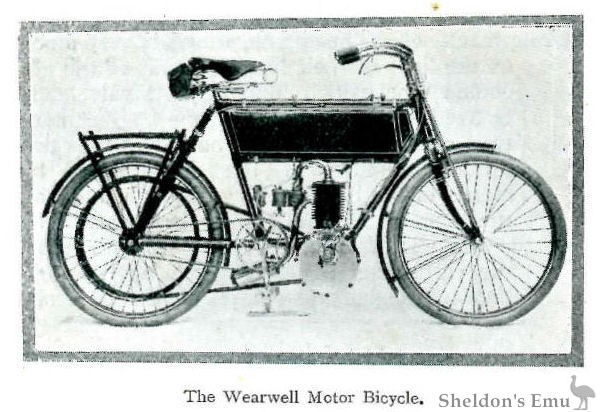

Two Types of Motor Bicycles
are shown by the Wearwell Motor Carriage Co. The most powerful of these are fitted with 3¼ h.p. vertical air-cooled engines. Great attention has been paid to the details in the construction of these machines; and the very best of components, so far as carburetters, induction coils, and accumulators are concerned, have been employed. The lesser-powered machines are fitted with 2½ h.p. aircooled engines, which are attached to the frame in an inclined position. A forecarriage machine is also to be seen on this stand. In this a 3¼ h.p. vertical water-cooled engine is employed. The drive is by means of chains and a Bowden clutch hub, which gives a free engine. Bowden twisting handle control is also to be found on this machine, and is another instance of its popularity. The disposition of the water-cooling system is always a matter of interest, and in this instance the water tank is clipped to the head of the machine behind the back of the forecarriage, the radiators being placed below the water tank in such a position that the rush of air from beneath the footboard of the forecarriage impinges directly upon the radiators. (Stand 2 9.)
The Motor Cycle November 25th, 1903. p850
National Motor and Cycle Show 1903
The Wearwell Cycle and Motor Carriage Co., Ltd., Wolverhampton
(Stand 155).
–
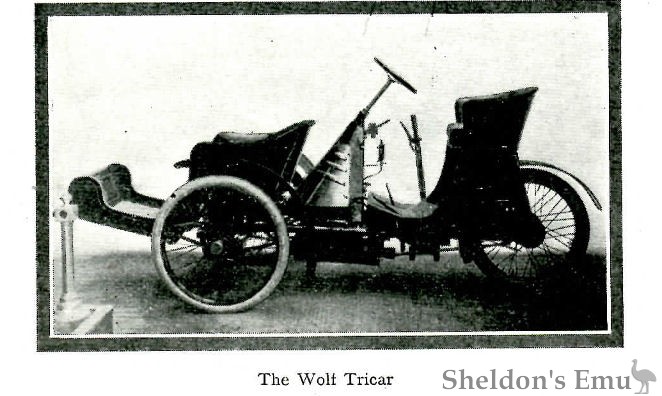
One of the most novel forecars in the show is the Wolf, made by the above firm. This has a two-cylinder engine of 5½ h.p., water cooled. The transmission is by means of a clutch to a two-speed gear contained in a box beneath the floor. From the secondary shaft the power is transmitted to the rear driving wheel through propeller shaft and bevel gear to the hub of the rear wheel. The spindle of this hub revolves in bearings formed on the rear fork ends. The change-speed gear lever is on the left hand side of the driver.
Wheel steering is employed, and the control levers are very conveniently arranged. Foot levers operate the clutch and brakes. The front seat is well sprung, and beneath this is placed the water tank, radiator, and the circulating pump, which is driven by an extension from the engine, which is, of course, placed longitudinally in the frame. The back driving seat is coach-built, and the body work is carried down to the frame, the working space thus obtained being taken advantage of for the provision of cupboards for accumulators, coils, and other parts. The standard type Wolf motor cycles made by this firm are also exhibited, and are well worthy of attention.
Report on the 1904 Stanley Show, The Motor Cycle, November 28th, page 1170.