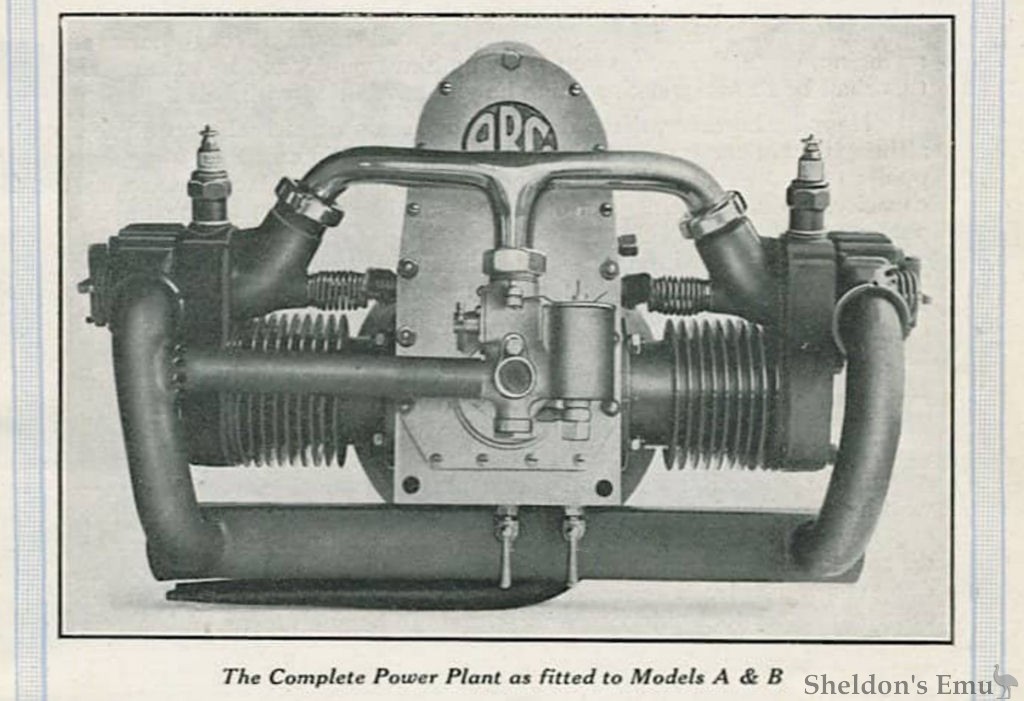
The Complete Power Plant as fitted to Models A & B
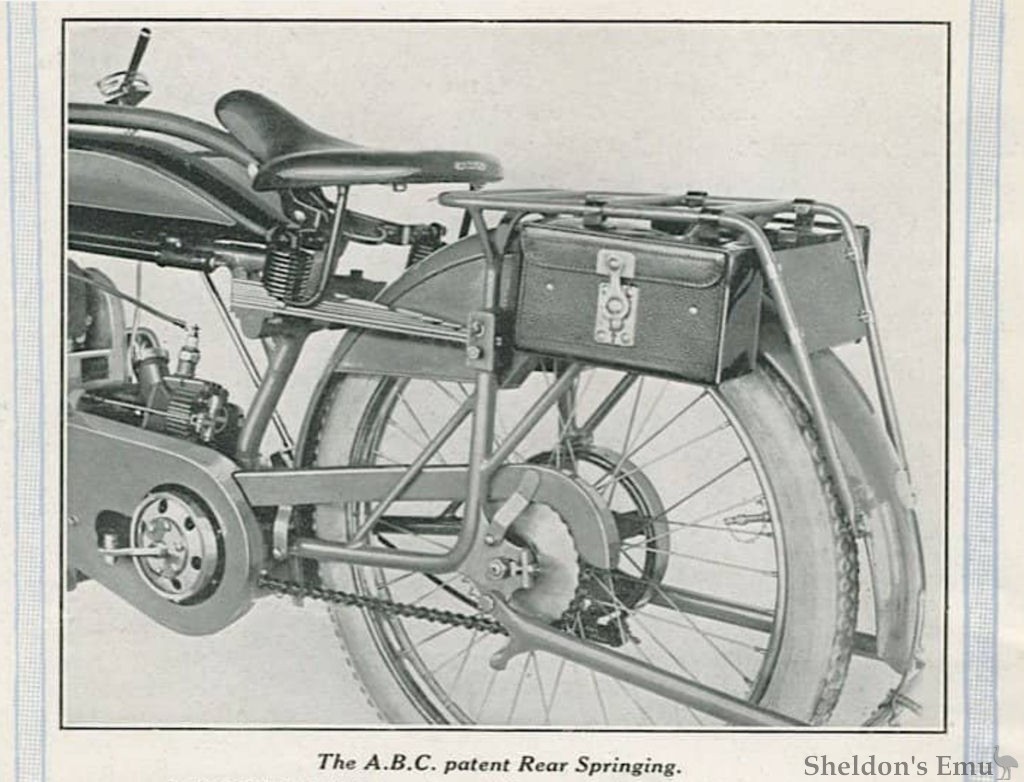
The A.B.C. patent Rear Springing. It should be noted that we have this year obviated the hinged joints at the rear spindle, the whole of the back section being in one piece and rigidly braced.
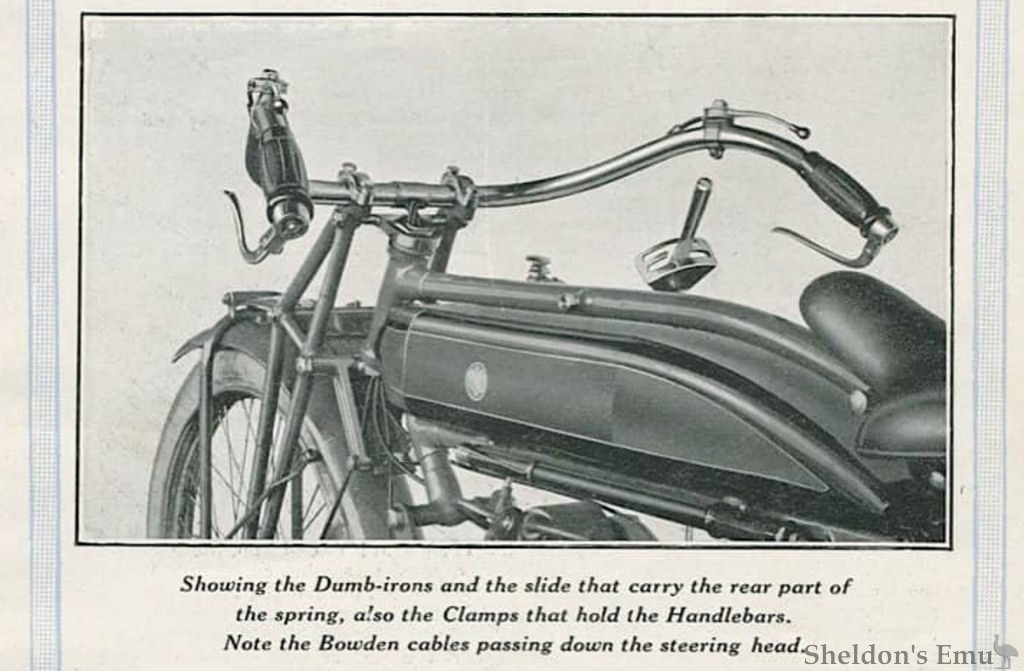
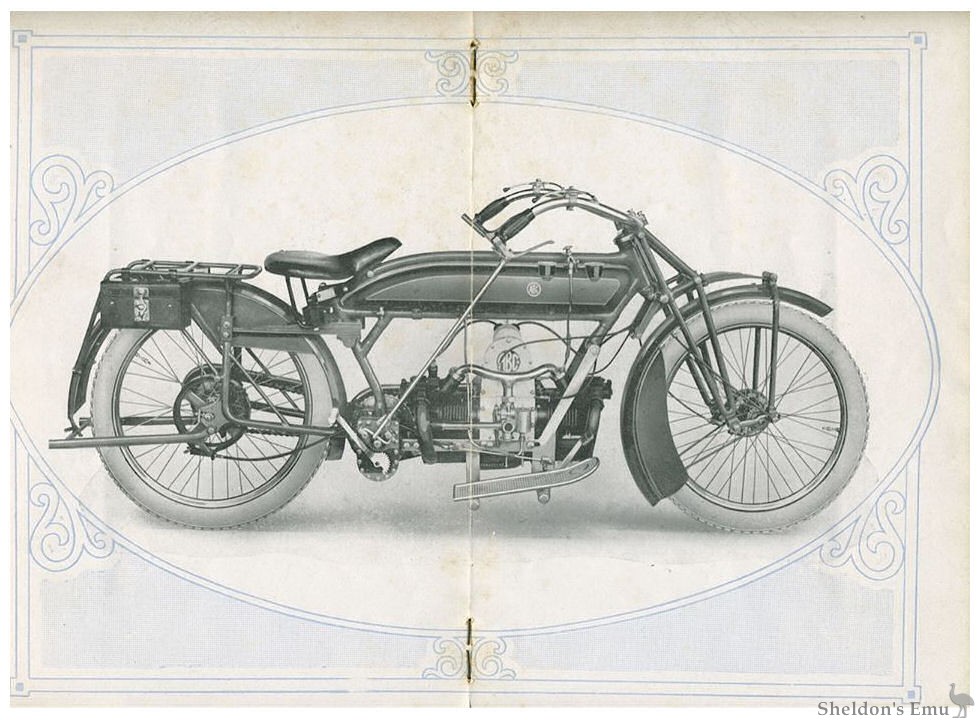
Showing the Dumb-irons and the slide that carry the rear part of the spring, also the Clamps that hold the Handlebars. Note the Bowden cables passing down the steering head.
Our rear springing is slightly improved for 1915, the springs having been raised in order to give a greater amount of movement to the back wheel, with the same length of spring, and whereas last year our back wheel could move vertically 3 ½ inches, the 1915 spring enables a deflection of 5 ½ inches, giving much greater comfort. The whole springing is extremely neat and practicable, and is entirely devoid of the numerous cross stays and girders usually associated with rear springing. We have also been able to considerably reduce the number of joints in our rear springing, there being now only one large joint, close to the gear box, this being of phosphor bronze 1 inch diameter by 4 ½ inches long.
The springs work in rollers, just below the carrier, and are designed so that they will not reduce the lateral rigidity of the machine. even should wear take place in these. The rollers are thoroughly protected from mud, and different strengths of springs can be fitted to suit all riders tastes.
The saddle is a large size "Lycett" pan seat, and this, in addition to the rear springing, gives the maximum amount of comfort that can be obtained on two wheels.
The engine is held into the frame on deep section solid steel plates, and the whole of the power unit can be removed in a few moments without disturbing any other part of the machine, or the engine can be removed separately, or either cylinder can be removed without taking the engine out of the frame.
Excerpt from Factory Catalogue, courtesy Murray Barnard, VMCCWA