
Cecil and Edward Alexander (Alick) Burney had been apprentices with Geoffrey de Havilland who later began building motorcycles. When he left that endeavour to pursue a career in aviation, the Burney brothers purchased the rights to his motorcycle engine along with casting patterns, and built their first machines. This was around 1910. In 1912 they partnered with a friend of de Havilland, Captain Harold Blackburn (later Wing Commander), as financier.
They formed a company named Burney & Blackburn Ltd. In fairly short order the name was changed to Burney & Blackburne.
Blackburne motorcycles were produced from 1913 to 1922.
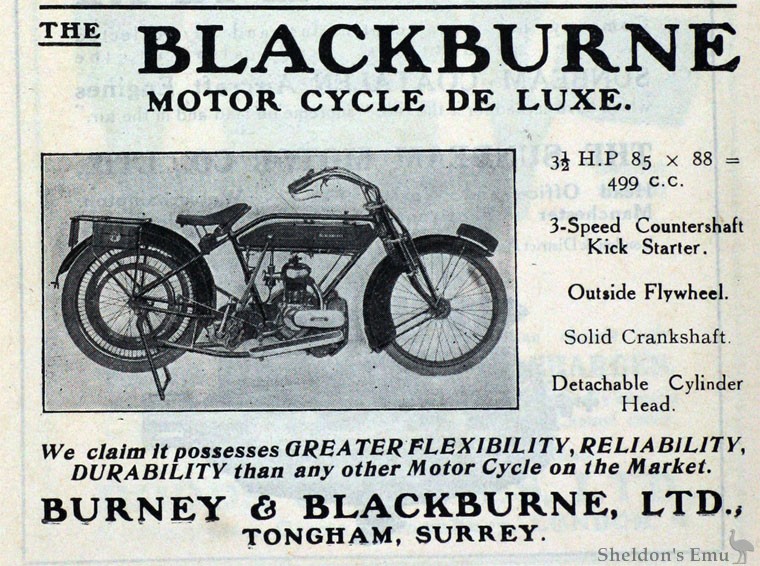
1913 The first Blackburne model entered the market early that year. It had a 499cc 3.5hp sv engine with a large outside flywheel and a one-piece forged crankshaft. This combination made it one of the smoothest running engines of the period. It also had a belt-driven three-speed hub gear and Saxon forks. Late that year the company moved to Tongham, Surrey.
1914-1915 The model adopted a three-speed Sturmey-Archer gearbox, chain-cum-belt drive and Druid forks. A single-speed TT model was also listed.
1916 Both models were still listed that year and were joined by a 3.5hp model with three speeds.
Post World War I. By 1919 they had established a relationship with OEC at Gosport, Hampshire, who built complete machines for Blackburne and also marketed them as OEC-Blackburne.
In 1919 there were four models: a 4 hp all-chain drive single (developed from the 1916 machine), a 2¾ hp two-speed single, and 8hp and 10hp V-twins.
Blackburne subsequently concentrated on engine production, and these were sold to many motorcycle firms and were used in a variety of automotive, marine and agricultural applications.
The Burney brothers formed another motorcycle business aided financially by Captain Oliver Baldwin, a well-known rider. These machines were powered by Blackburne, JAP and possibly other engines and were branded The Burney.
Produced light engines for the 1923 Lympne light aircraft trials and this led to the development of the Tomtit engine. The Thrush engine was developed from three Tomtit engines.
N.B. Blackburne is unrelated to Blackburn Aircraft Ltd 1914-1960.
Sources: Graces Guide; Martin Shelley.
If you have further information or a query related to this page, please contact us