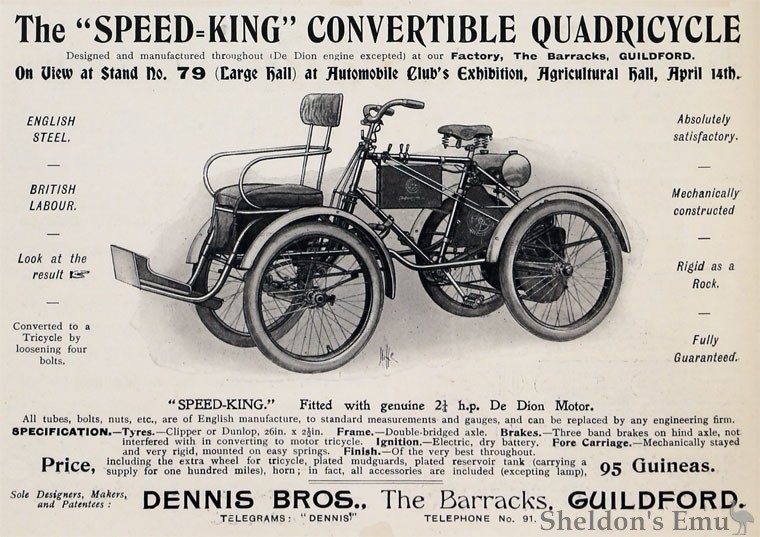
After several years as a country cousin, and various interludes with different bikes and trikes (none of which equalled the Excelsior), I returned to London, where motors were by now mildly plentiful; the streets and show-rooms afforded a more comprehensive survey of the industry than the press and the provinces had supplied. My next purchase demonstrates the whole philosophy of salesmanship. I was idling down the Euston Road when I beheld a secondhand Dennis quadricycle in one of the dealers' shops in that thoroughfare. I was still a novice, and need not conceal the fact that its gleaming aluminium mudguards drew me into the shop - so much do appearances count with motorists in their salad days. Once inside, the salesman grappled me to his soul with hooks of steel. What was I riding? A motor bicycle. Was its engine high up? Rather. Did it skid? I should say so. Had I prostrated myself beneath a bus yet? No? Well, one never knows. Had it a free engine? How did I like restarting it every half minute in a traffic block? "Now this 'ere quad. Cawn't sideslip-four wheels, y'know. A smart young feller like you's sure to have a sweetheart. Now trailers is orl right: but what they want is a twospeed gear. Ladies doesn't like 'avin' to walk up the 'ills. This 'ere quad 'as a two-speed gear. 'Ops up Sunrising, it does, like nothing on earth. Then motor-bikes hover'eats suthin' shocking. Put 'em at a 'ill, and yer 'ear their pistons a 'ammerin' and 'ammerin fit to bust theirselves. This quad engine is watercooled. Climbing she fair revels hin."
My salad days were not yet ended, and I fell. £55 was the price. The bus had originally cost £130, and except for the tyres was in excellent order. The man was a liar of the first water, but considered as a profiteer, he was the merest amateur. I owe him no grudge.
This quad survived to transport me and a variety of fairies over many thousand miles. Its worst trick was a habit of shedding the fork which actuated the low gear. As this fork was situated at the extreme tail of the machine, its loss was never noticed, until a hill called for low gear, when the lever would be thrown over, and the machine would slowly conk out, still on top gear. As the gear was of French make, and the factory in Paris ignored every S.O.S., the only remedy was to haul the machine round and drive back, eyeing the road already traversed till the fork was found. The salesman had said she could not skid. Injudicious braking, especially on tramlines, caused her to do "wheels "worthy of a Guards battalion under inspection by the King. There are skids and skids. The most dangerous vehicle I ever owned was a 3-1/2 h.p. Renault car which resembled the Holy City in that the length and the breadth and the height of it were equal. On a grassy road this voiturette would spin round like a Drury Lane columbine, being seen only as a faint blur. Second to it for skidding propensities came several high-powered tricars built about 1906, which would face about in their tracks like a soccer wing man of international class. But the old quad was capable of wheels and right-abouts which absolutely took one's breath away. On the other hand, her centre of gravity was so low that she never upset; and in the early days of motoring that was sufficient reason for thanksgiving.
She was convertible into a tricycle by the simple process of unbolting the long sidebars which held the fore-carriage, and sticking a spare wheel between her front forks. In this guise she was a perilous mount indeed. The engine and gearbox were slung at the extreme rear, behind the axle, like the bustle of a Victorian belle. Above them was a huge cylindrical plated tank, containing oil, water, and petrol, as big as the barrel of an eighteen-pounder field-gun, and nearly as heavy. To balance this bulky tail there was nothing in front but a pair of forks and a light wire wheel. If one stood behind the machine and hooked a forefinger under the saddle, it was possible to pull the whole contraption over backwards. I did not understand this till I gave a small boy a joyride on the bridge of the back axle. We came to a steepish hill, slowed down, and toppled slowly over backwards. If the trike front wheel hit a large stone in the road at speed, the front wheel would lift about a foot into the air, and we would career along like a racing hydroplane in the bay at Monaco poised on our extreme tail. Uphill the quad was nominally a two-speeder. Normally she was a one-speeder, for the low gear fork was generally missing when wanted. (I got over this by commissioning a friend in Paris to visit the Dupont works with a revolver, and not to quit until he had extracted a dozen forks from the proprietor.) But in practice she might rely on six speeds, viz.
If we utilized all six speeds, we could climb any hill. I use the word "running" above, but on sober reflection I must substitute the term "walking," for she was no flier at the best of times. She scaled a good quarter of a ton. Her engine was about 2-3/4 h.p. The epicyclic gear was a regular sponge for sopping up horsepower. On the level against a strong headwind, we had to force her hard if we wished to average twelve miles an hour, which, by the way, was the legal maximum in those days.