The Campion Cycle Co., Ltd., Nottingham (Stand 153).– An ordinary type of 2¾ h.p. engine motorbicycle which does not present any special features, but has the appearance of a good sound machine, is exhibited by this firm. A 4 h.p. forecar is also shown. The engine is water-cooled, and is fitted with a two-speed gear of the sliding gear type, driven by chains on to the back wheel. The machine is built as a tandem, and is of good appearance.
Report on the 1904 Stanley Show, The Motor Cycle, November 28th.
1905 The solo had now increased to 2¾ hp and the forecar had a water-cooled 4hp engine and two-speed gear.
1907-1911 Motorcycle production was dormant between those years.
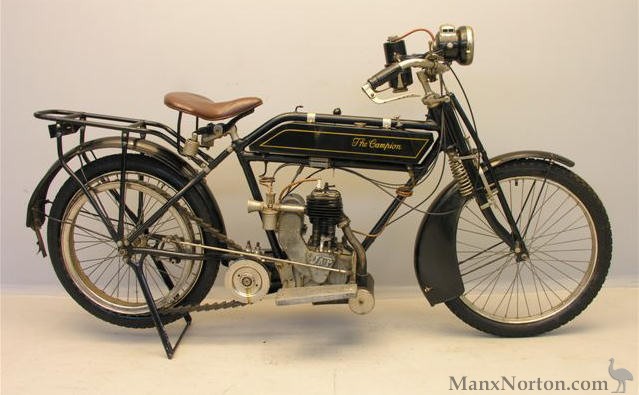
Campion 1918 Motorcycle
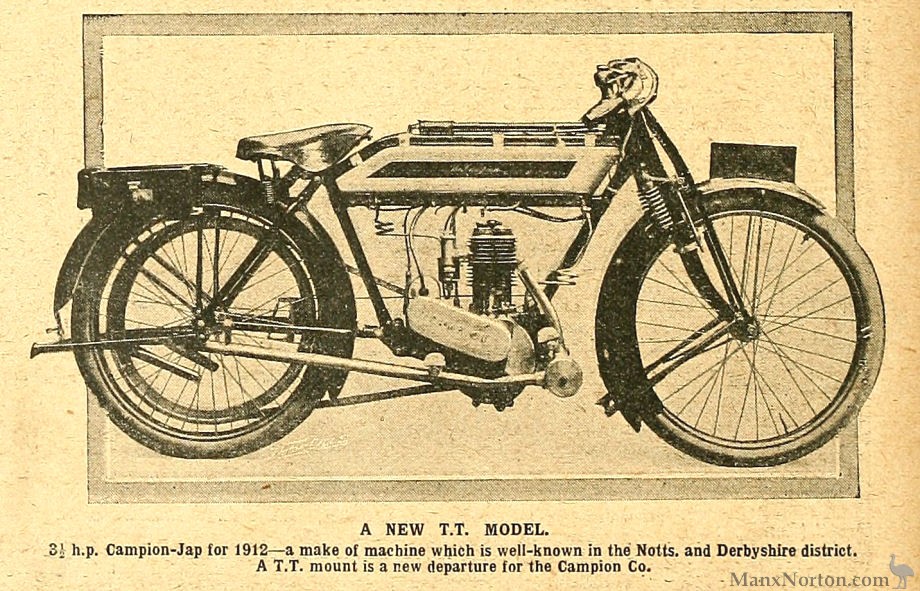
1912 A new range appeared with JAP singles and V-twins with belt drive, and some had Roc gears. Shortly afterwards there were two-speeds and chain drive, followed by models with Precision, water-cooled Green or Villiers engines, as well as the JAP ones.
1915 Three-speeds had arrived, using Sturmey-Archer and Jardine gearboxes.
The 1915 770cc V-Twin employed a Jardine gearbox, Druid forks and a Dixie magneto from Splitdorf. Many had Miller acetylene lighting.
1916 The sturdy big twin was now equipped with a Jardine four-speed gearbox, which was a very special feature in the teens when three-speed gears were common. The foot-boards were aluminium castings, as were the horizontally split primary cases. The magneto was an American-made Splitdorf, as specified for many English machines in the war years when there was a real shortage of British built magnetos. Secondary transmission was by rubber belt and the front forks were Druid.
1920 Post-World War I saw the company back in the listings with one model that had a 770cc JAP V-twin engine and Sturmey-Archer transmission.
1921 Several models were now available, including a 976cc version along with 293cc and 597cc sv JAP singles plus a 269cc Villiers model - all with two speeds.
1921 Motorcycle 500cc. Exhibit at Nottingham Industrial Museum.
1923 The largest twin was listed with three speeds or a four-speed Jardine gearbox, and in solo and sidecar forms. Yet another model had a Blackburne single engine.
1924 The range shrank to the 147cc Villiers, 293cc JAP and the 976cc V-twin.
A report on the 1924 Motor Cycle Show reads,
Blackburne engines are fitted throughout and Sturmey-Archer three-speed gear boxes. The transmission is by chain in all models, and both front and rear brakes take effect on the hubs. A B.T.H. magneto is fitted and 26 by 2½ in. Dunlop tyres. A special feature of all models is the new pattern Campion Aero front fork.
1925 They were using Blackburne engines in two sizes and touring sv or sports ohv. The firm then stopped making their own machines.
Note: For a couple of years afterwards the company remained in the trade, building motorcycles for New Gerrard.
Sources: Graces Guide motorsportmagazine.com
If you have further information or a query related to this page, please contact us