
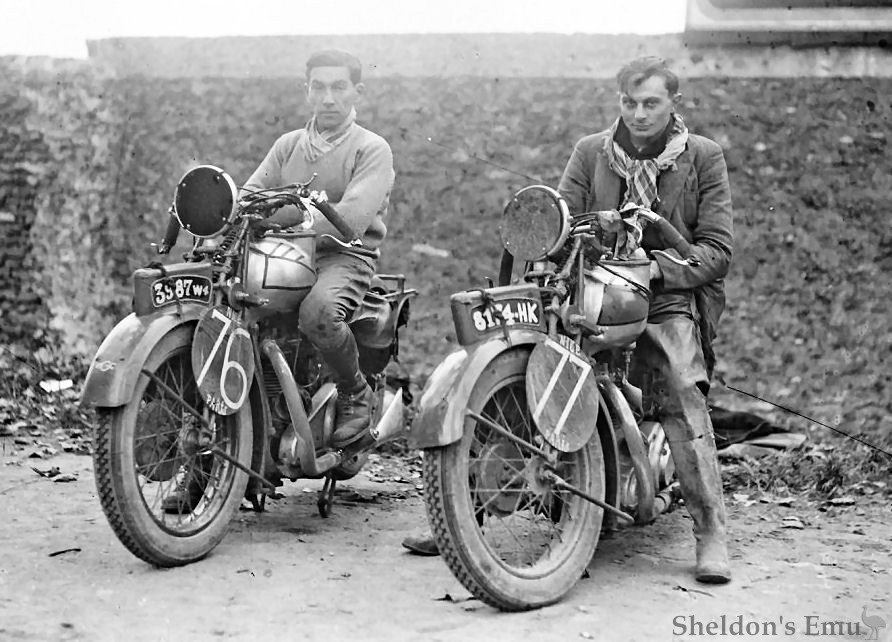
Montgeron, 23-10-29, Nice - Paris, de gauche à droite sur MGC Marcel Guiguet Compagnie
Made in France 1927-1938
Manufacturer: Marcel Guiguet & Compagnie
CORBELIN (Isère).
Number Built: around 250
Marcel Guiguet built his first motorcycle in 1918, when just 17 years old, and designed an engine which he built in 1920. He became a mechanic for a heavy vehicle manufacturer in Lyon, and later worked with Hispano-Suiza and Gnôme et Rhône.
In 1927, he converted the family carpentry into a motorcycle workshop.
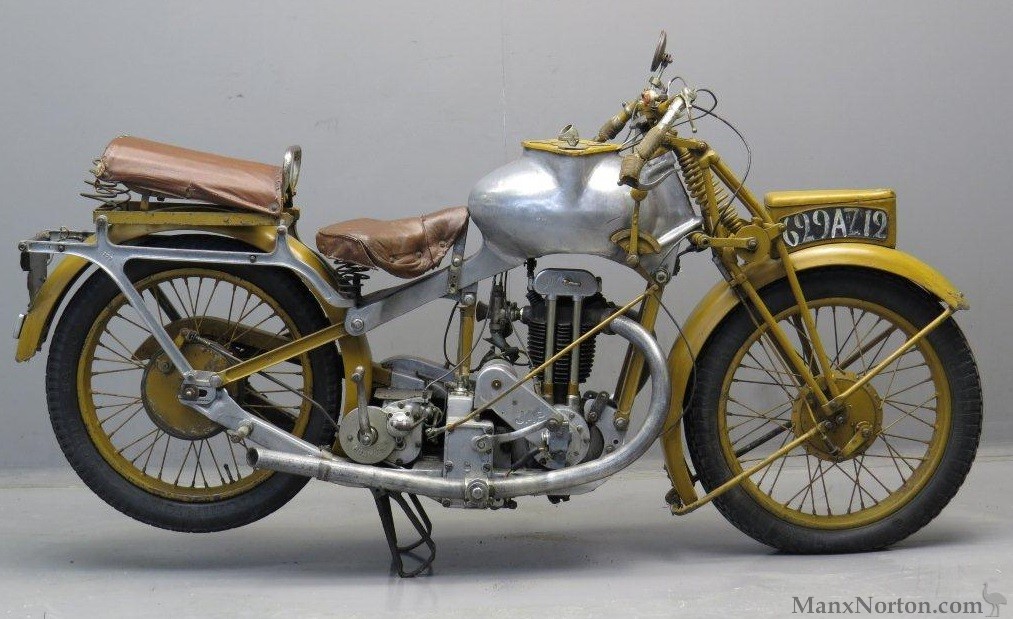
In 1928 Marcel and his brother Joseph formed the MGC company. Their prototype was equipped with a cast aluminium "Alpax" frame which caused a sensation when first presented at the 1929 Lyon show; the machines were fitted with J.A.P. 250cc and 500cc engines, and a 350cc Chaise.
Another technical innovation was integral braking, similar to that used by Moto Guzzi nearly fifty years later. The next production motorcycles to use an alloy frame were the RG250 of 1983 and the GSXR750 of 1985.
The alloys used were not of today's standards and the frames were prone to failure, and the integral fuel tank would leak. Tanks of these models were exchanged by the factory with new ones of a different design and appearance.
By 1931 the machines were much improved, incorporating the new fuel tank on the 500cc N3A model. Three years later, despite some reasonable racing results sales had not improved due to the financial crisis which had engulfed the world's economy.
The N34, powered by a 600cc inverted inline four of similar configuration to the Tiger Moth, was developed between 1935 and 1938, with the first concept drawing believed to be from 1931. Of unit construction it had a reverse gear, but had serious cooling problems. Power was transmitted via the camshaft to the gearbox. The fuel tank was integral with the upper frame in the same style as the single cylinder models, and it had plunger style rear suspension. The engine was possibly inspired by a similar design created by his brother Joseph-Henri and used in pre-WWI aircraft.
The project proved an expensive failure and was abandoned in 1938. Then came war.
Marcel Guiguet converted one of his racing machines for road use and continued riding it for many years after WWII, but no more MGC motorcycles were built.
The Stork logo is derived from the WWI Escadrille des Cigognes Spad squadron with which Marcel's older brother Joseph-Henri Guiguet (Légion d'Honneur) had flown, and who was co-founder of the MGC company. See also Aviation and Motorcycling
1930 Models
250cm3 Type N 3 B "Sport" 245.3cc JAP
350cm3 Type N 3 349cc JAP
500cm3 Type N 3 A "Sport" 490.5cc JAP
500cm3 Type N 3 A "Grand Sport" 490.5cc JAP
1931 Models
Type N3 350cc OHV JAP
Type N3R 350cc O.H.V
Type N3S 350cc O.H.V
Type N3C 350cc O.H.V
Type N3L 350cc S.V. JAP
Type N3LL 350cc S.V JAP
Type N3R 350cc OHV competition
Type N3A 500cc OHV JAP
Type N3AL 500cc S.V
Type N3AR 500cc OHV competition
Type N3AS 500cc OHV
Type N3A600 600cc OHV Sturmey Archer 3-speed
1934/35 Models
Type N3 350cc OHV JAP
Type N3A 500cc OHV JAP
Type N3AS 500cc OHV JAP
Type N3B 250cc OHV JAP
Type N3BL 250cc SV JAP
Type N3C Chaise 350cc
Type N3L 350cc S.V. JAP
Type N3LL 350cc S.V JAP
Type N3AL 500cc S.V JAP
Type N3BR 250cc JAP
Type N3R 350cc JAP
Type N3AR 500cc JAP
Type N3A600 600cc OHV JAP
Four-speed gearboxes were optional for many of the 34/35 season machines.
Further information: MGC Club de France
Sources: JLB Creations; logo.akeonet.com; Charlie Willis
Mon Nov 24 2008
oberger38 at orange.fr
infos
mgc n3as
bonjour
je possede une catre grise de MGC N3AS de 1938
je desire la vendre ,ou et qui pourris je contacter pour en savoir plus sur ces machines !
merci
cordialement
olivier
lyon fance
Translation:
I have a gray catre MGC N3AS 1938 I desire to sell, or which could I contact to find out more about these machines! Thank you cordially
Any motorcycle for sale in France must have a registration document (le certificat d' immatriculation), more commonly known as la carte gris. I suspect it's the carte which is for sale, not the motorcycle it mentions.
Sat Feb 18 2006
fournier.stephane at wanadoo.fr
MGC motocycles
I owned a MGC when I was young and I met Marcel Guiguet himself who told me his real history which is different that it is said in the most of article about him. Contact me if you whant........
Lyon France
Jan 6th 2004
This is the address of the French MGC Club
www.mgcclubdefrance.fr
This is a translation of the front page of their site (updated 2026):
MGC Motorcycles with the Stork Logo
Initially a motorcycle racer in the 1900s, Marcel Guiguet would later leave an indelible mark on the world of motorcycling. Before co-founding the company Marcel Guiguet et Compagnie (MGC), his mechanical creations, hallmarks of great talent and immense innovation, would indeed distinguish him and allow him to acquire worldwide renown.
This site is intended as a modest tribute to this extraordinary inventor. We will touch upon his story, his successes, and his incredible motorcycles.
A motorcycle enthusiast
Marcel Guiguet was born on February 25, 1901, in Corbelin, Isère. He was the son of a carpenter and also had a brother, Joseph Guiguet , who was a brilliant fighter pilot and an ingenious mechanic. François Guiguet, the brothers' uncle, was a painter. Together, in the late 1920s, they founded the company Marcel Guiguet et Compagnie, which would become a prominent name in the world of motorcycles.
Before delving into the technical details that explain this success, it's important to remember that from a very young age, Marcel Guiguet nurtured a passion for motorcycles, participating in several two-wheeled races. He was therefore well-positioned to know what to expect from a top-of-the-line machine. Beyond that, he also possessed a creative spirit, the hallmark of great inventors: this contributed significantly to the success of his transition from racing to the mechanical industry. Furthermore, the partners in the small family business proved to be perfectly complementary.
Marcel Guiguet motorcycles: a lifetime's work While not limited to this, the renown of Marcel Guiguet motorcycles rests, in large part, on their choice of material: a material based on a light aluminum and silicon alloy with high resistance in Alpax AS 13. The use of Alpax gives the tank an infallible hydraulic resistance.
The structure also adopts a special configuration with a beam chassis and fuel tank replacing the usual frame. This assembly method allows for an easily disassembled and interchangeable structure. The engine and gearbox assembly is intelligently designed to create a seamless unit extending to the rear wheel. Thanks to this assembly technique, from the early 1930s to the late 1940s, Marcel Guinguet et Compagnie was able to produce motorcycles with unparalleled mechanical properties, which conquered the French market and were even exported beyond its borders.
Hope this helps...
Charlie Willis charlie-w at ohnoyoudont dot com
If you have a query or information about MGC motorcycles please contact us.