
A Brief History of the Marque
Made in France from 1931 to 1956
P. P. Roussey Frères
15-17 quai de Belfort
DIJON (Côte-d'Or)
Pierre and Paul Roussey built sophisticated machines powered by Chaise, Staub and Aubier-Dunne engines of 100cc to 500cc capacity.
1930 Models
At the 1948 Paris Salon the FL22 Comdinus scooter appeared with a P.P. Roussey engine. Then in 1952 Roussey presented their own lightweight scooter with a 3-speed water-cooled engine of 125cc or 170cc. It reappeared at the 1953 Salon with changes, and finally entered production in 1955, albiet briefly and in low numbers.
Pierre Ducloux raced a water-coooled P.P. Roussey scooter in the 1958 Bol d'Or 175 class and was apparently doing very well before a handlebar fell off, which slowed him down some but did not prevent him from finishing. Ducloux had a long career in aviation and was CTO for the Concorde. He was a passionate motorcyclist, a restorer and historian, and wrote many articles for the French motorcycling press. He died early in 2017.
The scooter was apparently also raced under name of Frères Terrioux at the 1958 Bol d'Or.
Paris Salon de l'Automobile, Octobre 1948
ROUSSEY AUXILIARY ENGINE
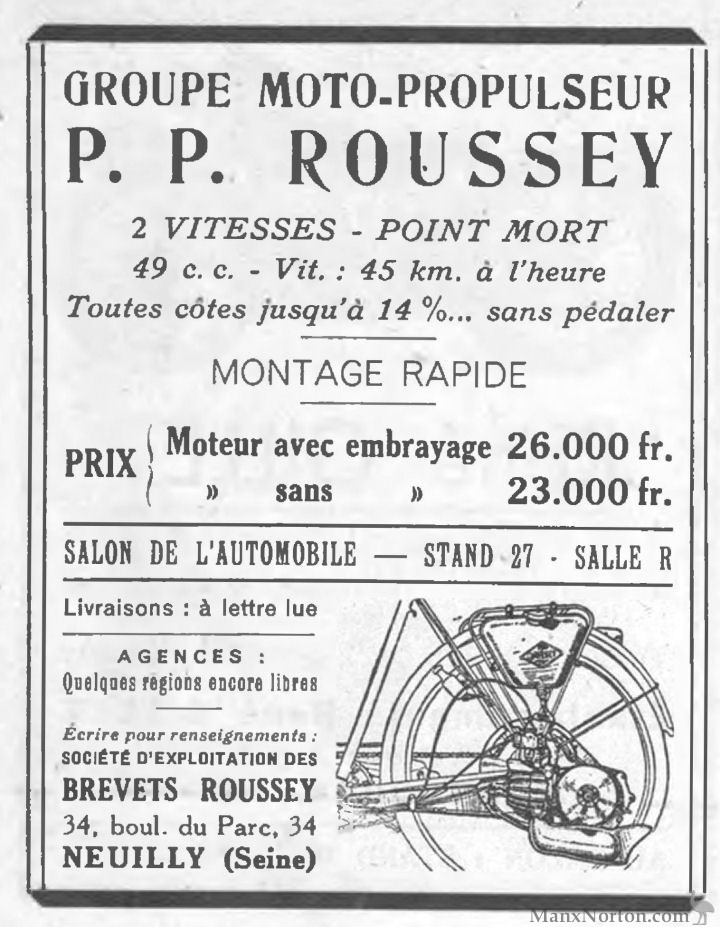
Société D'Exploitation Des
Brevets Roussey
34, boul. du Parc, 34 NEUILLY (Seine)
MOTEUR AUXILIAIRE ROUSSEY
Distribué par la Société d'Exploitation des brevets Roussey, ce moteur de 50 cmc. se distingue de ses confrères du fait qu'il constitue un groupe comportant deux vitesses avec embrayage et un moyeu frein.
Il se monte à hauteur du moyeu arrière par l'intermédiaire d'un flasque formant jambe de force venant se fixer à hauteur du pédalier et absorbant tous les efforts dont pourrait souffrir le cadre. La transmission se fait par une chaîne protégée par un carter.
Le Roussey donne 1 CV. à 4.500 tours; cette puissance le rend tout particulièrement apte au cyclotourisme.
Distributed by the Société d'Exploitation des brevets Roussey, this 50cc engine stands out from its competitors because it is a two-speed unit with a clutch and a hub brake.
It is mounted at the rear hub via a flange that acts as a strut, attaching to the bottom bracket and absorbing any stresses the frame might experience. Power is transmitted via a chain protected by a chain guard. The Roussey engine delivers 1 hp at 4,500 rpm; this power makes it particularly well-suited for touring.
1948 Paris Salon, Motocycles. Courtesy Memoire du Cycle.
Sources: JLB Creations, Amis Terriens, François-Marie Dumas, Memoire du Cycle, period literature.
If you have a query or information about P.P. Roussey motorcycles, please contact us.