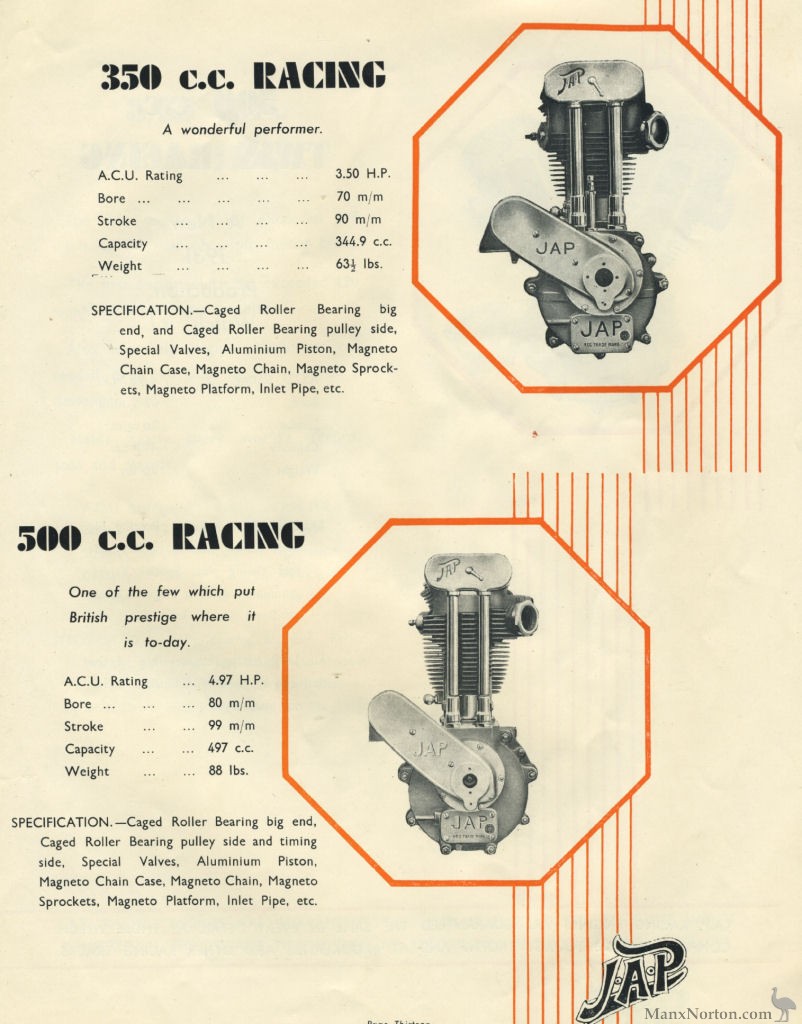

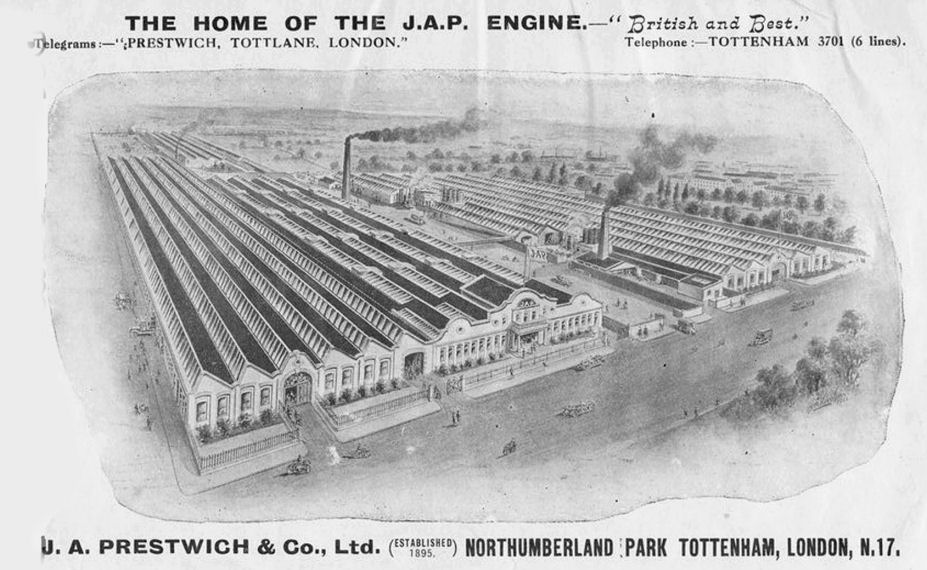
A. PRESTWICH & Co., Ltd. NORTHUMBERLAND PARK TOTTENHAM, LONDON, N.17.


Historically, the growth of the J.A.P. engine– ever in the forefront of the industry –would make interesting reading : but space prevents the description of the numerous earlier engine types and of the innumerable successes gained by them on road and track, and in the air. For the same reason it is not possible here to describe the special processes of manufacture, the fruit of experienced ingenuity, which upheld the J.A.P. reputation for first-class workmanship, and which ensure, for instance, the interchangeability of spare parts.
Page 3.
At the present day the trend of motorcycle engine design is becoming fairly clearly marked. It is not so much the obvious alterations–such as the general substitution of aluminium for cast iron as a piston material–that are significant ; but there is a growing tendency to multiply engine types and sizes to suit the various conditions of use, rather than to design one engine type to meet several sets of conditions. This tendency, which is well reflected in the J.A.P. range of engines, is, of course, right, as it is the road to greater Efficiency; and too much stress can hardly be laid on the necessity for selecting an engine of correct type for the particular work which it must perform. A standard engine, intended for ordinary touring, cannot be tuned to give the same results as a sports engine ; while conversely the sports or racing units should be treated with the care due to such types.
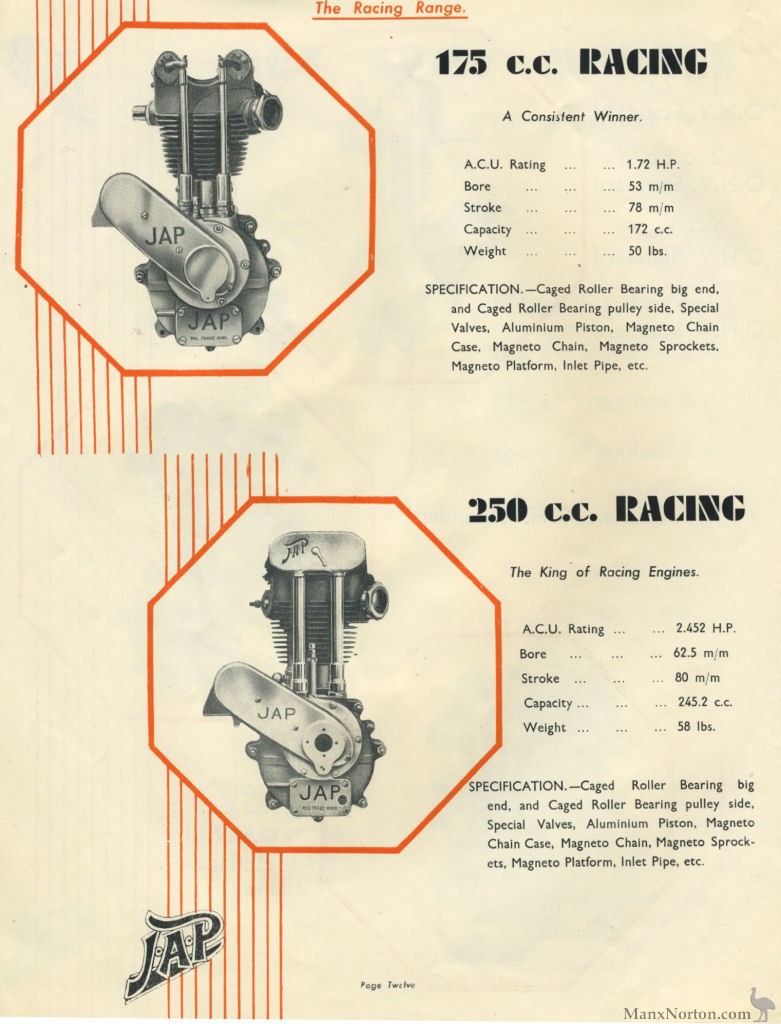
J.A.P. engines, then, are now supplied in various well graded sizes, and in three distinct ranges– Standard, Sports and Racing models. The Sports types give more power than the Standard engines, and are suitable for both touring and local competitions. The engines in the Racing range, however, should be used only for Racing; and are designed to perform well without special tuning in important events at Brooklands and elsewhere. The very fullest information about any particular model can always be obtained on application, but the descriptions in this book will convey a clear impression of the distinctions between types referred to earlier.
Page 4.
CYLINDERS, Comparison of present day designs for cylinders with those of 1920, or earlier, illustrates very clearly the search for efficiency mentioned on a previous page. But apart from the progress in cooling gained by deeper finning brought low down the barrel, a less obvious improvement lies inside the modern J.A.P. cylinder bead, which is carefully shaped to promote gas turbulence and, as a result, better petrol consumption and higher power. On some of the side-valve engines the cylinders are carefully machined from a one-piece casting, other engines have detachable cylinder heads, the head being securely fitted to the cylinder barrel by nine holts of special steel. Both types of cylinders are held to the crankcase by four holding down nuts, screwing on to studs passing through the cylinder base flange. The valve ports and chambers are carefully designed to minimize gas friction.
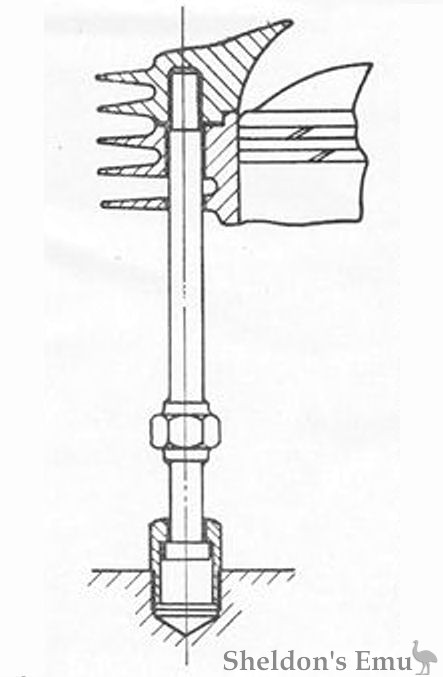
On the O.H.V. racing engines the cylinder barrel and cylinder head are separate castings, between which a copper gasket ensures a perfect joint. The head and barrel are drawn tightly down on to the crankcase by special flanged bolts screwing into the cylinder bead, and their operation can easily be seen from the accompanying illustration. The cylinder head contour is hemispherical, each valve axis being inclined some 35° from the vertical; and very particular care has been paid to the disposition of metal round the ports, valves and sparking plug, so that there shall be no possibility of distortion.
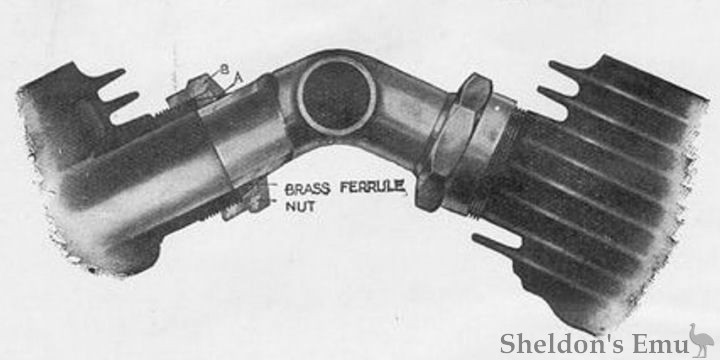
In the case of twin cylindered engines a special design of induction pipe union is employed. The inlet pipe is of the same diameter throughout, and the brass ferrule A, is a sliding fit on this.
Page 5.
The union nut B, is tapered to correspond with the bevel of the ferrule, and thus tightens it down on to the pipe when screwed to the port. An air-tight joint, which yet allows for cylinder expansion, is in this way obtained.
Page 6.
CRANKCASES are cast in dies from a special aluminium alloy, particular attention boing given to the design to ensure stiffness of the walls. In every crankcase is embodied the patent J.A.P. lubrication system, which ensures a full supply of oil under considerable pressure to all moving parts. There are three main variations of this patent system which have been embodied in our engines at various periods. On engines from 1913 to 1922 the oil is delivered to the engine either through a union at the apex of the crankcase or else at the back of the cylinder neck, a spot where normally little is thrown by the flywheels. After lubricating the piston skirt.it drops to the oil sump, and is forced thence by the pressure generated on the downward stroke of the piston via a non-return valve of the disc type, into nil oil box, where it is stored under pressure. From here it passes up a tube leading to the timing side main bearing bush, and thence through the drilled flywheel and crankpin to the big end. The timing gear is lubricated by oil escaping from the main bearing, and also by oil issuing from a non return vacuum valve, situated in the inner wall of the timing case. This valve relieves any excess of pressure in the crankcase, and actually sets up a partial vacuum, so that any oil which may tend to work out of the joints or bearings is drawn back into the case. It is not advisable to remove the two screws which, on most engines, hold the nonreturn valve seats to the crankcase, as these are burred over on the inside.
On engines built in the years 1923 and 1924 this system was modified; the oil being delivered first to the timing case, and the non-return valves being transferred to the oil box. The timing case and crankcase are in free communication, so that oil is pumped liberally over the highly stressed cam gear. The oil then drops into the oil box, where it is trapped by vacuum valves, and is kept at atmosphere pressure by a relief pipe. The suction caused by the upward stroke of the piston closes the non-return valves, and draws oil up a tube leading to the gear side main bearing, whence it is thrown by centrifugal force, through a duct in the flywheel, to the big-end rollers.
A more positive pressure supply is now provided for many later type engines.
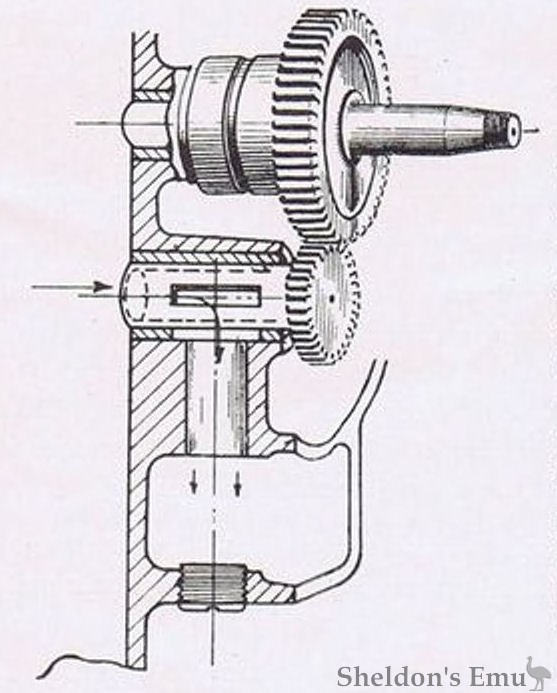
A vertical passage between the timing case and oil box is closed at its upper end by a horizontal sleeve, which is rotated at engine speed by the cam wheel, and is blanked oft at the driven end. The inner end of this sleeve communicates with the crankcase, and when a slot in the sleeve comes into line with the vertical passage, oil is forced through into the oil box by the descending piston. The rotary valve is timed so that the slot has just passed the oil box opening when the front piston is at bottom dead centre: or, in the case of singles, when the piston is 25° past bottom dead centre.
Page 7.
On all engines provided with the rotary valve, a system of lubrication is employed, whereby oil is delivered from the mechanical pump through a hollow timing side shaft, direct to the big end bearing of the connecting rod, thus ensuring an ample supply of lubricant to what is undoubtedly the most highly stressed bearing in the engine, and at the same time the most difficult to lubricate.
In recent years a number of engines have been designed with the " dry-sump " system of lubrication.
The oil pump incorporated in "J.A.P." engines is of the double acting type, i.e, one end of the plunger delivers the oil from oil tank to engine, and the other end of the plunger returns the oil from the sump to the tank.
The latter plunger is of a larger diameter than the delivery plunger, and is the scavenging side of the pump for maintaining the " dry sump."
Upon all "Dry Sump" engines the oil is gravity fed from the oil tank through a pipe to the pump, generally to the lower union. The oil is then pumped via connecting passages through a small steel tube projecting from the inside of the timing cover, into the drilled timing spindle, which connects with an oil passage in the timing side flywheel, and thence to the big-end bearing.
The method by which the oil enters the big-end bearing varies. In some engines the crankpin is drilled to correspond with the oil passage in the timing side flywheel and oil is pumped through the crankpin to the bearing, in other engines the crankpin is not drilled, but the oil passage in the timing side flywheel breaks the surface of the inside of the flywheel boss directly opposite the bearing.
From the big-end bearing the oil escapes into the interior of the crankcase, and by splash system lubricates the cylinder wall and piston.
The driving spindle bearing is lubricated by oil collecting upon the crankcase wall and draining into oil channels to an oil pocket connected by an oil hole to the bearing. The timing spindle bearing is lubricated in a similar manner.
Page 8.
Surplus oil in the interior of the crankcase is diverted into the sump. The sump is connected by drilled passages in the crankcase and timing cover to the pump, and the pump by an oil pipe to the tank. Oil collecting in the sump is thus returned under pressure to the oil tank and completes the system of circulation.
It is important that the oil tank be drained, cleaned out, and replenished with fresh oil every 1,000 miles. The oil level in the tank should be checked every hundred miles and replenished as found necessary.
On old type J.A.P. engines the MAIN TIMING PINION is screwed on to the gear spindle with a left-hand thread, and can only be removed satisfactorily by means of a special tool. On models since 1920, however, a tapered and keyed shaft is used, on to which the pinion is locked by a left-hand threaded nut. Three or five keyways are cut in the pinion taper on the " Vernier " system, so that the use of each keyway varies the valve timing by one-third or one-fifth of a tooth. On all O.H.V, engines the push rods are tubular. All O.H.V, and most of the S.V. engines have the cam levers fitted with rollers bearing on the cams, to lessen the friction at this point. The cam contours themselves are carefully calculated to obtain maximum efficiency coupled with minimum stress.
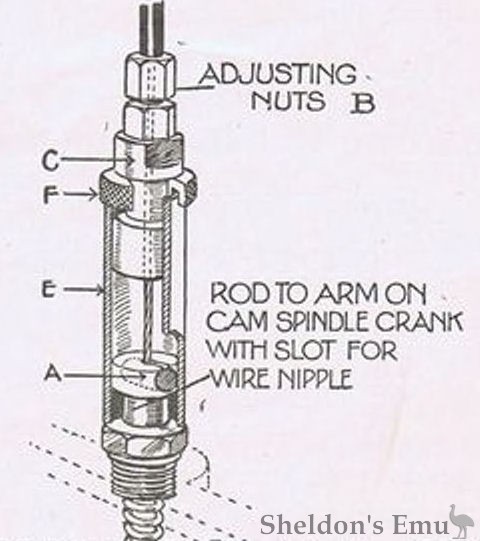
The EXHAUST VALVE LIFTER is screwed into the timing case cover, and its method of working can easily be understood from a glance at the sketch at the side. When the cable has to be detached, the Bowden adjuster must be pulled up until the knurled collar can be removed; the spacing sleeve is then slid up the wire until the nipple can be removed from the brass yoke piece.
Page 9
PISTONS. In few parts of an engine has there been a greater advance in design within the last few years than in pistons. Cast iron was once the only material contemplated for such a use on standard engines, but at the present day aluminium is generally much to be preferred. On all our engines we now use pistons of a special alloy of aluminium, the outcome of much research work both in the laboratory and on the Track. They are die-cast, since this produces a finer grain of metal.
A hollow steel gudgeon pin is fitted and is a floating fit both in the piston bosses and small end bush. The pin is located by spring circlips in the piston bosses.
The CONNECTING RODS are steel stampings, of ample strength. They are, however, already as light as possible, and no attempt, therefore, should be made to drill them. On the twin cylinder models the forked and centre rod principle has always been employed, since there is then no binding strain due to the connecting rods being out of the piston centre line. The big-end bearings are of the roller type, manufactured throughout at our Works. Single cylinder engines have two rows of rollers fitted in an aluminium alloy cage, and twin cylinder engines four rows of rollers separated by steel washers.
Inside FLYWHEELS are employed on all J.A.P. engines, since there is thus no possibility of crankshaft whip and probable fracture. They are of large diameter, and great care is taken to see that each individual wheel is perfectly balanced and paired with its fellow. The spindles are all specially hardened and ground, and are a taper fit in the wheels, being held tight by means of a lock nut.
VALVES. On almost every J.A.P. engine the inlet and exhaust valves, working in press-in guides, are interchangeable, but on certain types, even though the actual size of each valve is the same, the composition of the steel is very different. Every valve is stamped on the head with a number which indicates the material and if the inlet valve bears a different marking from the exhaust, the valves must on no account be interchanged.
Page 10
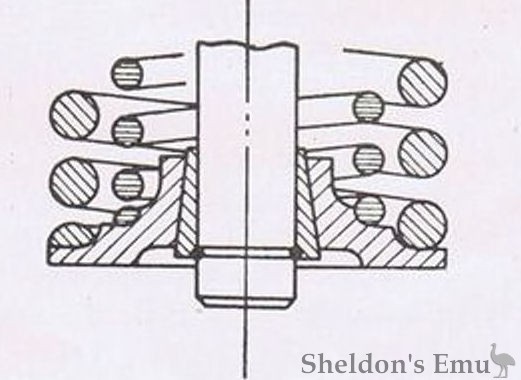
On many S.V. and all O.H.V, engines the valve stem is not drilled for a cotter, but is recessed near the end to locate a spring circlip. A split taper collar lodged here bears the pressure of the valve spring collar which is tapered inside to correspond.
Page 11
SPARES AND REPAIRS
A complete stock of replacement parts for all types of J.A.P. power units is maintained, and the repair and overhaul of customers' engines at the hands of an expert Staff is a speciality.
In order to facilitate delivery of SPARES the following points should be observed
1. The engine number should ALWAYS be quoted, WITH ALL ITS SYMBOLS; thus:– GTO/Z 1001/S. This number will be found stamped either on top of the timing case, or else on the top front crankcase bolt lug.
2. All correspondence should be conducted under one name only; and since, according to the usual business methods, we must be in receipt of a remittance before dispatching any parts, time will be saved by sending the correct amount with the order. All spare lists can be supplied on demand.
3. Customers claiming free replacement of parts under our guarantee, MUST return the alleged defective parts for our examination, carriage paid ; and must, in addition to the engine number, quote also the date of purchase. All parts returned from customers abroad must be accompanied by a certificate of origin : i e., a copy of the original invoice.
4. In the case of old type engines (prior to 1918), it is most advisable to send in the old parts as patterns, when replacements are required. Often engines of early type have since been brought up-to-date by fitting parts of recent design and manufacture.
Page 12
REPAIRS are always executed as speedily as possible consistent with good workmanship. When sending an engine to us for an over-haul or repair, full instructions should always be sent in in advance stating definitely whether work is to be put in hand, or whether an estimate only is required. In the latter case, the engine is stripped upon receipt, carefully examined, and a full report and estimate of cost sent. This estimate may be treated as an invoice, and a remittance to cover the amount will save any delay when the engine is ready for dispatch. If an estimate has been asked for, work is not commenced until we are in receipt of definite instructions to proceed. In dispatching repaired engines, unless we are instructed to the contrary, we return by goods train, carriage forward. In the case of urgent repairs, however, or where we have received instructions, engines are sent by passenger train, carriage paid. A further invoice is then sent for the carriage charge, or else an approximate amount is included in the estimate, and any balance is returned later, after the account has been received from the Railway Company.
The following points should be noted :–
1. In the event of damage to one side of a crankcase, it is essential for the other side to be returned to us with the order since the two halves have to be machined up together, in order to secure correct alignment of the two cylinder faces
2. An order for a flywheel must always be accompanied either by a description of the marks and letters on the rim, or, if these are obliterated, by the opposite wheel to that required. All flywheels have to be balanced most carefully and paired up with each other.
3. It is impossible for us to supply a crankcase or crankcase half, other than complete with all cylinder holding down studs, bushes, and other fittings.
4. Carriage in all cases is to be paid by the customer. Packing material is free, but cases are charged for and are credited if they are returned to us in good condition, carriage paid.
5. The name of the Sender should ALWAYS be attached to any parts sent in to us, quite irrespective of any correspondence that may have taken place.
Page 13
WE GUARANTEE, subject to the conditions mentioned below, that all precautions which are usual and reasonable have been taken by us to secure excellence of materials and workmanship; but this guarantee is to extend and be in force for three months only from date of purchase, and the damages for which we make ourselves responsible under this guarantee are limited to the replacement of any part which may have proved defective.
WE UNDERTAKE, subject to the conditions mentioned below, to make good at any time within three months any defects in these respects. As motor engines are easily liable to derangement by neglect or misuse, this guarantee does not apply to defects caused by wear-and-tear, misuse or neglect.
CONDITIONS OF GUARANTEE.– If a defective part should be found in our motor engines, it must be sent to us, carriage paid, and accompanied by an intimation from the sender that he desires to have it repaired free of charge, under our guarantee, and he must also furnish us at the same time with the number of the Engine, the name of the Agent from whom he purchased, and the date of tile purchase. Failing compliance with the above, no notice will be taken of anything which may arrive, but such articles will lie here at the risk of the sender, and this guarantee, or any implied guarantee shall not be enforceable.
14
CARE & MAINTENANCE.
It is not too much to say that the whole life of an engine depends mainly upon the way in which it is treated during the first 500 miles running. The bearings at first have all to be bedded in, and for this process a constant load maintained for some time, coupled with a generous supply of oil, is very necessary.
Even after the engine is thoroughly run in, however, lubrication is still a vital question, and it is essential that the rider should select the correct grade of one of the well-known brands of oil, such as ** Castrol." For standard engines we suggest " X.L." quality, and " R." for racing engines.
Our advice on the most suitable oil for any particular set of conditions can be had by return.
If the machine runs indifferently, failing on hills previously climbed with case, one of the first points to attend to is the compression, as good compression is one of the first essentials for satisfactory running. Leakage can occur at the valve seatings, valve caps, piston rings or compression tap. Leakage of gas past a valve seating can be verified by covering the port with a piece of paper well coated with oil when any loss of compression will be shown by the paper lifting. If this occurs and if the tappet is not holding the valve off its seating, it should be removed and examined, probably the seating will be pitted slightly, and in the case of the exhaust valve may appear burnt. It should at once be "ground in" with fine emery powder mixed with oil, until the seating is smooth and free from pits. Graphite or engine-oil should be smeared on the valve stem before re-fitting it into the cylinder.
P.15
Leakage at the valve caps can probably be detected by ear; but a definite test is to smear oil round the joint, and test the compression again; bubbles will appear if there is any leakage, and a now copper-asbestos washer should effect a cure. Graphite should be smeared on valve cap threads, and also on exhaust union nut threads, to prevent them from seizing in the cylinder. To verify piston ring leakage, inject small quantity of thick lubricating oil.
into the cylinder through the sparking plug hole; replace the plug and test the compression again. The oil affects a tight joint, but only for a short time; and if the slots in the piston rings have not moved round into line, new rings should be fitted. The rings should first be tried in the cylinder, and the clearance at the gap verified, this should be .003 in. per inch diameter of the piston.
As mentioned above there is a possibility that through being adjusted too closely a TAPPET may prevent a valve from seating properly, and may thus cause loss of compression, overheating and pitting or burning of the valve seatings. It is, however, just as necessary to guard against an excessive clearance between the valve stem and tappet head ; since through this the valve timing is considerably altered, causing a loss of power. This alteration to the timing ha3 a further serious effect; for cam contours are so plotted that the valves are at first lifted gently from their seatings, and are returned in the same manner. With too great a tappet clearance a hammering effect is set up, owing to the swiftly moving tappet striking the stationary valve stem, and this causes excessive wear on all parts. The TAPPET CLEARANCES, then, should be checked over frequently WHEN THE ENGINE IS COLD. THE CORRECT GAP is 004 in. on the inlet and 006 in. on the exhaust for side valve engines. For O.H.V, engines adjust both tappets to .002 in. when the engine is cold.
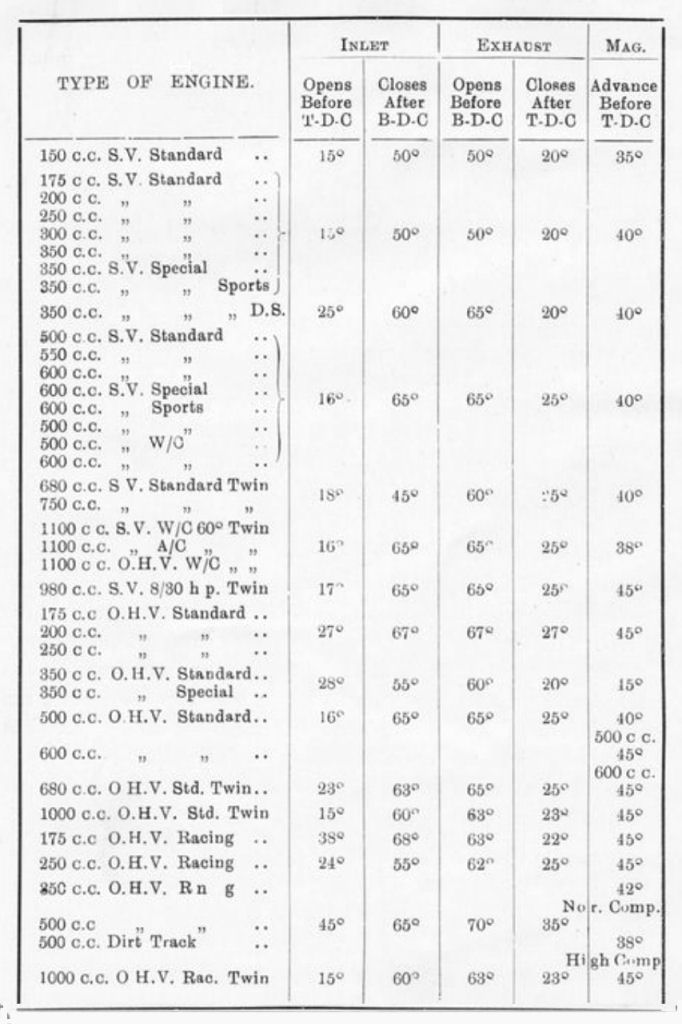
Valve and Magneto Timings seem to the beginner to bristle with difficulties. There is, however, no real reason for this, as timing an engine is by no means hard, the main point to remember is that the exhaust valve should be almost closed, and the inlet valve just opening, when the piston is at top dead centre.
Any engine timed in this manner is bound to run, provided nothing else is out of order. At the same time, for best results, an exact setting of the valve timing is essential and this can be obtained, as described on a previous page, by the use of a different keyway on the mainshaft pinion. A list of correct Valve and Magneto timings for our engines is given overleaf.
P. 16
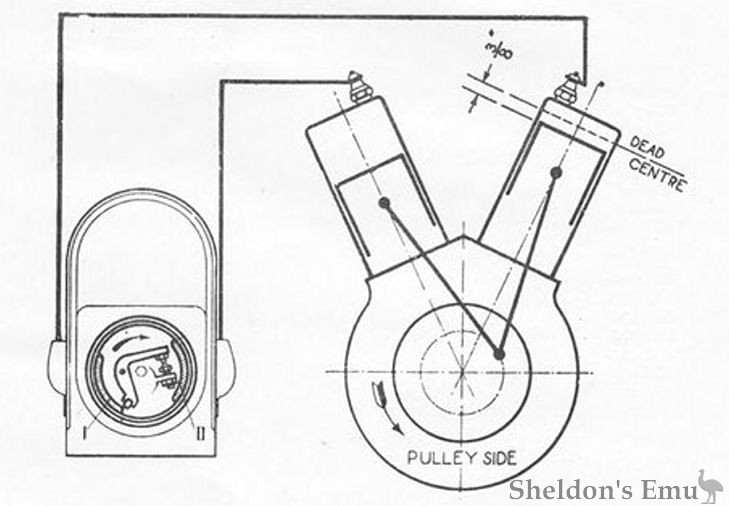
In setting the magneto timing the following method should be adopted. The engine should be turned forward until the piston - in the case of twins, the REAR piston - is 7⁄16 in. or so before the top dead centre of the compression stroke. (The correct timing is given overleaf.) The contact-breaker on the magneto should then be placed in the fully advanced position, and the armature rotated until the platinum points are just being separated by the cam.
The cam for the REAR cylinder is marked No. 1 and is the one following the shorter space between the two cams, when considered in the direction of armature rotation. (See diagram.) The magneto sprocket must then be pushed on to the armature spindle, and locked with the nut, care being taken not to move the armature while so doing. The timing should then be verified. In modern magnetos a high standard of reliability has been attained, but in the case of any loss of power due to this Instrument it should be returned to the makers.Page 17

Page 18
Every 500 to 1,000 miles the crankcase should be drained of all oil, flushed out with paraffin, and recharged with approximately half-a-cup of fresh oil. The silencer should be cleaned periodically, roughly every 1,000 miles in order to secure full power and cool running. Decarbonisation should be undertaken at least every 1,000–1,500 miles, with cast iron pistons, but can be allowed to run very considerably in excess of this with aluminium pistons. It is much the best way to carry out this work with the engine out of the frame and on the bench. Absolute cleanliness is the essential point in dismantling and re-assembling a power unit, and all parts should be thoroughly washed in clean paraffin. When removing the cylinders care is necessary to prevent the piston skirt falling over and cracking against the connecting rod ; while the valve side of the piston should be marked if it is to he removed from the rod. If the crankcase is parted it is advisable to verify that the flywheels are running perfectly true. When re-assembling, it is necessary to make sure that the piston rings are free in their grooves ; while the slots must be spaced evenly round the piston. It is not necessary to fit a paper washer at any joint, as all faces are carefully machined to fit; but a film of seccotine will make oil leakage still more unlikely. The cylinder holding down nuts must be tightened down alternately, a little at a time, as otherwise the cylinder neck may be strained.
It is impossible for us to recommend any particular brand of sparking plugs, but as a result of extensive tests we advise that for S.V. engines either " Lodge" C.3 or " K.L.G." K.l, and for O.H.V, engines either " Lodge" H.1 or "K.L.G." KS.5 should be used. Overheating, knocking and lack of power, as well as apparent seizures, can frequently be traced to the use of an incorrect plug, which has caused pre-ignition. Other causes, however, are often alteration of the standard gear ratios to a higher ratio, or the use of an incorrect jet in the carburetter, or too tight a primary chain. Carburetters should always be left as sent out by the Makers, or their advice obtained if any alteration is contemplated.
Slow running is perhaps the quality which most gives rise to pride of Ownership, and when striving after a good " tick over " the following points should be noted. The induction system should be examined for all possible air leaks, and each should be eliminated.
P.19
A slightly smaller jet can thus be fitted without loss of power. Proper tension of the valve springs, and in the case of twins equal tension should be maintained : sparking plug points should be carefully adjusted to a gap of approximately & in., and the contact breaker points should be given attention. All oil, grease, or dirt, should be removed from this point. To secure even firing on twins, everything appertaining to each cylinder must be the same, including contact-breaker gap, sparking plug gap, etc.
The foregoing notes apply in their essentials to all J.A.P. engines; but since the side valve type has been indicated in the language used, it seems advisable to give here a few hints which apply particularly to our range of O.H.V, engines.
The O.H.V, engine is very sensitive to carburation, and no attempt should be made to run with a very small jet in the carburetter, as this causes serious overheating of the exhaust valve.
With regard to O.H. valve gear, the clearance between the rocker face and the valve stem should be adjusted to .002 in., when the engine is cold.
P. 20
Notes on Racing Engines.
At the beginning of this booklet it was pointed out that for any particular conditions of work the correct type of engine should be selected. We wish to emphasise this in connection with our range of Racing engines, and we disapprove strongly of these being used under touring conditions if they are also used for competition, such a practice would be as unfair as the use of a racehorse for driving.
Our racing engines are designed to develop their maximum power at a very high rate of revolutions per minute and to this end racing timing gear and light reciprocating parts are fitted.
In the case of the O.H.V, engines we can supply washers to fit beneath the base of the cylinder, in order to vary the compression ratio slightly to suit the different conditions of road and track racing. In the latter case, if the engine is to be run without those washers, it is essential to use one of the special racing fuels now available, since these alone will prevent detonation and consequent harm to the engine. With the maximum number of washers in position–this implies raising the cylinder barrel 5⁄32in. and in consequence longer valve push rods–the compression ratio is reduced to a point where the engine can safely be run on a mixture of 50% pure benzol, and 50% of either Aviation or Number 1 petrol.
The remarks on previous pages concerning sparking plugs apply with even greater force to the Racing engine. If more speed is sought by using the highest compression ratio, all advantage will be nullified unless the correct type of plug is used. A plug specially designed for racing, and capable of resisting the high compression must be used.
In other respects racing engines conform on the whole to the maintenance instructions already given. To retain the original speed, however, or to increase it, much time spent in careful work such as the reduction of friction everywhere–is necessary. If the rider desires to raise the compression ratio beyond our standard limit one point should always be borne in mind : that there must be a clearance of fully & in. between the valve heads and piston crown on O.H.V. engines when the piston is at top dead centre.
P. 21
GEAR RATIO CHART.
GEAR RATIO.
To find the gear ratio of an engine divide the product of the number of teeth of the Driven Sprockets by that of the Driving Sprockets. Thus the rear wheel sprocket multiplied by the large sprocket of the gear box is divided by the engine sprocket multiplied by small sprocket of the gear box.
TOP GEAR RATIO.
Rear Wheel Sprocket x Large Gearbox Sprocket.
Engine Sprocket x Small Gearbox Sprocket.
To find the value of the other terms it is only necessary to change the equation accordingly, thus:–
ENGINE SPROCKET.
Rear Wheel Sprocket x Large Gearbox Sprocket.
Top Gear ratio x Small Gearbox Sprocket.
LARGE GEAR SPROCKET.
Engine Sprocket x Small Gearbox Sprocket x TG.R.
Rear Wheel Sprocket.
SMALL GEAR SPROCKET.
Rear Wheel Sprocket x Large Gearbox Sprocket.
Engine Sprocket x Top Gear Ratio.
REAR WHEEL SPROCKET.
Engine Sprocket x Small Gearbox Sprocket x T G.R.
Large Gearbox Sprocket.
ENGINE SPROCKETS.
The following is the usual range of sprockets fitted for various capacities. The information is merely given as a guide for reference with regard to finding suitable gear ratios.
Up to 175 c.c. 14 to 17 teeth 250 c.c.– 300 c.c. 16 to 19 teeth– 350 cc– 600 cc 16 to 20 teeth– 980 cc - 19 to 24 teeth
Page. 22
If you have further information or a query related to this page, please contact us