
AN ORIGINAL DESIGN WITH SEVERAL NEW POINTS.
INASMUCH as the sidecar is a thoroughly British production, which only within the last few months has shown any signs of gaining favour in America and on the Continent, one would suppose that for some time to come some manufacturers will introduce new ideas in sidecar design. It is true that the sidecar has been improved very much, but except in point of body design and detail fittings not a great deal of change has taken place. Hence the new ideas which are contained in an Austrian dedesign should not fail to be of interest.
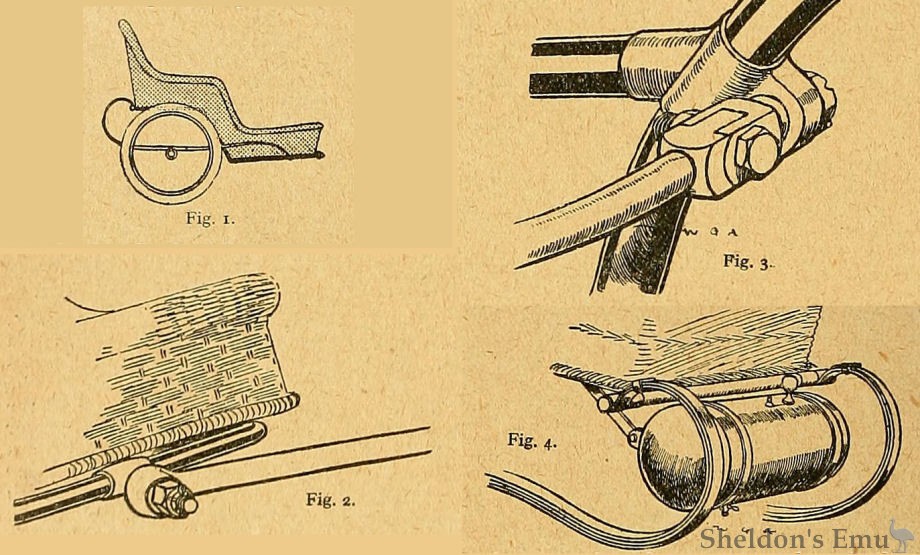
At first sight the Puch sidecar presents much the same appearance as any other, though it must be admitted that the shape of the body is not quite of the most modern type. As a matter of fact, however, its construction is quite different. In the ordinary design the "chair," or body, is slung both fore and aft upon S springs, which, in turn, are supported upon a rigid chassis. In some cases this chassis is itself sprung from the axle, but in the ordinary and most common type the frame is rigid. The principal individuality of the Puch design is that there is no rigid chassis at all. As shown in fig. 1, the chair springs, which are attached at the seat and the toe, are carried direct on the wheel axle, which is made of unusual strength, and is connected to the chain stay and back hub of the motor cycle in such a manner that it cannot possibly twist round. It is, as usual, further reinforced by a cranked diagonal tube leading from the saddle pillar clip to the stub end. The sidecar chair is made of wicker, underneath which is a light steel tubular framework, which follows its under contour and upon which it is built up. This framework is shown in bold lines in the sketch. From the front end of it there proceeds a tubular cross-piece to the steering head of the motor cycle frame ; this cross-piece acts as a coupling rod, and is jointed at each end as shown in figs, 2 and 3...
The Motor Cycle May 16th 1912