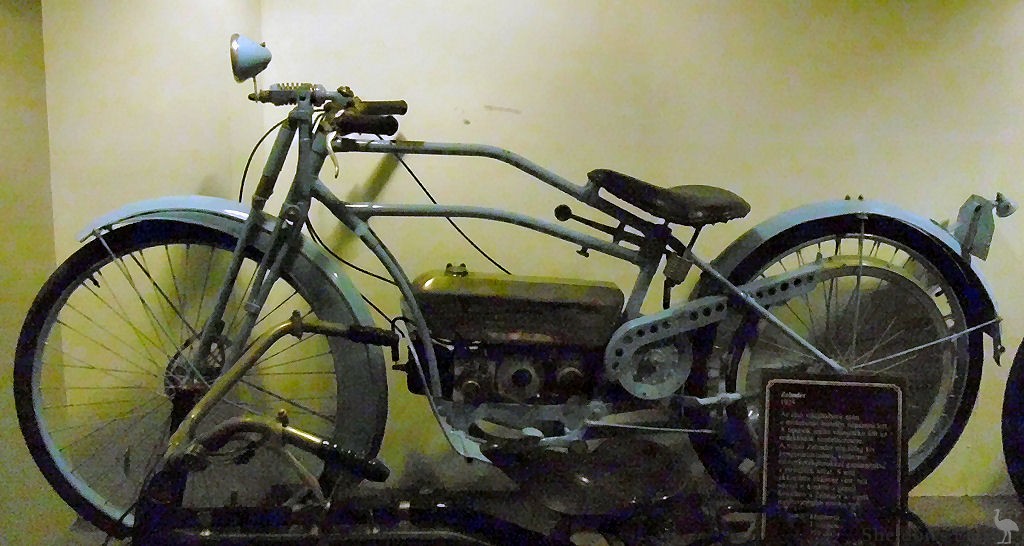

Between 1923 and 1939 Zehnder established a reputation for reliability and over the years built commuter-style motorcycles with horizontal single-cylinder two-stroke engines of 110cc, 150cc and 220cc along with a number of higher performance sports and racing machines.
Jakob Zehnder began his retail career in 1895, and became well-established as a repairer and retailer of sewing machines and Adler bicycles. The business did very well during the 1914-1918 war making munitions which they sold to the French. Following the armistice they built machine tools (lathes and the like); two of the seven sons travelled to Germany to purchase a Sphinx automobile, but the car was not ready. With their finances dwindling due to inflation in Germany, they decided instead to buy a Gockerell motorcycle.
On Jan 1st 1924 the family established Aktiengesellschaft J. Zehnder & Söhne. Their first machines were developed from those designed by Friedrich Gockerell and produced by Zehnder under licence. Nicknamed the Zehnderli, the 110cc twostroke was economical and reliable, and responded well to tuning for sports work. In 1925 a Lady's version appeared, and they went to chain drive in 1927, with optional 3-speed gearbox and lighting.
Competition successes included class wins in the 1926 and 1927 Paris-Nice races, with Ernst Zehnder at the helm. Zehnderli almost always performed well in the very popular mountain races, winning or achieving podium placing against strong competition from German and Swiss riders. At the Staufberg race in 1926, three Zehnderli won in the 125cc class, ridden by Otto Graf, C. Sager and Walter Widmer. Other successful riders were Jean Jenny and Otto Zehnder.
By 1926 they had almost 170 dealers in Switzerland, with the annual factory output approaching 1,500 motorcycles. They had 10% of the market share, in a country which had countless brands available, both locally made and imported.
In order to meet market demand for more powerful machines, for 1928 a new machine entered the catalogue fitted with a 250cc Zehnder two-stroke engine and a 3-speed Hurth gearbox. This one was not a great success, as the engine had faults.
The following year Otto Zehnder took second place in the Klausen race, despite two falls.
With the recession biting hard, sales in 1930 faltered, particularly with the new 250. The Zehnder brothers resigned, and the company's main creditor assumed management.
The company was taken over by Alfred Gautschi and in 1931 it was renamed to Maschinenfabrik Gränichen AG (MAFAG). That company is believed to have continued production of Zehnder motorcycles until 1939 [1].
The Zehnder brothers had developed a new type of radiator in 1930 and the new company focused their efforts on that field, with considerable success. The radiator is now familiar to millions of school children around the world.
Notes: 1. Some sources give the end of production of Zehnder motorcycles as 1930, and there do not appear to be images extant of the machines dated later than that.
Sources: moto-collection.org, fuw.ch, pantheonbasel.ch, zehnder-systems.de, zehnder-rittling.com, ogs-seebach.ch.
If you have a query or information about these Swiss motorcycles please contact us.