
WANDERER, No. 84.
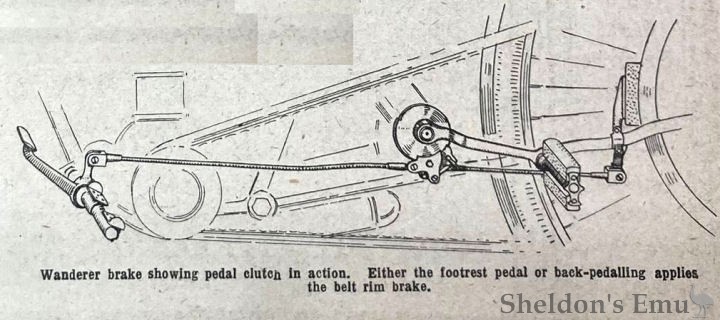
Wanderer brake showing pedal clutch in action. Either the footrest pedal or back-pedalling applies the belt rim brake.
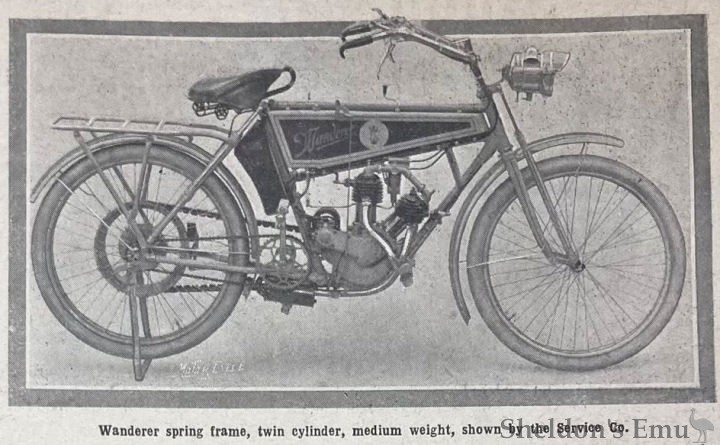
Wanderer spring frame, twin cylinder, medium weight, shown by the Service Co.
Service Co., Ltd., 292-293, High Holborn, W.C.
The Wanderer machines shown on the Service Co.’s stand are among the neatest spring frame machines in the show. The springing method is quite unobtrusive; in fact, may not be noticed at a casual glance. One point in its favour is that it has stood the test of time. The springs are enclosed in the rear forks, double springs in compression controlling the vertical movement of the rear wheel.
The machine throughout is simply bristling with clever notions. The magneto is gear-driven and fitted at the rear of the crank case. The method of applying the belt rim brake is quite new. It may be operated by two actions - either the pedal on the footrest may be depressed or a similar retarding effect is obtained by back pedalling. On the single-cylinder model the throttle and extra air chambers are cast in one piece with the inlet chamber.
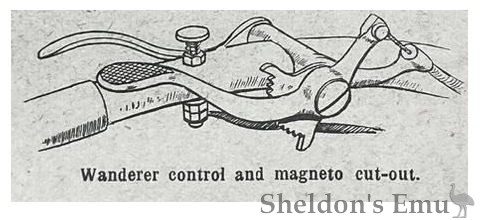
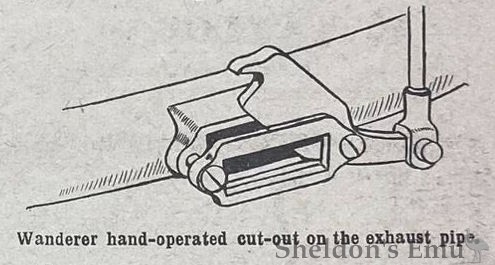
The engine pulleys on both the models are under-geared, enabling larger-sized pulleys to be used, and we are assured that the gain derived from the use of the larger pulleys more than counteracts for the slight loss in friction due to the gear. The tension of the belt may be adjusted by a lever on the top tube whilst riding along. The cut-out is controlled by a lever on the tank.
The magneto switch which is fitted on the left handle-bar grip may be left permanently in the "off" position if desired. Another good point is the ratchet control on the external expanding brake in the rear hub. To release the stand one merely has to loosen a ring nut, when it immediately flies out of action.
The little V-twin is placed in the frame so that the front cylinder does not screen the back one from cooling draughts. In other words, the rear cylinder is vertical. The features already mentioned in regard to the single-cylinder model apply in every case to the twin, and for real novelties we would recommend our readers to closely inspect these models.