
Bradbury and Co., Ltd.
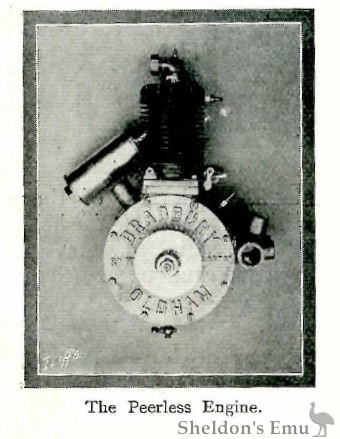
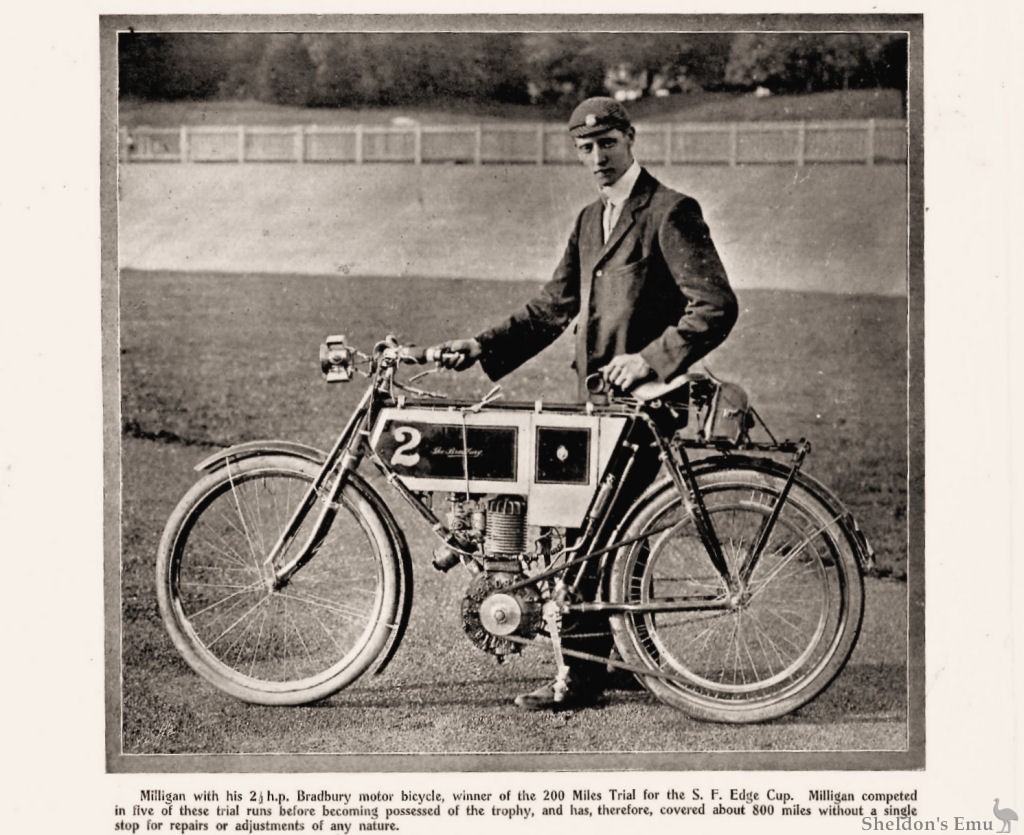
The makers of the Peerless motor bicycle, who have just won first honours in the two hundred miles reliability trial for the S. F. Edge cup, will exhibit a full set of standard pattern machines. The new features of the 1904 Peerless will be an entirely new contact- breaker of the wipe type. The contact case is a metal ring oscillating on a bracket attached to the crank chamber, fitted internally with a hard fibre ring, and a metal section to make the contact. The wiper is a swing lever attached to and revolving with the exhaust lifter cam. By means of a tension spring the end of the lever is pressed upon the fibre ring during its revolutions, and it is further fitted with a roller to prevent undue wear of the fibre ring. A transparent cover encloses all the mechanism, making it dustproof, and at the same time enabling the rider to see that effective contact is being made without opening the case. Misfiring from the accumulation of dirt upon the fibre ring is impossible. The higher the speed the better the contact. In the usual type the outside wiper had a tendency to make a less perfect contact at high speeds, whereas in the new contact breaker the centrifugal force generated by the revolution of the cam spindle induces a greater pressure upon the ring as the speed increases, and, consequently, great regularity in firing. All standard pattern cycles will be fitted with Longuemare carburetters. This applies both to the 2 h.p. and the 2¾ h.p. engines. The tank for the 2¾ h.p. will hold no less than two gallons of petrol, and the capacity of lubrication will be oil sufficient to carry a passenger six hundred miles. The Bowden exhaust lifter and the Bowden back rim brake will be fitted as standard patterns to all the above machines.
The Motor Cycle, November 18th 1903
Stanley Show 1903
Bradbury and Co., Ltd.
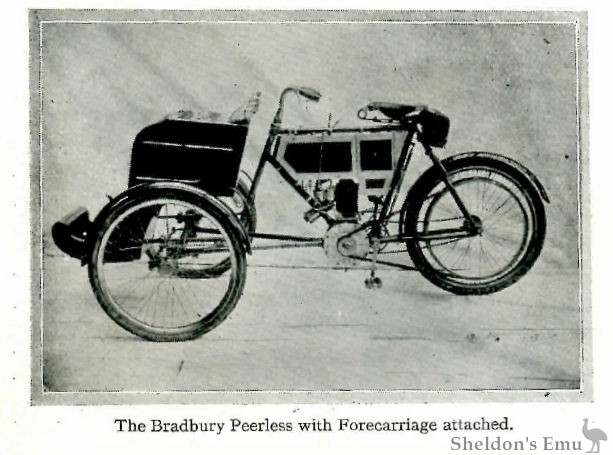
The Peerless motor cycles are fitted with a new type of contact-breaker, with an internal wiping roller, which tends to increase its wiping action as the speed of the motor increases. The contact-breaker is enclosed in a hinged glass face, with a snap catch, and, therefore, is easily opened without undoing any screws. The petrol capacity has been, enlarged, and the machines are now fitted with two sets of accumulators and a two-way switch. The forecar shown on this stand is of the non-detachable type. The frame is designed on original lines, the tubes from the extremities of the front axle converging on the crank case of the engine. Midway on these tubes two tubes run up to the head clip, and make a very rigid construction. The bodywork is detachable, so that the machine may be used as a tricycle without the front seat. (Stand 105.)
The Motor Cycle, November 25th 1903
Stanley Show 1903
The Motor Cycle, November 18th 1903
Bradbury and Co , Ltd., Oldham
(Stand 125)–
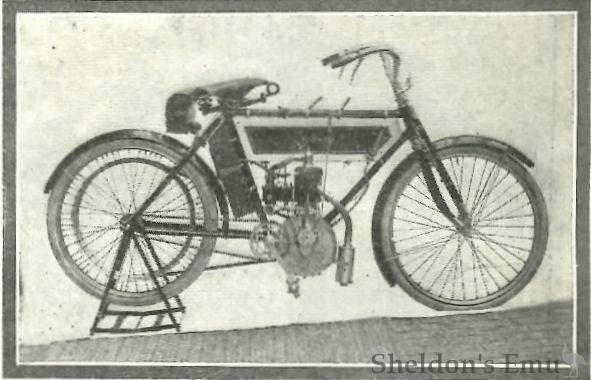
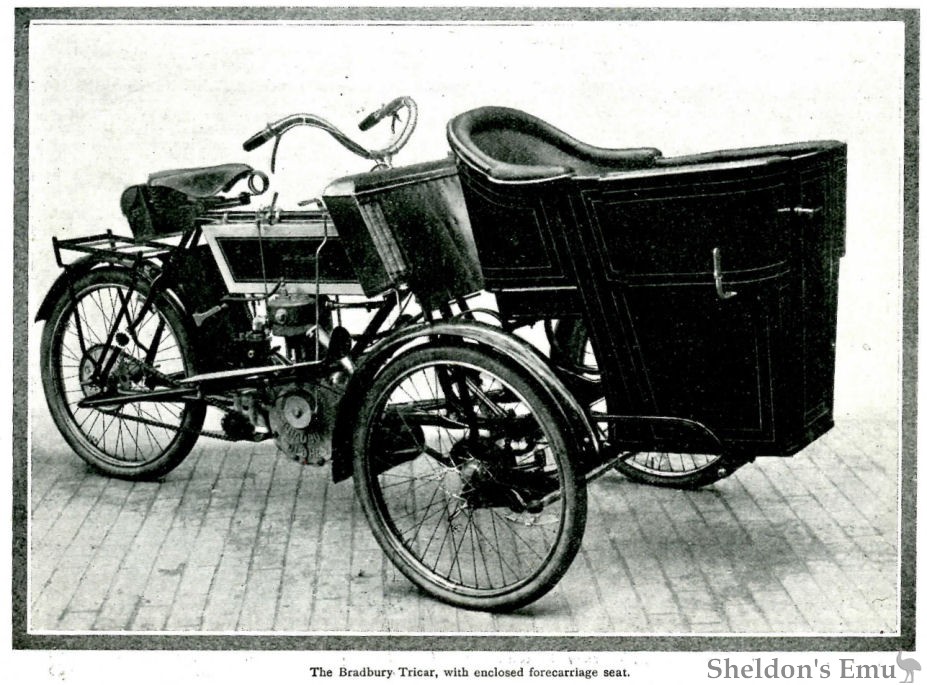
The Bradbury tricar this year has not been altered in any way since the time when this excellent machine took part in the 1,000 miles trials. The water circulation is arranged on the thermo-syphon system. A large tank and radiator combined is fitted which is of registered design. The engine is a powerful 4½ h.p. fitted with m.o.v. and two speed gear and chain drive. Two tricars are shown, one has an ordinary coach-built body, while the other is fitted with a special body to contain one passenger and two children, the entrance being effected from the front through a door. For next season the 3 h.p. Bradbury motor bicycle has undergone several improvements. The flywheels are now larger, but despite this fact the weight has not been increased. The distribution gear is now carried in an aluminium box forming part of the crank chamber casting outside. The coil and accumulators are carried in a wooden box fixed behind the down tube, leaving the whole of the chamber for petrol and oil. The wheelbase has also been considerably extended. The carburetter is now placed behind the cylinder. Bowden rear and front brakes are fitted.
A 2¼ h.p. machine is also shown, and a similar machine fitted with the Hub two-speed gear. A 3 h.p. Bradbury of last year's pattern is included in the exhibit. This machine is fitted with a back-pedaling brake applied to the belt rim.
Report on the 1904 Stanley Show, The Motor Cycle, November 28th.