
Hobart Bird and Co.
are showing three Hobart motor cycles fitted with their standard 2¾ h.p. engines, and one fitted with a larger engine, viz., 3¼ h.p. They have somewhat altered the frame design for the coming season, although it still maintains the distinctive features originally introduced. The Hobart Tricar is also now shown for the first time.
The Motor Cycle, November 18th 1903, p795
Stanley Show 1903
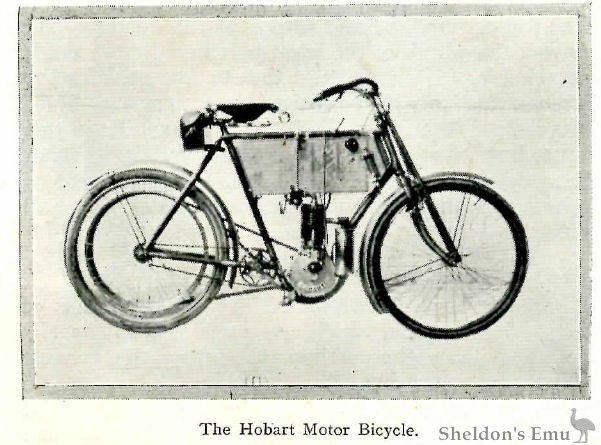
The Hobart Motor Bicycle.
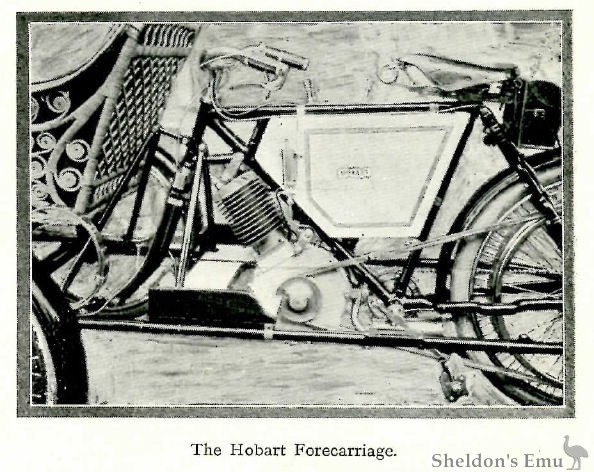
As reported in our anticipatory issue, Messrs. Hobart Bird and Co., although having made several additional improvements to their 1904 types, have not materially altered the design, and continue to fit 2¾ and 3 h.p. engines in both vertical and inclined positions. The principal novelty on the machines consists of an emergency handle-bar control, the movement of one lever performing the operations of breaking the electric circuit, lifting the exhaust valve and applying an ordinary brake to the back wheel. The Hobart Tri-car is fitted with a 3½ h.p. engine, and is belt driven in the usual manner. The frame has side tubes, which come right back to the rear wheel axle, and a convenient rubber covered footrest is provided for the driver's feet. Non-slipping foot plates are also fitted nearer to the rear axle for mounting the machine after it has been started. The front wheels of these machines are fitted with band brakes operated by Bowden wire. The springing and design of the forecarriage seat are very handsome and particularly neat. (Stand 98.)
The Motor Cycle, November 25th 1903
Stanley Show 1903
Hobart Bird and Co., Ltd., Coventry (Stand 104).–Four motor bicycles and one forecar are exhibited here. Three of the motor bicycles have 2¾ h.p. engines, while the fourth is fitted with a 3½ h.p. White and Poppe. Belt drive is employed in all cases, the Dermatine belt being well selected for this purpose. The exhaust boxes are neatly arranged across the front of the crank case, and a Brown and Barlow spray carburetter supplies the mixture. pedaling band brakes are fitted to the rear wheels, and the usual lifting rim brake to the front. Two accumulators are provided, these being carried in a nicely-finished box behind the diagonal tube, and fitted with two-way switch at the top. The coil is accommodated in a compartment of the tank. The tricar is propelled by a water-cooled motor, and has a chain drive, giving two speeds. The change-speed gear is very substantially constructed, and is fitted on the motorshaft. A countershaft is employed and carried in the bottom bracket, and is fitted with a powerful band brake. The front of the frame is spring suspended, and a wheel is employed for steering purposes. The whole is completed by a handsomely-finished carriage-built body.
Report on the 1904 Stanley Show, The Motor Cycle, November 28th.
Sources: Graces Guide, The Motor Cycle
If you have further information or a query related to this page, please contact us