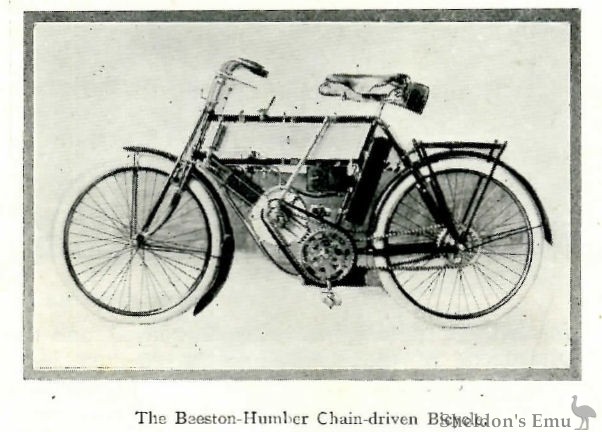


Humbers, Ltd., Beeston, have an immense array of cycles of all grades. One standard pattern motor-bicycle is shown. The special features of these machines are well known from the recent London Shows.
Paris Salon 1902 in Motor Cycling, December 17th, 1902.
Humber Ltd.
This exhibit includes models of the Humber chain-driven motor cycles. Some of the bicycles are fitted with a free engine, clutch, and chain guard.
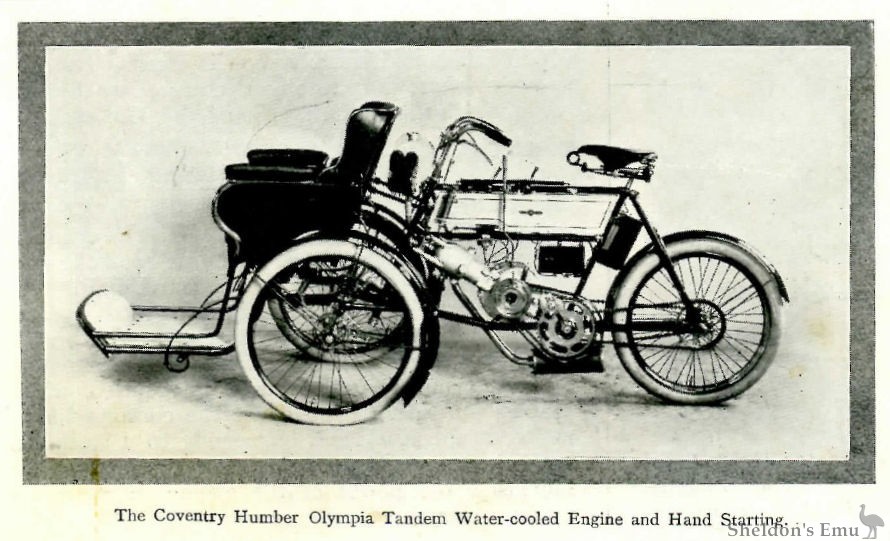
The forecarriage in one case is fitted with water-cooled engine arranged in the usual Humber position, the water tank and radiators being arranged behind the forecar seat. An exhibit, which attracts great attention, is a parcels delivery forecar constructed for the G.P.O. This is complete in Royal red, and is most imposing. In cases where the free engine clutch is provided, the engine can be started up with starting handle, as with a car—a great convenience in the case of a forecarriage. (Stand 154.)
The Motor Cycle, November 25th, 1903. Page 827
Stanley Show 1903
Humber, Ltd., Beeston (Stand 132 and Stand 18, Minor Hall).–
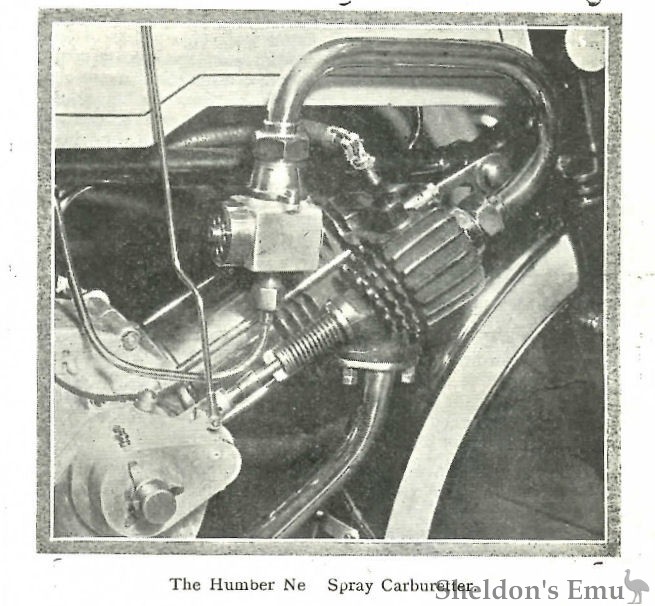
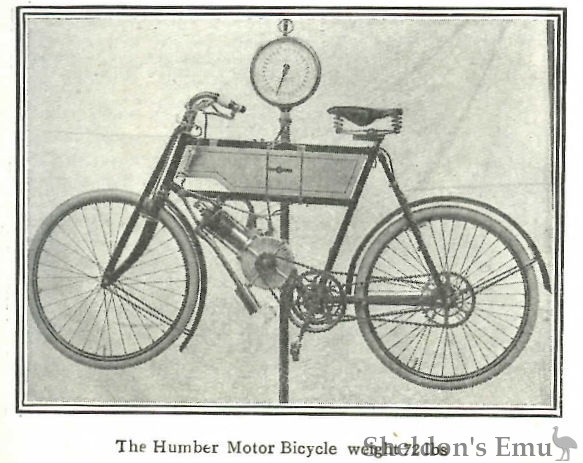
Several alterations have been made for next season. These alterations chiefly lie in the direction of weight. On one of these machines–the power of which is given as 1¾ h.p., and weighing but 72 lbs.–the silencer has been considerably lightened. A new spray carburetter is fitted. The wooden box which was fitted behind the down tube has been done away with, and the coil and accumulator are now placed in a compartment inside the tank. The other machine is of 3 h.p., and weighs but 120 lbs.
This year the free engine clutch is not fitted as a standard, but it can be supplied as an extra, while exhaust valve lifters are supplied with all machines. The 1¾ h.p. engine has a bore of 2½in. and 3in. stroke, and a normal speed of 1,800 revolutions per minute. The engine weighs 21¼ lbs. with silencer and carburetter complete, this being exceptionally light. An automatic inlet valve is fitted, this and the exhaust valve being placed in the head of the combustion chamber. The exhaust valve is operated by means of an overhead lever mounted on a swiveling pillar, so that extreme accessibility is obtained. The engine is supported to the bottom member of the frame by means of two stays attached to a lug near the crown forks, and at the crank case bottom two bolts are attached to a bracket supported by a short tube issuing from the bottom bracket lug. The engine, in fact, forms the bottom member of the frame. The drive is taken from a chain wheel on the engineshaft to a chain wheel mounted on the bottom bracket shaft, as in the usual Humber chain-drive practice. A force pump fixed to the left-hand side of the petrol tank supplies lubricating oil to the crank chamber of the engine. A front rim brake operated from a right-hand lever and rear rim brake by the left-hand lever provide efficient braking power. Operating the right-hand brake lever breaks the electrical circuit, and so cuts out the engine. The exhaust valve elbow pipe is, to our mind, a rather weak feature of this engine. It should be carried down at an angle, and the right-angled bend disposed with, as trouble is sure to be experienced with overheating at this point.
Four other motor bicycles are mounted, these having 2 h.p. and 3 h.p. engines of the usual Humber pattern. The higher-powered machine has a starting handle and a friction clutch, so that the engine can be started separately without mounting the machine, a convenient adjustable stand which can be instantaneously let down being fitted to the rear axle. All the machines are fitted with a specially-strengthened front fork of exceptionally strong construction. Wipe contact and high-speed trembler coil are fitted to all the machines.
A 4½ h.p. water-cooled engine Olympia tandem is shown fitted with the Humber two-speed gear; this has already been illustrated and described in our pages. On the left side of the machine is situated the speed lever, which is neatly fitted and marked so that the positions of free engine, slow, and fast speeds are seen at a glance. A pedal operated by the left foot takes the clutch out of action, whilst a pedal for the right foot applies the balanced front hub band brakes. A lever operated by the left hand from the handle-bar applies the rear rim brake. The starting handle is carried by means of two clips attached to the left side member of the frame, and therefore need not be placed in any tool box, as it is always ready for use. Affixed to the right-hand side tube of the frame is a small box to carry tools and any accessories that may be required, this being a detail not generally attended to in the lighter class of machines. The Front seat is carried on special double-curved S springs, and should give most easy riding.
A Humber 5 h.p. water-cooled engined tricar is also shown. This is fitted with a similar type of engine to the Olympia tandem, but the control and general arrangement of the machine appear to be more on the lines of a light car. The engine is immediately beneath the rear passenger's seat, and the drive is taken in the same manner as already explained for the tandem to the rear wheel. The rear passenger controls the steering, the wheel having a single arm. A two-speed gear lever is situated on the steering stem, and is operated by the left hand, the ignition and throttle valves being operated by the right hand. All these three levers are mounted on the same bracket, which is clipped to the steering stem. The rear band brake is operated by means of a right-hand lever similar to a small car brake. The left pedal operates the clutch, and the right pedal the front rim brakes. The petrol tank is mounted behind a small dashboard, this tank and lubricating oil tank being all in one. A sight feed force pump distributes oil to the crank chamber of the engine, splash lubrication being relied on for a thorough lubrication of all the working parts. The water tank is carried immediately in front of the dash, and has in the centre vertical radiating gilled tubes, a small geared circulating pump forcing the water through the system.
Although the main body is rigidly attached to the tubular frame, there being no springs to the frame proper–this being rigidly attached to the road wheels –the rear seat is mounted on four double elliptical springs one on each side and one at the front and rear–thus providing a most easy riding seat; and, also, there is no tendency for the frame to roll badly. The front seat is mounted on very long S shaped leaf springs, and a feature of this is the long supporting links, which, whilst giving a large amount of movement fore and aft, yet are claimed not to interfere in any respect with the steering arrangement, the weight of the passenger keeping these well down to their work. When the front passenger is not carried a small attachment secures this seat to the dashboard, and thus prevents any rattle or vibration.
The steering wheels are carried on inclined centres with ball bearings. In the ignition arrangement a spare accumulator is fitted in an accessible position on the left hand of the machine, access being obtained to the case carrying both accumulator? and the coil by means of a side door. All the wires are short, so that the chances of short circuiting troubles are eliminated. The steering handle is a fixture to the side frame, and is so arranged as always to be held with the handle in the top position, so that no dirt can gather on to it, and also there is no tendency to catch against bricks or high standing parts of the road.
Report on the 1904 Stanley Show, The Motor Cycle, November 28th, page 1161
If you have further information or a query related to this page, please contact us