
This page is adapted from an archive of Histoire de la Moto, 1900-2000
First of all, an explanation for the choice of this subject: Why deal with the history of Husqvarna when so many other, better-known brands have an incomparable aura?
Precisely because these brands are much better known and other sites talk about them. But above all, because Marc Boniface - always him - recently sent me some interesting documents concerning the first motorcycles built by this brand. I thought it would be a shame not to share them with you.
The origins of Husqvarna go back well before the history of the motorcycle, since in 1689, King Charles XI had a factory built in Jönköping, intended for the manufacture of muskets, on the banks of the Huskvarna river. The power of the river made it possible to create a factory operating solely by hydraulic power.
This type of manufacturing would help to establish the image of quality of Swedish steels, whose reputation would last until the 1970s. In the public mind, there were three types of steel: The low end - generally attributed to Italy, where it was said that the material used for the manufacture of steels came from ships that had been sunk at sea - the standard quality steel and, at the top, the superior quality steel, from Sweden.
It turns out that this quality has never wavered and that Husqvarna, the motorcycles in any case, have always demonstrated great reliability.
After building foils, Husqvarna then turned its attention to cannons, and then, in 1872, to sewing machines. The brand is still active in this field today.
First turns of the wheel:
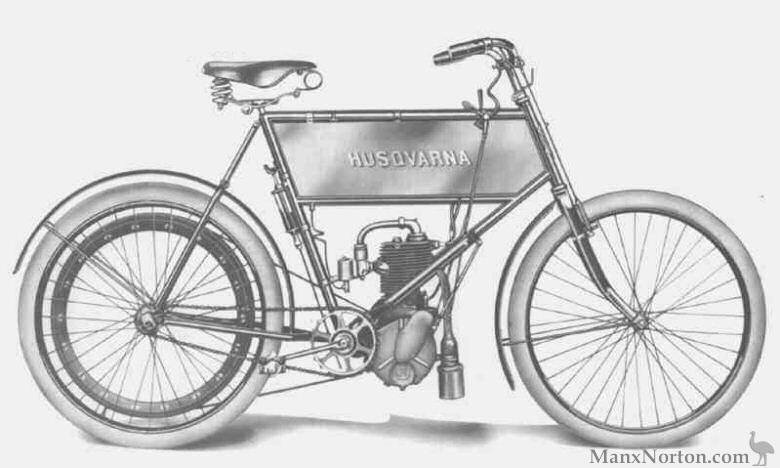 From 1896, Husqvarna diversified and started manufacturing bicycles, which naturally led it to devote itself to motorcycles from 1903. But it did not manufacture its own engines at that time. After numerous tests, it opted for a Belgian FN engine of 1¼ h.p. which allowed excellent performance since its catalogue specified that the machine was capable of 50 km/h.
The cold climate of the region gives us the opportunity to read in the same catalo a piece of advice that is rather... chilling: when the gasoline was too cold, it was advisable to heat the carburettor with a lit piece of paper but to avoid, above all, the use of a blowtorch. Phew! We were scared. How many machines were consumed in this way? The statistics do not specify. But this is perhaps the reason why this motorcycle is so rare!
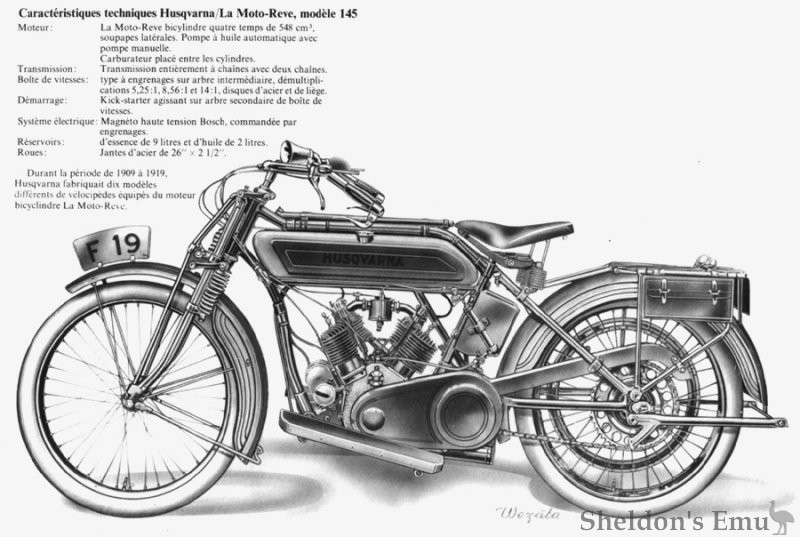
In 1909 a new model appeared, the cycle part of which was still made by Husqvarna, but the engine, a 548 cm3 "V" twin cylinder, was of Swiss " Moto-Reve" origin. This collaboration was not always without conflicts: a brochure concerning this machine stated: "Attention. We do not give any guarantee, neither for the engine and its accessories, nor for the tires, but the velocipede itself is covered by our normal one-year guarantee."
This did not prevent Husqvarna from delivering its first motorcycles to the armies from 1916, from entering competition and from recording its first international victory.
It was not until 1919 that the first 100% Husqvarna motorcycle model appeared, equipped with a 550 cc "V-twin" engine with side valves designed by the engineer Carl Heimdal. The same model was later released in a 750 rocker arm version.
Competitive debut:
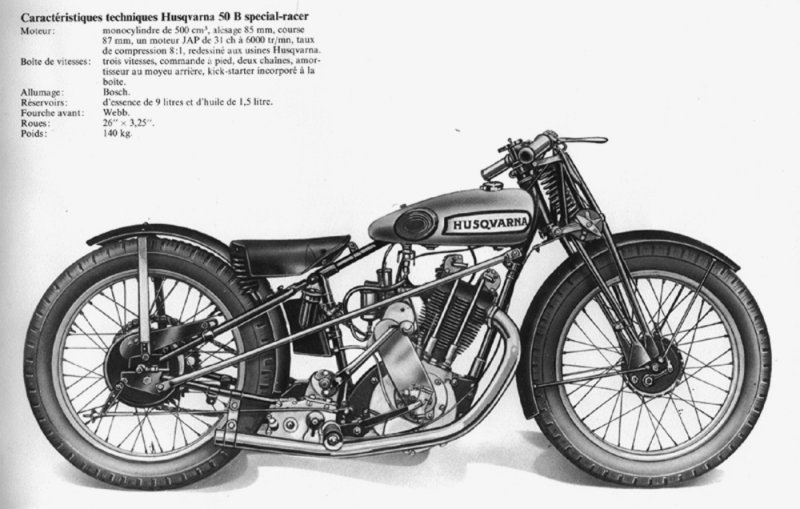 In 1928, Folke Mannerstedt was called to Husqvarna to assist Carl Heimdal. Folke devoted himself to the study of racing motorcycles. This was a turning point and probably the beginning of Husqvarna. Mannerstedt was wise enough not to devote all his energy to the design of an "in-house" competition engine:
The first Husqvarna racer (500 50° "V" twin cylinder of 25 h.p., 177 kg) was ready but it did not initially achieve great international success due to a lack of sealing of the exhaust valves. This did not prevent him from winning 181 victories at the national level. At the same time, Mannerstedt developed 350 and 500 cm3 JAP engines which allowed the brand to begin to establish its reputation in competition.
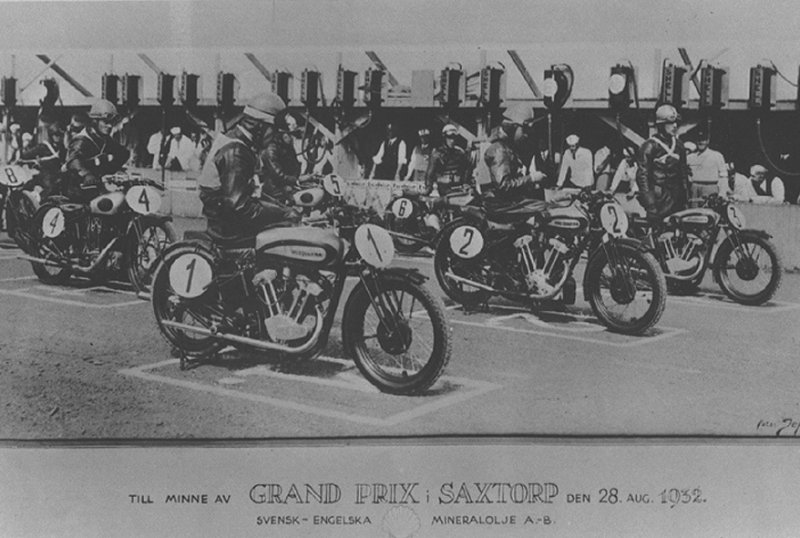 But the competition department was on the right track. The twin-cylinder model presented in 1932 included many improvements: redesigned engine crankcases, oil pump incorporated into the engine, cylinders in sleeved aluminium, magneto raised for better compactness and, above all, exhaust valves in nickel chrome alloy.
Husqvarna began to record numerous Grand Prix successes: Sweden in 1932 with Kälen
(doc. opposite, where the brand's motorcycles occupied the first 3 places on the starting line), victory repeated in 1933.
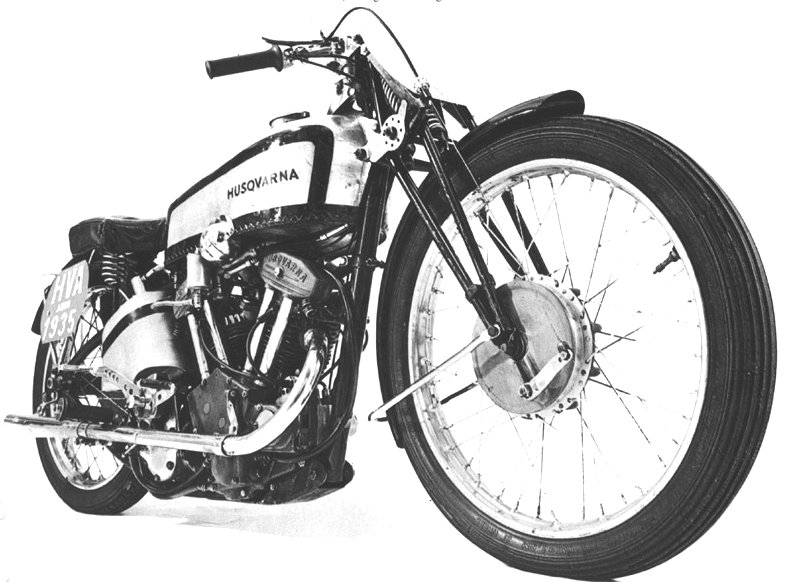 For
1934 the motorcycle, grey with black edges, changed colour (it looked too much like a Norton) to become burgundy, even if this is not noticeable on the attached document, since it is from the period and therefore in black and white! But the real novelty was the commitment of Stanley Woods. Based on previous results, Husqvarna decided to start an international campaign. But bad luck was to befall the team:
For
1934 the motorcycle, grey with black edges, changed colour (it looked too much like a Norton) to become burgundy, even if this is not noticeable on the attached document, since it is from the period and therefore in black and white! But the real novelty was the commitment of Stanley Woods. Based on previous results, Husqvarna decided to start an international campaign. But bad luck was to befall the team:
At the Tourist Trophy, the winch placing the truck on the quay broke. The mechanics worked miracles and Stanley Woods broke his frame in practice (after hitting a sheep!) but was entrusted with Sunnqvist's motorcycle. In the race, he broke the lap record before falling at Ramsey. This did not prevent him from setting off again and regaining the lead... before running out of gas a few kilometres from the finish.
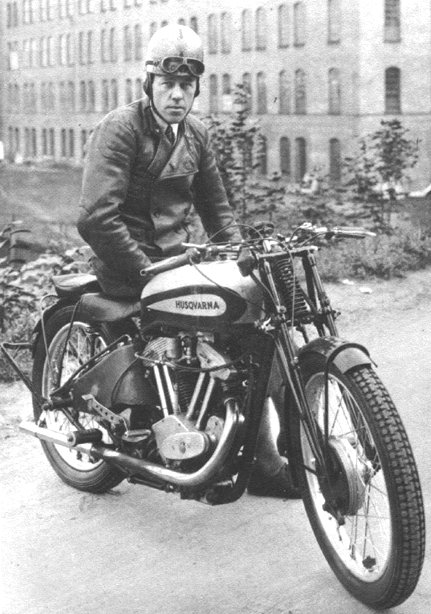 Also in 1934, Gunnar Kälen broke the lap record at the Dutch Grand Prix. The event was not so much notable for the performance itself, but for the reception it received from the English press: Indeed, a journalist from " The Motor Cycle " wrote: " We British can no longer turn a deaf ear to the undeniable fact that our machines are far inferior to the "Huskies" (Editor's note: the name was not given by the Americans) in terms of speed." This speaks for itself, given the chauvinism of British journalists... which is more or less the same in all other countries!
But that year, for sure, the Isle of Man cats had been repainted black!
The worst thing was that the team truck had to take a few of them on the way back from the TT. Disasters continued to strike: At the Belgian GP, a Dutch rider, an agent for the brand in Belgium, was killed riding a Husqvarna. In Germany, it was Kälen who disappeared. On the way back from this Grand Prix, the truck transporting the motorcycles caught fire. They still managed to put one back together: Finally, Sunnqvist won the Swedish Grand Prix ahead of Nortons, BMWs and other Guzzis.
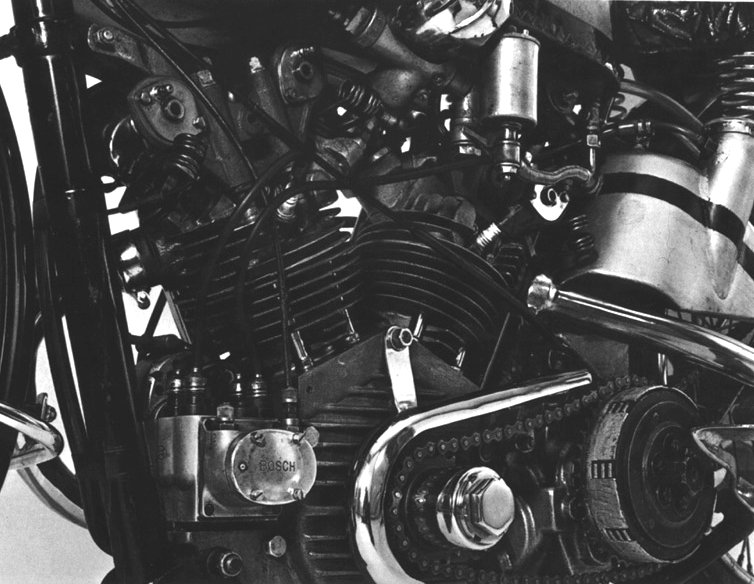 It is impossible, before closing the saga of these fantastic machines, not to give you a close-up of the engine. The original document from which it comes tells us that the engine has a displacement of 498 cm3 (65 x 75 mm), has cylinders and cylinder heads entirely made of light alloy, which allow it, depending on the version, a compression ratio varying from 8 to 9:1 and provides a power of 44 h.p. for 128 kg. Among other particularities, the machine is equipped with conical hubs in... electron and Dunlop, Avon (the firm was not Japanese at the time) or Trelleborg tires. Anecdotally, the latter will become famous (in a restricted circle, it is true) many years later (around 1960) because they will be unbeatable in the Swedish car rally.
Sleep:
1935 marked the swan song of these motorcycles, not without Stanley Woods setting the lap record at the Tourist Trophy and winning the iconic Grand Prix: the Swedish Grand Prix. At the end of this season, Husqvarna stopped its competitive efforts.
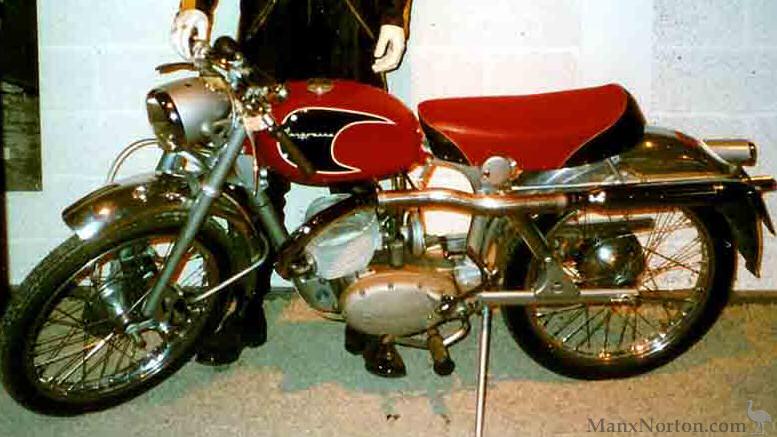 From 1936 onwards, Husqvarna abandoned motorcycle production to concentrate on manufacturing not weapons - as many others would do during the war - but agricultural machinery or household utensils, such as vacuum cleaners. The only remaining two-wheeler was the much more profitable production of a small moped equipped with a 98 cc two-stroke engine.
This same moped evolved after the war into a 118 cm3, equipped with a three-speed gearbox: the " Black Mill", which gradually evolved and became the " Silverpilen " from which a 175 cm3 competition model (still a single-cylinder two-stroke, 9 h.p.) was derived in 1953, which allowed Husqvarna to get back into competition, this time off-road. Entered in the Six-Days in Sweden, it obtained no less than seven first places (in different rankings). At the ISDT, the same year, the riders of this motorcycle obtained six first places.
Back in force:
In 1958 Husqvarna decided to intensify its efforts on several fronts:
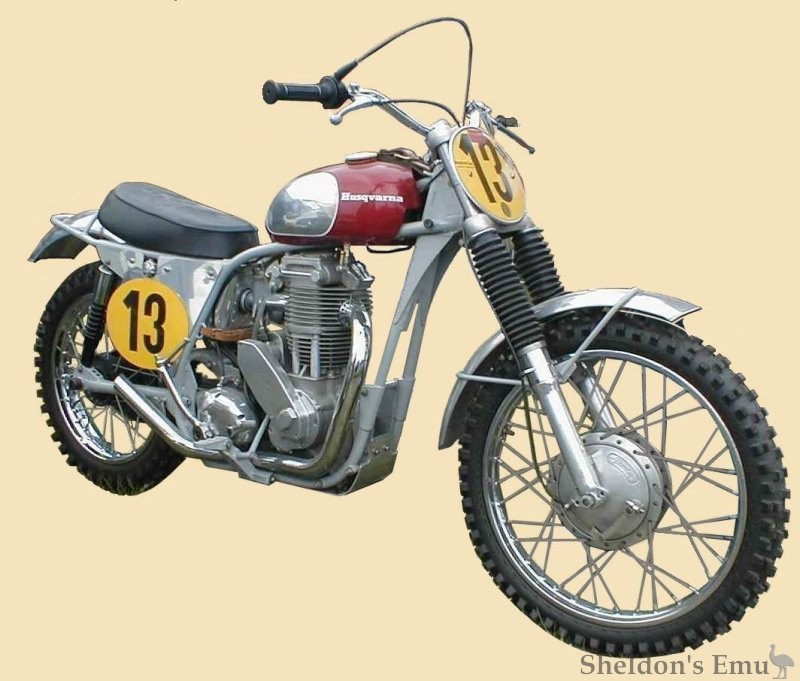
with a motorcycle designed by Nils Hedlund and developed by Rolf Tiblin, whose 500 cm3 four-stroke engine, entirely made of aluminium, is significantly more efficient and robust than that of its English competitors, from which it is nevertheless inspired. This motorcycle won the world title in 1960 in the hands of Bill Nilsson. It will be "only" second in 1961, still in the hands of the same rider and regains its title in 1962 and 1963, this time with Rolf Tiblin. This year, the supreme insult to the English industry, Lundin on Lito and Lundell on Monark, both on Swedish motorcycles, occupy second and third places. In 1964 and 1965, Husqvarna again successively obtains second and third places. But it is already the decline for this type of engine. CZ leads the way: its two-stroke engines have begun to dominate the premier motocross class. The factory then decides to put its premier class activities on hold to better focus on developing its machines in the lower class.
The 250cc commitment actually began earlier. In 1958 a motorcycle with an engine derived from the "Silverpilen " mentioned above won the European Championship, in the hands of Rolf Tiblin. A victory that would be repeated the following year. When the International Federation created a World Championship in 1962, the Swedish factory naturally decided to enter with its new rider: Torsten Hallman , who would go on to win two successive titles in 1962 and 1963. The following two years, Hallman encountered strong competition from CZ riders, who won with Joël Robert in 1964 and Viktor Arbekov in 1965. But Hallman did not give up and regained his title in 1966 and 1967. It should be noted that he was one of the only riders to have beaten Joël Robert fairly in this category.
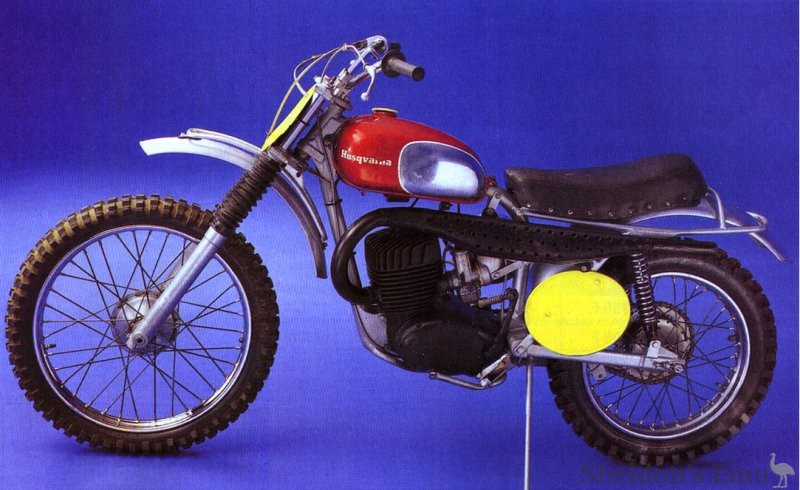
Having noticed that its 250s were achieving times very close to those of the bikes in the higher category, Husqvarna then decided to invest again in the 500s with a bike derived from its champion, retaining almost all of the cycle parts and equipping it with a 360 cm3. Why such a cylinder capacity? Simply because the FIM imposed a cubic capacity greater than 350 cm3. As the bottom end was unchanged, it is a safe bet that a larger cylinder capacity would have called into question the now legendary reliability of these engines. Initially, Husqvarna therefore favoured lightness (the bike weighed only 97 kg). But this was not enough: entered from 1966, it did not achieve immediate success. At least, it did not win the supreme title before its cylinder capacity was increased to 400 cm3. It was then that she found the path to glory again, in 1969 and 1970, in the hands of Bengt Aberg. A title they would renew in 1974.
Last lap:
It is often forgotten to mention that from 1967 onwards, Bo Granath began to enter a Husqvarna equipped with a 350 cc single-cylinder engine in Grand Prix racing. He then carried out private tests in 1967/68 with two coupled single-cylinder engines, mounted in a Norton-Manx cycle part (opposite). Given the viability of the project, Husqvarna implemented, in 1971, a real twin-cylinder, initially air-cooled, which was followed by a "water" engine.
The bike would thus bear the factory name, although it was equipped with a Seeley frame. Some encouraging results were recorded, including two third-place finishes at the Austrian Grand Prix, then in Sweden, earning it a 5th place finish in the World Championship standings. These were respectable results for a first year that did not, however, encourage Husqvarna to continue this experiment.
Business is good:
Commercially, business was going very well for the Swedish firm. Its performance was no longer in doubt. Its reliability even less so!
This success, seen from Europe, does not seem obvious. The reason is that the Swedes - who have always been turned towards the outside world - and more particularly towards America - their ancestors were the first to have set foot there - had noticed that, precisely, the off-road market was much more developed in the USA than in Europe. Not only in terms of competition (at that time, only a few "entertainment" events like "Baja-1000" were organized there), but especially for utilitarian purposes: cowboys had started to replace their horses with motorcycles!
Concerned about the comfort of users and the destination of their products for export, Husqvarna even went so far as to develop an automatic transmission version of its 400cc.
These efforts paid off, as it is said that in the 1970s, in some states of America, there was at least one motorcycle with a red and chrome tank in every garage. If you want to find a "Husky" from the "great era" of the brand, you know what you have to do!
Decline :
Unfortunately for Husqvarna, Japanese competition was becoming increasingly pressing, both commercially and in competition. An attempt was made in 125cc to conquer new world titles between 1972 and 1974. Without success.
It was Hakan Carlkvist who fired the final salvo in 1979 by winning the last title for Husqvarna, at least in its original form: Husqvarna-Sweden.
A rather extraordinary event when you consider the financial difficulties the brand was struggling with.
It was in fact in 1979 that Husqvarna came under the control of the Electrolux group, which was more interested in the production of household accessories than in the motorcycle branch of the company. However, the latter's employees were given a chance to prove that it could be competitive and profitable.
The sporting results will not be there and the profitability even less. Electrolux will therefore decide to sell the "motorcycle" branch to the Castiglione brothers (Cagiva) in 1985. Cagiva is then in full ascendancy since it wins the world titles in Motocross 125 in 1985, 1986 and 1987!
The Castiglione brothers will always have a policy favourable to competition. This allowed to perpetuate the image of the Husqvarna brand, which will win another "manufacturer" title in Motocross 125 cc in 1999. As for the "pilot" titles it won two in the same category in 1998 and 1999 ( Chiodi ) as well as another in 500 cm3 in 1993 ( Martens ) and three vice-champion titles in 1994 ( Martens ), 1997 and 1998 ( D.King ).
In France, it is mainly Chambon's exploits as a "supermotard" that are remembered.
But the story is not over since the workers who remained in Sweden will found the Husaberg brand, which will develop a range of motorcycles mainly focused on enduro and will continue its efforts in competition. The brand's motorcycles, in the hands of the highly talented Joël Smets, will win two Motocross world championship titles - 500 cm3 in 1995 and 1998, ahead of... Husqvarna! A brand that it also finds on the "super-cross" circuits, where the exploits of its riders have probably done, in France, as much for the brand's notoriety as all the other titles, however more prestigious.